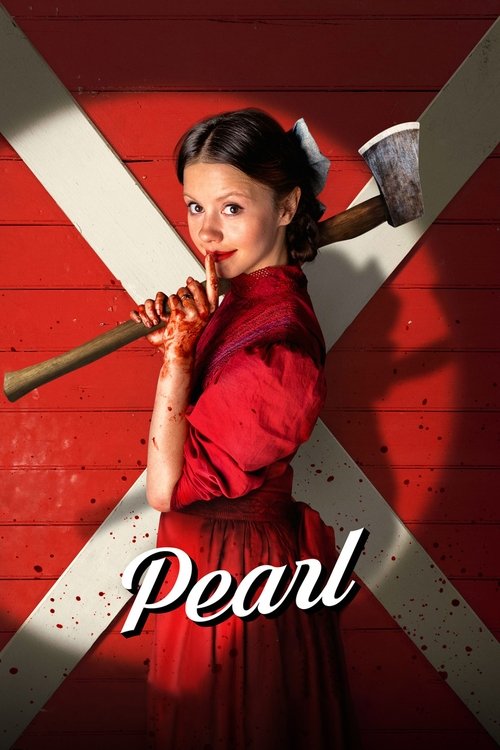
Pearl (2022)
Directed by Ti West
No — Pearl is not woke, scoring 6 out of 100 on our wokeness meter.
Ti West's Pearl arrives dressed as a Technicolor melodrama and departs as something far less wholesome.
Consciousness Markers
Pearl's rage at domestic confinement and her rejection at the audition for not being 'young, blonde, or all-American' gesture at women's limited options, but the film is a villain origin story rather than a feminist thesis.
The cast is almost entirely white, led by Mia Goth, with no notable diverse or inclusive casting choices. The 1918 Texas setting offers no natural space for representation commentary.
There are no LGBTQ+ characters, themes, or subtext anywhere in the film.
The film engages no racial themes whatsoever; its immigrant-family tension is ethnic (German) rather than racial.
The Spanish flu pandemic features as a plot device for isolation, but there is no environmental or climate messaging.
Hollywood stardom is depicted as a seductive fantasy, but the film offers no economic critique or eat-the-rich framing.
No body-positivity themes or messaging are present.
Pearl's violence and instability are framed as psychopathy and repressed rage, not as neurodivergent identity or advocacy.
The 1918 setting is period backdrop for a fictional slasher; no historical narrative is revised or recontextualized for ideological ends.
The film is a stylized, Technicolor-tinged character study that shows rather than preaches; it contains no moralizing monologues or didactic messaging.
Why it received this score
Ti West's Pearl arrives dressed as a Technicolor melodrama and departs as something far less wholesome. Mia Goth plays the title character, a farm girl in 1918 Texas who tends a paralyzed father, endures a devout mother, and dreams of the chorus line. The Spanish flu keeps the family isolated. A war keeps the husband away. None of this is deployed as commentary. The pandemic is a device for confinement, not a sermon on public health. The tension inside the household is German and ethnic, not racial, and the film has no interest in drawing lessons from it.
There is a faint pulse of something like feminist grievance. Pearl rages against domestic servitude, and the audition scene delivers a rejection on grounds of not being young, blonde, or all-American. It is a sharp observation about the narrow shelf life granted to women in 1918. But the film is a villain origin story, and it treats Pearl's fury as pathology, not thesis. Her violence is psychopathy and repressed rage. Nobody is advocating for her. Nobody is diagnosing her either, which spares us a lecture on neurodivergence.
The rest of the ledger is quiet. The cast is white and the film makes no apology or correction for it. Hollywood stardom is a seductive fantasy here, not an economic indictment. There are no queer currents, no body-positive messaging, no climate anxiety, no reworking of the historical record. We get instead a stylized character study that shows its horrors and declines to explain them. It is a film about a woman with an axe and a smile, and it trusts us to be disturbed without being told how. Refreshing, in its grim way.
Analysis generated by our Consciousness Algorithm
Part of


Synopsis
Trapped on her family’s isolated farm, Pearl must tend to her ailing father under the bitter and overbearing watch of her devout mother. Lusting for a glamorous life like she’s seen in the movies, Pearl’s ambitions, temptations, and repressions collide.
Questions about Pearl
Is Pearl woke?
No — Pearl is not woke, scoring 6 out of 100 on our wokeness meter. That earns it a verdict of Ultra Based.
Does Pearl have any woke elements?
Very few. None of the 10 markers reaches 30, the level where a marker counts as present; the highest is Feminist Agenda at 10.
How does Pearl compare to other 2022 movies?
It ranks #190 of the 223 films from 2022 we've scored; their average is 22. The wokest is Bros (92).
Is Pearl the most woke X movie?
No. It ranks #3 of the 3 X films we've scored; the wokest is MaXXXine (15).