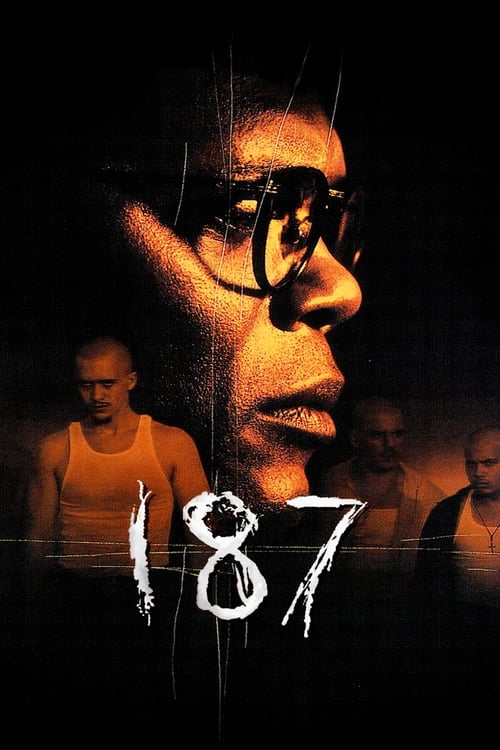
One Eight Seven (1997)
Directed by Kevin Reynolds
No — One Eight Seven is not especially woke, scoring 27 out of 100 on our wokeness meter.
One Eight Seven arrives from the 1997 cellar, a vintage that has aged into a grim curiosity.
Consciousness Markers
A notably diverse ensemble for 1997, with a Black lead (Samuel L. Jackson) and a predominantly Latino supporting cast, but the diversity is organic to the inner-city school setting rather than a self-conscious representational statement.
The film is a message movie about the plight of teachers, capped by a closing narration citing a MetLife-Louis Harris survey on teacher assaults, giving it a didactic, sermonizing streak.
Race is present through the Black-teacher-versus-Latino-gang dynamic, but the film treats it as backdrop to a violence-and-discipline story rather than a systemic-racism critique.
Features a female teacher and a female student, but they function as narrative devices in a story about male violence; no feminist thesis is advanced.
Critiques a negligent school administration and legal-averse bureaucracy, but offers no economic or class-based indictment of capitalism.
No LGBTQ+ characters, themes, or subtext of any kind.
No environmental or climate content whatsoever.
No body-positivity themes or messaging.
No neurodivergence representation or themes.
Inspired by the screenwriter's real teaching experiences, but it makes no revisionist claims about history.
Why it received this score
One Eight Seven arrives from the 1997 cellar, a vintage that has aged into a grim curiosity. Samuel L. Jackson plays Trevor Garfield, a Brooklyn teacher stabbed by a student and then relocated to a Los Angeles classroom that proves equally hostile. The film's ensemble is more varied than its era required, with a Black lead surrounded by Latino students and colleagues, though this diversity feels native to the setting, not like a casting memo. There is no LGBTQ business, no climate sermon, no body-positive subplot, and no neurodivergent arc. We are here for chalkboard warfare and moral exhaustion.
Women appear, chiefly as a colleague whose dog is killed and a student who needs rescuing, but the film has no feminist thesis to offer. Race exists as a texture of the Black teacher versus Latino gang conflict, treated as backdrop to a discipline-and-violence story. The screenplay glances at a negligent administration and a legal-averse bureaucracy, yet it stops short of any economic indictment. Its anger is aimed at paperwork and liability, not at capital. History is not revised. The film is inspired by a substitute teacher's real experiences, but it makes no claims about the past beyond the anecdotal.
The closing narration cites a survey on teacher assaults, and the whole project leans toward sermon. This is a message movie about the plight of educators, and it delivers that message with the subtlety of a fire alarm. The result is not without conviction. Jackson is strong. The film is simply too busy being a cautionary pamphlet to notice the larger cultural currents it never bothers to surf. It wants to talk about teachers. It does.
Analysis generated by our Consciousness Algorithm
Part of


Synopsis
When a Brooklyn high school student writes the police code for homicide, 187, inside a textbook owned by teacher Trevor Garfield, Garfield feels threatened. The principal dismisses the incident, but the same student stabs Trevor soon after. Fifteen months later, a physically and emotionally scarred Trevor relocates to California and takes up substitute teaching. To his dismay, his new school is as full of dangerously undisciplined students as his old one—including four Latin Americans and a European American claiming membership in tagging gang K.O.S. (Kappin' Off Suckers)—driving him over the edge.
Questions about One Eight Seven
Is One Eight Seven woke?
No — One Eight Seven is not especially woke, scoring 27 out of 100 on our wokeness meter. That earns it a verdict of Based.
Does One Eight Seven have any woke elements?
2 of the 10 markers register at 30 or above, led by Lecture Energy (35) and Representation Casting (35). On Lecture Energy: The film is a message movie about the plight of teachers, capped by a closing narration citing a MetLife-Louis Harris survey on teacher assaults, giving it a didactic, sermonizing streak.
How does One Eight Seven compare to other 1997 movies?
It ranks #10 of the 109 films from 1997 we've scored; their average is 12. The wokest is Happy Together (65).
How is the Woke Score calculated?
An AI-assisted process researches the film and its reception, scores it 0–100 on ten markers, then combines those into one 0–100 Woke Score. It measures a specific set of 2020s cultural themes, not film quality.