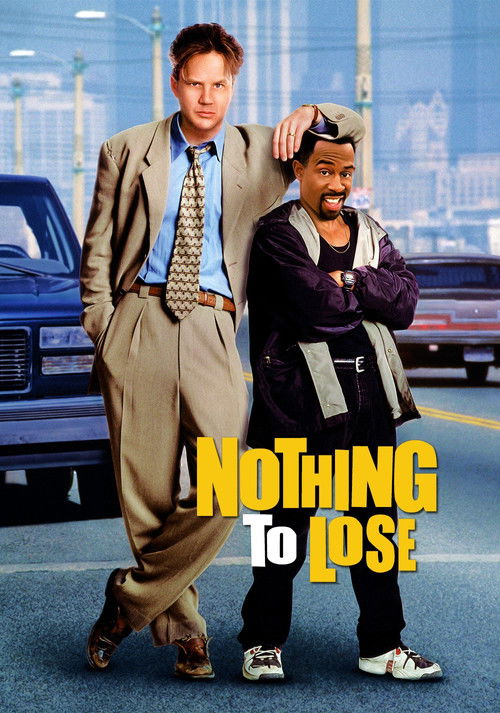
Nothing to Lose (1997)
Directed by Steve Oedekerk
No — Nothing to Lose is not woke, scoring 15 out of 100 on our wokeness meter.
Nothing to Lose is a 1997 buddy action comedy about advertising executive Nick Beam, his mistaken belief about his wife's infidelity, and the carjacker T-Paul Davidson who becomes his partner in a revenge robbery.
Consciousness Markers
Martin Lawrence is a Black co-lead and the cast includes Black family members and a Latino antagonist, giving the film notable multiracial representation for a 1997 buddy comedy. However, the casting is not framed as a deliberate diversity statement.
The film includes racial humor and a Black co-lead whose family lives in a troubled neighborhood, but it does not seriously examine racism or systemic inequality.
No LGBTQ+ characters, themes, or subtext are present.
Female characters are largely wives, girlfriends, or objects of infidelity jokes; the film offers no feminist critique or agenda.
No environmental or climate-related themes appear.
The robbery targets a boss for personal revenge, not as a critique of capitalism or wealth inequality.
No body-positivity themes or messaging are present.
No neurodivergence themes or characters are present.
The film is not historical and makes no revisionist historical claims.
It is a broad buddy comedy with no preachy or lecture-like messaging.
Why it received this score
Nothing to Lose is a 1997 buddy action comedy about advertising executive Nick Beam, his mistaken belief about his wife's infidelity, and the carjacker T-Paul Davidson who becomes his partner in a revenge robbery. The premise is a screwball misunderstanding stretched over desert highways, hotel rooms, and a lip-syncing security guard. As a vehicle for Tim Robbins and Martin Lawrence, it runs on the contrast between Robbins' muted despair and Lawrence's motormouth panic. The film wants to be a caper, a road movie, and a male-bonding comedy. It succeeds modestly at the first two and mostly relies on Lawrence to carry the third.
On the social consciousness front, the film is largely a product of its moment and not a dispatch from any later cultural battle. Martin Lawrence's co-lead status gives the casting a multiracial dimension that was notable for a 1997 studio comedy, and T-Paul's family and neighborhood add a faint racial texture. Still, the movie treats race as material for jokes and background detail, not as a subject for serious examination. Female characters orbit the plot as wives, girlfriends, or infidelity punchlines. The robbery targets a boss for personal revenge, not as an indictment of wealth or labor. There is no environmental sermon, no body-positive message, no neurodivergent arc, no historical revision, and no LGBTQ presence. The film does not lecture. It mostly wants to get to the next gag.
What remains is a modestly amusing genre exercise with a few sharp comic performances and a soundtrack that outlived the movie. It is not hostile to progressive values; it simply predates the specific vocabulary and concerns that later became markers of cultural alignment. The result is a buddy comedy that can be enjoyed as a period piece, provided we do not ask it to be a manifesto. It has nothing to lose because it never picked up the baggage in the first place.
Analysis generated by our Consciousness Algorithm


Synopsis
Advertising executive Nick Beame learns that his wife is sleeping with his employer. In a state of despair, he encounters a bumbling thief whose attempted carjacking goes awry when Nick takes him on an involuntary joyride. Soon the betrayed businessman and the incompetent crook strike up a partnership and develop a robbery-revenge scheme. But it turns out that some other criminals in the area don't appreciate the competition.
Questions about Nothing to Lose
Is Nothing to Lose woke?
No — Nothing to Lose is not woke, scoring 15 out of 100 on our wokeness meter. That earns it a verdict of Ultra Based.
Does Nothing to Lose have any woke elements?
1 of the 10 markers register at 30 or above, led by Representation Casting (45). On Representation Casting: Martin Lawrence is a Black co-lead and the cast includes Black family members and a Latino antagonist, giving the film notable multiracial representation for a 1997 buddy comedy.
How does Nothing to Lose compare to other 1997 movies?
It ranks #28 of the 109 films from 1997 we've scored; their average is 12. The wokest is Happy Together (65).
How is the Woke Score calculated?
An AI-assisted process researches the film and its reception, scores it 0–100 on ten markers, then combines those into one 0–100 Woke Score. It measures a specific set of 2020s cultural themes, not film quality.