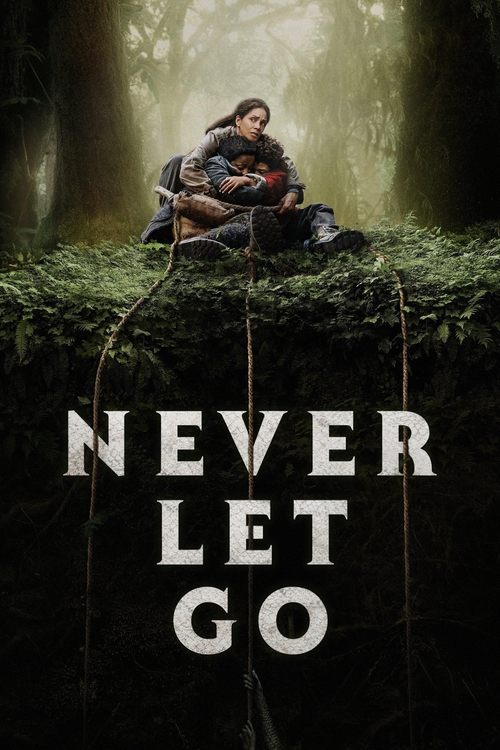
Never Let Go (2024)
Directed by Alexandre Aja
No — Never Let Go is not especially woke, scoring 27 out of 100 on our wokeness meter.
Never Let Go positions itself as a grueling exercise in psychological endurance, yet it manages to coalesce around a surprisingly potent cultural core.
Consciousness Markers
The mother has schizophrenia, and the supernatural Evil is revealed as an allegory for generational mental illness, making neurodivergence a central thematic element.
The film centers a Black family, with Halle Berry and two Black child actors in the lead roles, though race is not a thematic focus.
The protagonist is a mother and matriarch, but the film does not advance an explicit feminist agenda or critique patriarchal structures.
The film carries an allegorical message about mental illness, but it is delivered through horror imagery rather than explicit preaching.
There are no LGBTQ+ characters, relationships, or themes in the film.
The film does not engage with racial identity, racism, or racial consciousness as themes.
There are no climate change or environmentalist themes in the film.
The film contains no anti-capitalist, class-warfare, or eat-the-rich messaging.
The film does not address body positivity, body image, or related themes.
The film is not historical and does not revise or reinterpret historical events.
Why it received this score
Never Let Go positions itself as a grueling exercise in psychological endurance, yet it manages to coalesce around a surprisingly potent cultural core. The film centers a Black family unit, offering representation through casting, even if race remains a passive element within the narrative structure. The story relies heavily on the fraught relationship between a matriarch struggling with schizophrenia and her twin sons. This exploration of generational mental illness, which the film allegorically frames as a pervasive supernatural threat, is where the picture finds its most significant cultural weight. The depiction of neurodivergence, viewed not as a character quirk but as a tragic inheritance, gives the piece its progressive sensibility.
However, the film stops short of achieving sweeping social commentary. Its portrayal of the female lead functions more as a survival mechanism than as an explicit feminist statement. The progressive undertones are often found in the heavy, atmospheric delivery of its message rather than in a direct thematic confrontation with systemic issues. The narrative does not attempt to critique capitalism or focus on broader racial consciousness. Instead, it keeps its focus tightly bound to the internal struggles of the homestead, presenting its weighty concepts through a lens of survival horror.
What results is a grim, somber meditation on mental health and isolation. It carries an allegorical burden about inherited instability, and while the messaging is undeniably heavy, it achieves its goal without resorting to a sermonizing delivery. We are left with a film that utilizes its progressive themes to justify its bleak setting, creating a work of art that is both emotionally taxing and surprisingly focused. It demands attention from those interested in the modern cultural awareness of mental health, even if it offers little in the way of broad social critique.
Analysis generated by our Consciousness Algorithm


Synopsis
As an evil takes over the world beyond their front doorstep, the only protection for a mother and her twin sons is their house and their family’s protective bond.
Questions about Never Let Go
Is Never Let Go woke?
No — Never Let Go is not especially woke, scoring 27 out of 100 on our wokeness meter. That earns it a verdict of Based.
Does Never Let Go have any woke elements?
2 of the 10 markers register at 30 or above, led by Neurodivergence (60) and Representation Casting (55). On Neurodivergence: The mother has schizophrenia, and the supernatural Evil is revealed as an allegory for generational mental illness, making neurodivergence a central thematic element.
How does Never Let Go compare to other 2024 movies?
It ranks #45 of the 189 films from 2024 we've scored; their average is 22. The wokest is The Six Triple Eight (92).
How is the Woke Score calculated?
An AI-assisted process researches the film and its reception, scores it 0–100 on ten markers, then combines those into one 0–100 Woke Score. It measures a specific set of 2020s cultural themes, not film quality.