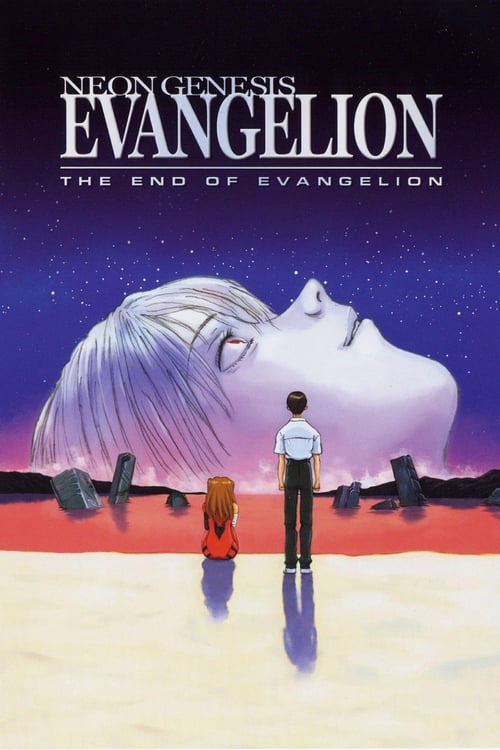
Neon Genesis Evangelion: The End of Evangelion (1997)
Directed by Kazuya Tsurumaki
No — Neon Genesis Evangelion: The End of Evangelion is not woke, scoring 17 out of 100 on our wokeness meter.
Twenty-six years on from its release, this remains the most punitive act of closure ever committed to celluloid, a film that exists because the television finale refused to explain itself and the audience would not let the matter rest.
Consciousness Markers
The film is centrally preoccupied with Shinji's depression, anxiety, and psychological collapse, and Asuka's trauma, offering a serious if not modern-framed depiction of mental distress.
Shinji's relationship with Kaworu Nagisa, a significant same-sex bond from the series, is invoked in the film's climactic vision, lending genuine queer subtext even if it is not foregrounded.
Women like Misato, Ritsuko, Asuka, and Rei occupy command and combat roles, but the film's treatment of Asuka (masturbated over while comatose) and its sexualization of minors undercut any feminist reading.
The film is famously oblique, abstract, and introspective rather than preachy, though its closing affirmation that life is worth living carries a faint didactic note.
The cast is entirely Japanese voice actors voicing Japanese characters; there is no deliberate diverse or inclusive casting initiative at play.
The film engages no racial themes whatsoever; its concerns are metaphysical, psychological, and theological.
The post-apocalyptic setting stems from the supernatural 'Second Impact,' not from any ecological or climate-change message.
The conflict between NERV and SEELE is a struggle over apocalyptic theology and personal grief, not a critique of wealth or capitalism.
The film's treatment of bodies is one of horror and dissolution into primordial fluid, the opposite of body-positive messaging.
There is no historical revisionism; the film is set in a wholly fictional apocalyptic future.
Why it received this score
Twenty-six years on from its release, this remains the most punitive act of closure ever committed to celluloid, a film that exists because the television finale refused to explain itself and the audience would not let the matter rest. Anno, freshly recovered from a period in which strangers debated the best method of killing him, responded by dissolving the human race into orange fluid and calling it a conclusion. The concerns on display are metaphysical, theological, and psychological. There is no interest whatsoever in the social questions that occupy the contemporary cultural conversation, and the film makes no apology for that.
Where the film does brush against modern sensibilities, it does so obliquely. Shinji's depression and Asuka's trauma are treated with a seriousness that predates the current vocabulary for such things, and the climactic vision invokes Kaworu, lending the finale a genuine queer undercurrent that the film declines to foreground. Women hold command posts throughout NERV, though the film's treatment of Asuka, comatose and exposed, complicates any claim of feminist sympathy. On race, ecology, economics, and bodily affirmation, the record is blank. The apocalypse here is supernatural in origin and personal in meaning.
The closing argument, that life contains pain and is nonetheless worth continuing, lands with a faint instructional thump, the only moment the film stops being oblique and starts telling us something. Everything else is abstraction, religious imagery deployed without a decoder ring, and a great deal of screaming. We have sat through many sermons dressed as entertainment. This is not one of them. It is a funeral, as its makers intended, and funerals rarely lecture the mourners. A difficult vintage. Devastating, unfashionable, and almost entirely free of the cultural agendas we are contractually obliged to inventory.
Analysis generated by our Consciousness Algorithm


Synopsis
SEELE orders an all-out attack on NERV, aiming to destroy the Evas before Gendo can advance his own plans for the Human Instrumentality Project. Shinji is pushed to the limits of his sanity as he is forced to decide the fate of humanity.
Questions about Neon Genesis Evangelion: The End of Evangelion
Is Neon Genesis Evangelion: The End of Evangelion woke?
No — Neon Genesis Evangelion: The End of Evangelion is not woke, scoring 17 out of 100 on our wokeness meter. That earns it a verdict of Ultra Based.
Does Neon Genesis Evangelion: The End of Evangelion have any woke elements?
1 of the 10 markers register at 30 or above, led by Neurodivergence (30). On Neurodivergence: The film is centrally preoccupied with Shinji's depression, anxiety, and psychological collapse, and Asuka's trauma, offering a serious if not modern-framed depiction of mental distress.
How does Neon Genesis Evangelion: The End of Evangelion compare to other 1997 movies?
It ranks #26 of the 109 films from 1997 we've scored; their average is 12. The wokest is Happy Together (65).
How is the Woke Score calculated?
An AI-assisted process researches the film and its reception, scores it 0–100 on ten markers, then combines those into one 0–100 Woke Score. It measures a specific set of 2020s cultural themes, not film quality.