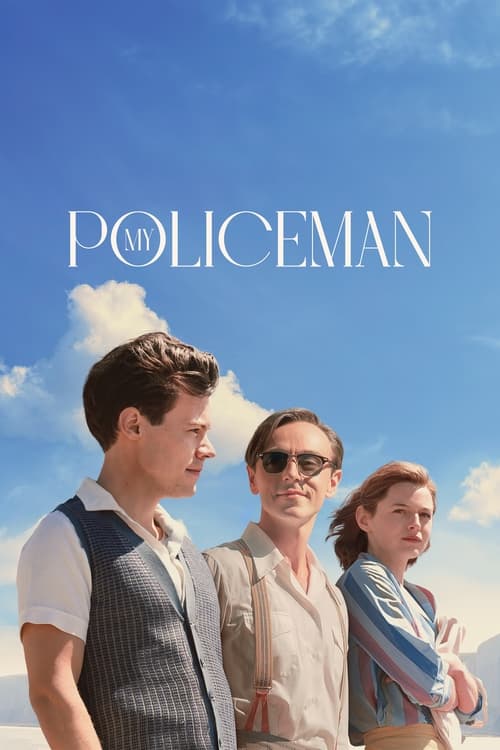
My Policeman (2022)
Directed by Michael Grandage
Yes — My Policeman is woke, scoring 60 out of 100 on our wokeness meter.
My Policeman arrives as a 2022 romantic drama set largely in 1950s Brighton, where a policeman named Tom conducts a secret affair with a museum curator named Patrick while courting a schoolteacher named Marion.
Consciousness Markers
The entire plot revolves around a closeted gay relationship and the historical criminalization of homosexuality in 1950s Britain.
The film centers on a same-sex romance and features several openly LGBTQ+ performers, including David Dawson, Rupert Everett, and Emma Corrin, though the lead is played by a straight pop star.
Marion is given substantial interiority and a late-act confession, but the narrative remains primarily a tragedy of gay male desire rather than a feminist statement.
The film is restrained and melancholic rather than preachy, though its subject matter carries an implicit social message.
No racial themes or commentary; the cast includes a Black actor in a minor role, but the story is entirely focused on white British characters and homophobia.
No environmental themes whatsoever.
No critique of capitalism or wealth inequality.
No body positivity themes.
No neurodivergence themes.
A period piece about historical homophobia, not a revisionist rewriting of history.
Why it received this score
My Policeman arrives as a 2022 romantic drama set largely in 1950s Brighton, where a policeman named Tom conducts a secret affair with a museum curator named Patrick while courting a schoolteacher named Marion. The film's entire engine is the criminalization of homosexuality, the fear of discovery, the journal that becomes evidence, the prison sentence, the decades of silence. On the matter of LGBTQ+ themes, there is no ambiguity to adjudicate. This is the film's subject, its atmosphere, and its reason for existing. The casting adds another layer: David Dawson, Rupert Everett, and Emma Corrin bring openly queer performers into a story of closeted desire, though the central role goes to a straight pop star whose presence has its own commercial logic. That mixture registers as meaningful representation casting, even if it is not a complete triumph.
Marion receives more interiority than such a wife usually gets. She has suspicions, rage, a confession in the final act, and a challenge to the lie of her marriage. Still, the film treats her as a witness to a tragedy of gay male desire, not as the center of a feminist argument. The narrative has no interest in racial consciousness, climate anxiety, economic inequality, body image, or neurodivergence. Those absences are not oversights in a story this focused; they are simply outside its frame. The film is also not a work of revisionist history. It depicts mid-century homophobia with period detail and melancholy, which is historical representation, not historical rewriting.
The prevailing tone is restrained, mournful, and eager to avoid sermons. The social message is implicit, carried by the plot's cruelty and the waste of love denied. That keeps the lecture energy modest, though not zero. The result is a tasteful, well-acted, occasionally plodding drama that knows exactly which injustice it wants us to mourn. It does not shout. It sighs. In the ledger of modern cultural markers, that sigh is enough to register, but it is not enough to dominate the room.
Analysis generated by our Consciousness Algorithm

Synopsis
In the late 1990s, the arrival of elderly invalid Patrick into Marion and Tom’s home triggers the exploration of seismic events from 40 years previous: the passionate relationship between Tom and Patrick at a time when homosexuality was illegal.
Questions about My Policeman
Is My Policeman woke?
Yes — My Policeman is woke, scoring 60 out of 100 on our wokeness meter. That earns it a verdict of Woke.
What makes My Policeman woke?
2 of the 10 markers register at 30 or above, led by LGBTQ+ Themes (100) and Representation Casting (75). On LGBTQ+ Themes: The entire plot revolves around a closeted gay relationship and the historical criminalization of homosexuality in 1950s Britain.
How does My Policeman compare to other 2022 movies?
It ranks #12 of the 223 films from 2022 we've scored; their average is 22. The wokest is Bros (92).
How is the Woke Score calculated?
An AI-assisted process researches the film and its reception, scores it 0–100 on ten markers, then combines those into one 0–100 Woke Score. It measures a specific set of 2020s cultural themes, not film quality.