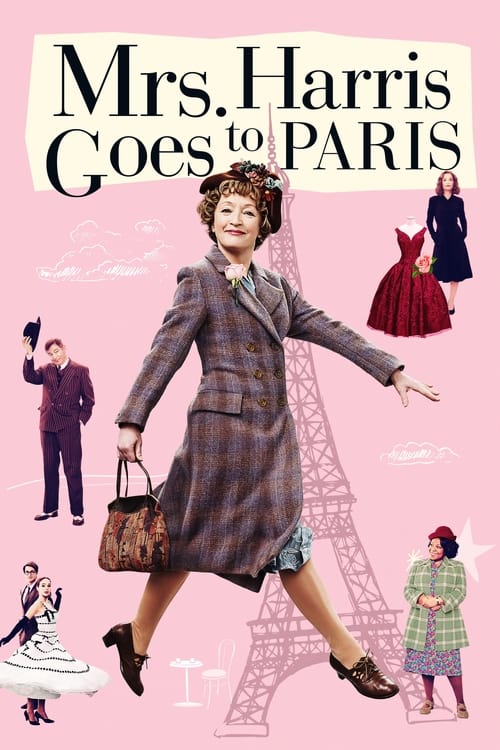
Mrs. Harris Goes to Paris (2022)
Directed by Anthony Fabian
No — Mrs. Harris Goes to Paris is not woke, scoring 17 out of 100 on our wokeness meter.
Mrs. Harris Goes to Paris arrives with impeccable manners and a wardrobe to match, following a 1957 London charwoman who fixes her heart on a Christian Dior gown and simply refuses to be told no.
Consciousness Markers
Ada organizes a worker strike against Dior's layoffs and pushes to make haute couture accessible to less affluent buyers, a mild class-conscious critique of exclusivity and profit.
A working-class widow asserts herself in a male-dominated luxury world, and Claudine runs Dior with authority, but the film frames this as plucky charm rather than a feminist thesis.
A largely white British and French cast, with Ellen Thomas as Ada's friend Vi providing the only notable non-white presence, included naturally without comment. Modest, period-appropriate diversity.
The film is a gentle, charming crowd-pleaser; its mild messages about worker dignity and accessibility are delivered through story rather than sermon.
No LGBTQ+ characters, themes, or subtext appear anywhere in the film.
The film features a Black supporting character but makes no comment on race, class-racial dynamics, or social justice; the 1950s setting is presented without racial consciousness.
No environmental or climate themes are present in this fashion-world period piece.
No body-positivity themes or messaging about body image appear in the film.
No neurodivergent characters or themes are depicted.
The film is a straightforward period adaptation of a 1958 novel, not a revisionist reframing of history.
Why it received this score
Mrs. Harris Goes to Paris arrives with impeccable manners and a wardrobe to match, following a 1957 London charwoman who fixes her heart on a Christian Dior gown and simply refuses to be told no. Lesley Manville carries the enterprise with a quiet dignity that the screenplay rarely earns on its own. The film is adapted from Paul Gallico's 1958 novel, and it wears that provenance openly, all cobblestones and couture and pleasant coincidences.
The cast is overwhelmingly white, which suits the period and the milieu without any apparent anxiety about it. Ellen Thomas appears as Ada's friend Vi, present and unremarked upon, the sort of quiet inclusion that asks nothing of the audience. Where the film does flex a mild social muscle is in its treatment of labor and luxury. Ada organizes a strike when Dior sheds workers, and she nudges the house toward serving customers of modest means. This is class consciousness as a parlor game: agreeable, frictionless, and resolved before the tea goes cold. Claudine, the steely director, is allowed competence and authority, though the film prefers to call it pluck when a widow does the same.
There is no romance here with race as a subject, no environmental sermon, no meditation on body image, and no neurodivergent interiority to speak of. History is rendered straight, unrevised, a fond postcard. The sermonizing is kept to a murmur; the film would sooner pour you a sherry than correct your politics. It is a good old-fashioned story, charmingly told, and it knows exactly how little it wants to say.
It is a good old-fashioned story, charmingly told, and it knows exactly how little it wants to say. What remains is craft, costume, and a widow who wanted a dress and got one, and no viewer will be scolded on the way out the door. The sommelier sets down the glass, notes the pleasant finish, and reaches for the next bottle with no great urgency. The film is a 2022 adaptation of a 1958 novel and behaves accordingly, which is its own kind of integrity. It will not be mistaken for a manifesto, and it has no interest in being one. The ledger closes with a shrug and a smile, and the sherry was, in the end, perfectly fine. Nothing here demands a second pour. The costume design, we are told, earned an Academy Award nomination, and that is the most political statement the whole affair is willing to make. It is a lovely dress. It is only a dress. The credits roll, and the world is unchanged, which was always the point of the exercise, and there is a certain relief in that. The projectionist dims the lamp. The audience files out, quietly, unprovoked, and perhaps a little charmed. That is the entire transaction, and it is enough. The sommelier would call it approachable, uncomplicated, best served chilled, and gone before you can form an opinion about it. Some vintages are built for contemplation. This one is built for a Sunday afternoon, and it knows its place in the cellar. There is no manifesto in the bottle. There never was. The cork goes back in, and the evening continues, unbothered, exactly as it began, which is more than most films can honestly claim, and less than some might hope for, and precisely what the label promised from the start. Good night, Mrs. Harris, wherever you are.
Analysis generated by our Consciousness Algorithm


Synopsis
A 1950s London cleaning lady falls in love with an haute couture dress by Christian Dior and decides to gamble everything for the sake of this folly.
Questions about Mrs. Harris Goes to Paris
Is Mrs. Harris Goes to Paris woke?
No — Mrs. Harris Goes to Paris is not woke, scoring 17 out of 100 on our wokeness meter. That earns it a verdict of Ultra Based.
Does Mrs. Harris Goes to Paris have any woke elements?
1 of the 10 markers register at 30 or above, led by Eat the Rich (30). On Eat the Rich: Ada organizes a worker strike against Dior's layoffs and pushes to make haute couture accessible to less affluent buyers, a mild class-conscious critique of exclusivity and profit.
How does Mrs. Harris Goes to Paris compare to other 2022 movies?
It ranks #102 of the 223 films from 2022 we've scored; their average is 22. The wokest is Bros (92).
How is the Woke Score calculated?
An AI-assisted process researches the film and its reception, scores it 0–100 on ten markers, then combines those into one 0–100 Woke Score. It measures a specific set of 2020s cultural themes, not film quality.