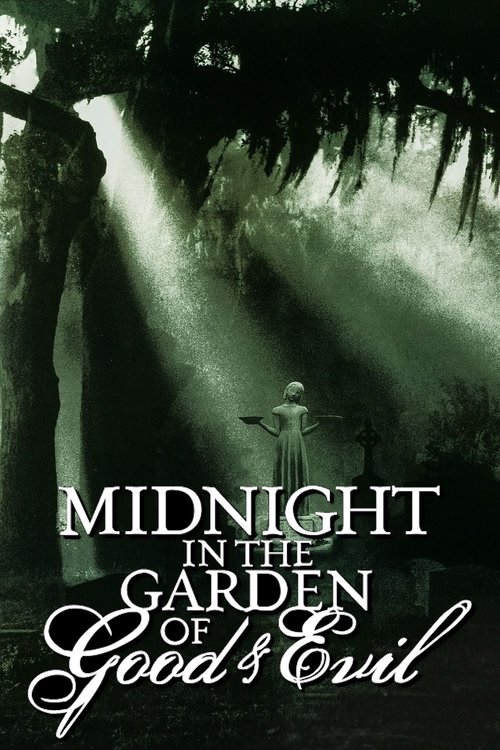
Midnight in the Garden of Good and Evil (1997)
Directed by Clint Eastwood
No — Midnight in the Garden of Good and Evil is not especially woke, scoring 26 out of 100 on our wokeness meter.
Clint Eastwood's 1997 adaptation of John Berendt's bestseller arrives in Savannah with the patience of a man who has decided that atmosphere is its own reward.
Consciousness Markers
The central murder revolves around antiques dealer Jim Williams's relationship with his male lover Billy Hanson, and Williams is depicted as a semi-closeted homosexual navigating Savannah society; the film treats this matter-of-factly without advocacy framing.
The film notably casts The Lady Chablis, a real-life Black transgender entertainer, as herself, alongside a predominantly Black supporting cast including Irma P. Hall as Minerva; this is genuine, uncommented-upon representation rather than a modern casting initiative.
Black characters such as Minerva the root doctor and The Lady Chablis feature prominently, but the film makes no commentary on race or systemic inequality; their presence is atmospheric rather than thematic.
Mandy serves largely as a romantic interest and torch singer, and The Lady Chablis is a scene-stealing presence but not deployed toward any feminist thesis; no gender-politics agenda is present.
The film is a leisurely character study of Savannah eccentricity and never pauses to deliver a moral lesson to the audience.
Jim Williams is a self-made millionaire and art collector whose wealth is largely celebrated rather than critiqued; there is no eat-the-rich sentiment.
No environmental or climate themes appear anywhere in the film.
No body-positivity themes or messaging are present.
Eccentric locals like Luther Driggers are played for Southern-gothic quirk, not framed through any neurodivergence lens.
The film adapts real events but does not reframe or reinterpret history through a modern ideological lens; it is a straightforward dramatization.
Why it received this score
Clint Eastwood's 1997 adaptation of John Berendt's bestseller arrives in Savannah with the patience of a man who has decided that atmosphere is its own reward. The camera lingers on Spanish moss and wrought iron, the locals speak in unhurried cadences, and a murder trial unfolds at the pace of a garden tour. It is a film about a killing that would prefer to be a film about cocktails. We are asked to admire eccentricity, and we do, mostly because the alternative is to notice how little happens.
The film's most progressive gesture is also its most incidental. The Lady Chablis, a real transgender entertainer, plays herself, and the performance is allowed to be brash, funny, and entirely unexamined. Jim Williams stands trial for shooting his young male lover, and his homosexuality is presented as one more piece of Savannah furniture, known to everyone and discussed by no one. There is no advocacy here, no lesson, no moment where the screenplay turns to the audience and explains what we ought to feel. The film records a closeted millionaire and his circle, and trusts us to keep up.
Elsewhere the ledger is thin. Minerva the root doctor and the Black supporting cast lend texture without commentary. Williams's wealth is celebrated, not indicted. The eccentrics are played for Southern-gothic charm, not diagnosed. No one lectures us about the environment, the body, or the republic. What remains is a slow, handsome, faintly melancholic picture that treats its themes as weather. It is the rare film content to let its social consciousness sit in the shade, sipping something cold, saying nothing.
Analysis generated by our Consciousness Algorithm
Part of


Synopsis
A visiting city reporter's assignment suddenly revolves around the murder trial of a local millionaire, whom he befriends.
Questions about Midnight in the Garden of Good and Evil
Is Midnight in the Garden of Good and Evil woke?
No — Midnight in the Garden of Good and Evil is not especially woke, scoring 26 out of 100 on our wokeness meter. That earns it a verdict of Based.
Does Midnight in the Garden of Good and Evil have any woke elements?
2 of the 10 markers register at 30 or above, led by LGBTQ+ Themes (60) and Representation Casting (45). On LGBTQ+ Themes: The central murder revolves around antiques dealer Jim Williams's relationship with his male lover Billy Hanson, and Williams is depicted as a semi-closeted homosexual navigating Savannah society; the film treats this matter-of-factly without advocacy framing.
How does Midnight in the Garden of Good and Evil compare to other 1997 movies?
It ranks #11 of the 109 films from 1997 we've scored; their average is 12. The wokest is Happy Together (65).
How is the Woke Score calculated?
An AI-assisted process researches the film and its reception, scores it 0–100 on ten markers, then combines those into one 0–100 Woke Score. It measures a specific set of 2020s cultural themes, not film quality.