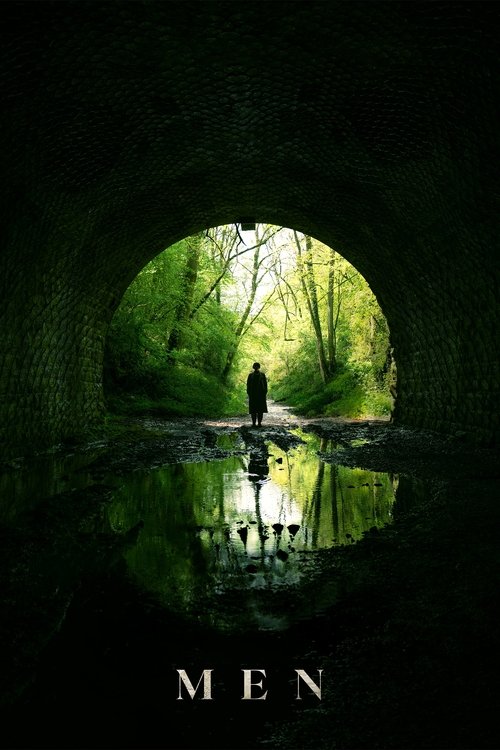
Men (2022)
Directed by Alex Garland
Partly — Men is somewhat woke, scoring 47 out of 100 on our wokeness meter.
Men is a 2022 British surrealist folk horror film from Alex Garland, and it arrives with the solemnity of a therapy session conducted in a damp hedge.
Consciousness Markers
The film is explicitly organized around a woman's trauma at the hands of male abuse, gaslighting, and violence, with a vicar blaming her for her husband's death and a climax interrogating male entitlement to her love.
Critics repeatedly called the film 'unsubtle and schematic' with 'slick political points' about toxic masculinity, though it delivers these through surreal allegory rather than direct preaching.
The cast is largely white British, with Paapa Essiedu and Sonoya Mizuno in supporting roles; the diverse casting reads as ordinary ensemble-building rather than a pointed representation agenda.
No LGBTQ+ characters, relationships, or themes appear anywhere in the narrative.
No racial themes, commentary, or dynamics are engaged with; the minority casting carries no racial content.
The Green Man and nature imagery are folk-horror iconography, not environmental advocacy.
No economic critique, class warfare, or anti-wealth themes are present.
The film's extreme body horror and grotesque male birthing sequence are the opposite of a body-positive message.
No neurodivergent characters or themes are depicted or referenced.
The film has no historical setting or historical revisionism; it is a contemporary allegorical horror.
Why it received this score
Men is a 2022 British surrealist folk horror film from Alex Garland, and it arrives with the solemnity of a therapy session conducted in a damp hedge. Jessie Buckley plays Harper, a widow who retreats to the Herefordshire countryside after her husband's suicide, only to find that every man in the village wears Rory Kinnear's face. The film is organized around a woman's trauma at the hands of male abuse, gaslighting, and violence. A vicar suggests she is partly responsible for her husband's death. The climax interrogates male entitlement to her love. This is a clear feminist agenda, executed with the subtlety of a sledgehammer wrapped in moss.
The cast is largely white British, with Paapa Essiedu and Sonoya Mizuno in supporting roles. That diversity reads as ordinary ensemble-building, not a pointed representation campaign. The film has no LGBTQ characters or themes. It engages no racial dynamics, no environmental advocacy, no economic critique, no neurodivergent characters, and no historical revisionism. Its body horror is the opposite of body positivity, especially the grotesque male birthing sequence. The Green Man imagery is folk-horror decoration, not climate crusading. We are left with a narrow, intense study of masculine menace.
Critics have called the film unsubtle and schematic, with slick political points about toxic masculinity. That is fair. Yet the sermonizing arrives through surreal allegory, not direct preaching, so the lecture energy is moderate. The cultural awareness is real but confined to one note. Men is a chamber piece of masculine dread, not a broad progressive checklist. It earns some of its provocation and loses some to repetition. We classify it as a strong vintage of a single varietal, with little else in the cellar.
Analysis generated by our Consciousness Algorithm
Part of


Synopsis
In the aftermath of a personal tragedy, Harper retreats alone to the beautiful English countryside, hoping to find a place to heal. But someone — or something — from the surrounding woods appears to be stalking her, and what begins as simmering dread becomes a fully-formed nightmare, inhabited by her darkest memories and fears.
Questions about Men
Is Men woke?
Partly — Men is somewhat woke, scoring 47 out of 100 on our wokeness meter. That earns it a verdict of Woke-Adjacent.
What makes Men woke?
2 of the 10 markers register at 30 or above, led by Feminist Agenda (74) and Lecture Energy (50). On Feminist Agenda: The film is explicitly organized around a woman's trauma at the hands of male abuse, gaslighting, and violence, with a vicar blaming her for her husband's death and a climax interrogating male entitlement to her love.
How does Men compare to other 2022 movies?
It ranks #33 of the 223 films from 2022 we've scored; their average is 22. The wokest is Bros (92).
How is the Woke Score calculated?
An AI-assisted process researches the film and its reception, scores it 0–100 on ten markers, then combines those into one 0–100 Woke Score. It measures a specific set of 2020s cultural themes, not film quality.