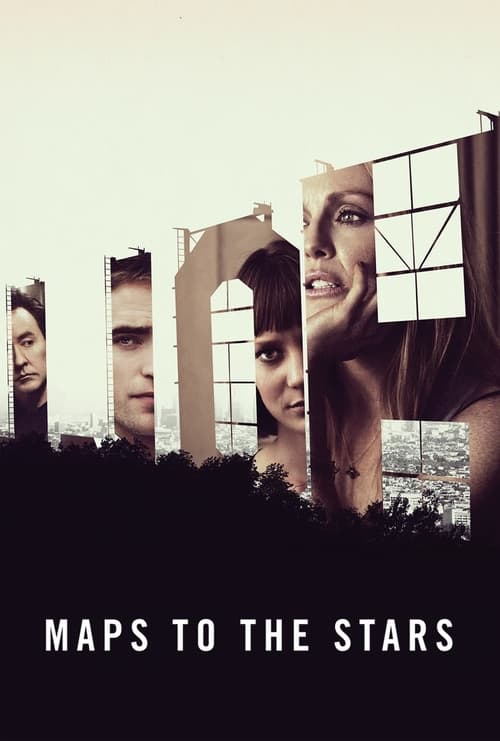
Maps to the Stars (2014)
Directed by David Cronenberg
No — Maps to the Stars is not woke, scoring 16 out of 100 on our wokeness meter.
Maps to the Stars arrives as a black comedy of Hollywood cannibalism, directed by David Cronenberg and written by Bruce Wagner, who clearly has scores to settle.
Consciousness Markers
The film critiques the misogyny and exploitation faced by women in Hollywood, especially the aging actress Havana and her abusive mother, but it is a bleak satire rather than a modern feminist manifesto.
It satirizes celebrity culture, nepotism, and the commodification of fame, but its target is Hollywood narcissism rather than capitalism as a system.
The film has satirical commentary on Hollywood, but it is delivered through absurdist drama and black comedy rather than preachy social-justice lecturing.
The cast is almost entirely white and the film makes no effort at inclusive or color-conscious casting; diversity is not a thematic concern.
No LGBTQ+ characters, relationships, or themes appear; the transgressive material is heterosexual incest and Hollywood narcissism.
Race is not addressed; the story focuses on a white Hollywood family and industry insiders.
No environmental or climate themes are present.
The film treats bodies with horror and disgust—burns, scars, menstrual blood, and self-destruction—offering no body-positive message.
Mental illness, addiction, and hallucinations are present, but they are framed as pathology and gothic dysfunction, not as neurodivergent identity or advocacy.
No historical revisionism; it is a contemporary satire.
Why it received this score
Maps to the Stars arrives as a black comedy of Hollywood cannibalism, directed by David Cronenberg and written by Bruce Wagner, who clearly has scores to settle. The Weiss family runs on incest, pills, and the labor of a child star. Havana Segrand, an aging actress, is haunted by her dead mother and by the remake she wants to headline. Agatha, scarred and freshly released from a sanatorium, drifts through this ecosystem with a stolen wedding ring and a poem she recites like a prayer. Nobody here is well. Nobody here is meant to be.
For our purposes, the film registers faintly on a few cultural meters. It has a genuine interest in the misogyny that grinds women down in the industry: Havana is devoured by her mother's memory, and Cristina manages her son's career with the warmth of a talent agency. That earns a modest nod toward feminist critique, though the film is a bleak satire, not a manifesto. There is also a mild swipe at celebrity as commodity, at nepotism and the monetization of fame. But the target is narcissism, not the economic order. The commentary arrives through absurdism and gore, not through a lecture, which keeps the sermonizing to a minimum.
Everything else is absent. The cast is white, the concerns are white, and race goes unmentioned. No LGBTQ material appears; the transgression on offer is heterosexual incest. The climate is not a subject. Bodies are treated as sites of horror (burns, scars, menstrual blood, self-destruction), so there is no uplift to be found there. Mental illness is gothic pathology, not identity. History is not revised because history is not consulted. A somber vintage, this one. It bites hard and offers nothing to feel good about.
Analysis generated by our Consciousness Algorithm


Synopsis
Driven by an intense need for fame and validation, members of a dysfunctional Hollywood family chase celebrity, one another, and the relentless ghosts of their pasts. Their fragile ecosystem is disrupted by the arrival of Agatha, the scarred and estranged pyromaniac daughter.
Questions about Maps to the Stars
Is Maps to the Stars woke?
No — Maps to the Stars is not woke, scoring 16 out of 100 on our wokeness meter. That earns it a verdict of Ultra Based.
Does Maps to the Stars have any woke elements?
1 of the 10 markers register at 30 or above, led by Feminist Agenda (30). On Feminist Agenda: The film critiques the misogyny and exploitation faced by women in Hollywood, especially the aging actress Havana and her abusive mother, but it is a bleak satire rather than a modern feminist manifesto.
How does Maps to the Stars compare to other 2014 movies?
It ranks #80 of the 303 films from 2014 we've scored; their average is 13. The wokest is Selma (68).
How is the Woke Score calculated?
An AI-assisted process researches the film and its reception, scores it 0–100 on ten markers, then combines those into one 0–100 Woke Score. It measures a specific set of 2020s cultural themes, not film quality.