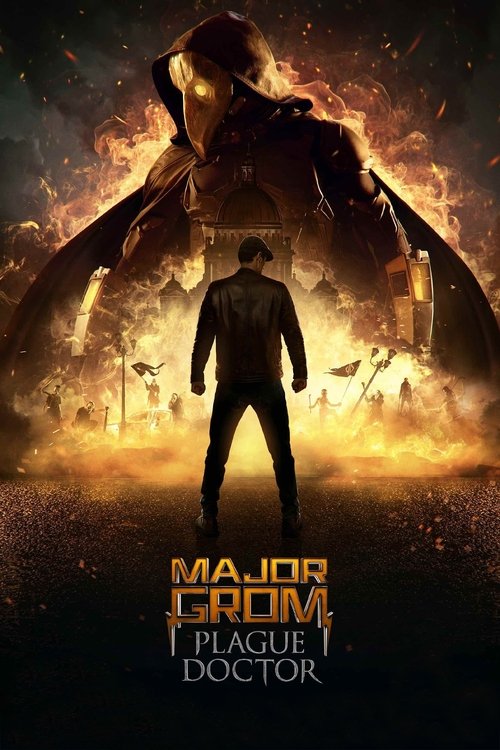
Major Grom: Plague Doctor (2021)
Directed by Oleg Trofim
No — Major Grom: Plague Doctor is not especially woke, scoring 20 out of 100 on our wokeness meter.
Major Grom: Plague Doctor arrives from Russia with a comic-book pedigree, a masked avenger, and the quiet composure of a film that has no interest in the culture wars of the English-speaking world.
Consciousness Markers
The vigilante targets corrupt bankers, oligarchs, and a billionaire acquitted of manslaughter, giving the film a pronounced 'punish the rich' streak, though it ultimately condemns vigilantism rather than capitalism itself.
Grom delivers a closing speech acknowledging the country's problems while rejecting murder as a solution, giving the film a moderate moralizing streak about corruption and justice.
Yulia Pchyolkina is a capable blogger-journalist who aids the hero, but she functions as a standard action-film ally rather than a vehicle for any feminist statement.
One of the Plague Doctor's victims is a landfill owner killed for polluting, a passing environmental note rather than any climate crusade.
The cast is almost entirely white Russian actors, chosen for being lesser-known rather than for any diversity agenda; a single Black performer appears incidentally as a henchman.
The villain's split 'dark side' personality and a mental-institution coda touch on dissociative identity, but as a villain trope rather than neurodivergence advocacy.
No LGBTQ+ characters, themes, or subtext appear anywhere in the film.
The film engages no racial themes or commentary; its social critique is entirely about class and corruption.
No body-positivity themes; the leads are conventionally athletic and the film makes no comment on body image.
The story is a present-day fictional narrative with no historical revisionism.
Why it received this score
Major Grom: Plague Doctor arrives from Russia with a comic-book pedigree, a masked avenger, and the quiet composure of a film that has no interest in the culture wars of the English-speaking world. Oleg Trofim's adaptation of the Bubble Comics series sets an honest, unorthodox police major loose in Saint Petersburg to chase a flamethrower-wielding vigilante in a plague doctor's mask. The casting is almost entirely white and deliberately stocked with lesser-known performers, a decision born from fatigue with Russia's small rotating repertory of familiar faces. A single Black actor appears as a henchman and is not asked to carry any thematic freight. There is no queer content of any kind, and the film does not appear to have noticed that such a category exists.
Where the film does show a pulse is in its class resentment. The Doctor's victims are a banker who defrauded depositors, a billionaire's son acquitted of killing a pedestrian, and the owner of a polluting landfill, which lends the proceedings a punish-the-rich streak that runs hot for a mainstream action picture. The landfill killing doubles as the film's lone environmental gesture, a passing note about pollution that never swells into a broader crusade. For all the blood spilled on behalf of the wronged, the script keeps its distance from any real economic argument. Vigilantism is the target, not capital.
Yulia Pchyolkina, a blogger who stages her own mugging to get a story, is a competent ally and nothing more. The film has no interest in making a statement about her gender. The villain's split personality is played as a classic madman device, and the mental institution coda treats dissociative identity as a horror beat. The closing speech, in which Grom concedes that his country is riddled with problems while refusing murder as the remedy, gives the last act a mild sermonizing hum. This is a film of modest cultural temperature: some anger at corruption, a little moralizing, and no ambition to lecture anyone about identity. It wants to be a superhero movie, and on that narrow front it succeeds.
Analysis generated by our Consciousness Algorithm
Synopsis
In present day St. Petersburg, police major Igor Grom, an honest and skilled cop with unconventional methods, pursues a vigilante murderer in the mask of a plague doctor.
Questions about Major Grom: Plague Doctor
Is Major Grom: Plague Doctor woke?
No — Major Grom: Plague Doctor is not especially woke, scoring 20 out of 100 on our wokeness meter. That earns it a verdict of Based.
Does Major Grom: Plague Doctor have any woke elements?
1 of the 10 markers register at 30 or above, led by Eat the Rich (45). On Eat the Rich: The vigilante targets corrupt bankers, oligarchs, and a billionaire acquitted of manslaughter, giving the film a pronounced 'punish the rich' streak, though it ultimately condemns vigilantism rather than capitalism itself.
How does Major Grom: Plague Doctor compare to other 2021 movies?
It ranks #108 of the 242 films from 2021 we've scored; their average is 23. The wokest is The Forever Purge (83).
How is the Woke Score calculated?
An AI-assisted process researches the film and its reception, scores it 0–100 on ten markers, then combines those into one 0–100 Woke Score. It measures a specific set of 2020s cultural themes, not film quality.