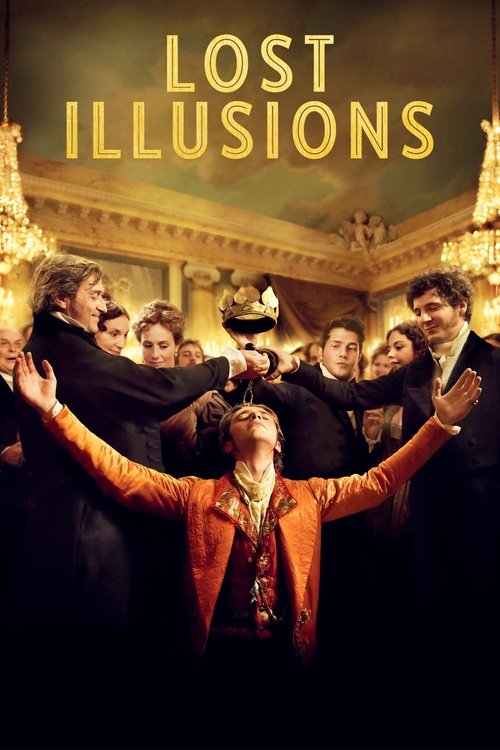
Lost Illusions (2021)
Directed by Xavier Giannoli
No — Lost Illusions is not woke, scoring 16 out of 100 on our wokeness meter.
Xavier Giannoli's adaptation of Balzac arrives draped in the respectable robes of a period literary drama, and for long stretches it earns them.
Consciousness Markers
The core of the story is the corruption of art and journalism by money, bribery, and cronyism — a genuine indictment of commercialized culture and the wealthy patrons who buy influence. It is a period critique rather than a modern 'eat the rich' polemic, but the theme is central.
The film's themes of 'fake news' and media manipulation resonate with modern concerns, but they are dramatized through character and plot rather than delivered as direct moral instruction.
The cast is overwhelmingly white French performers, with only a minor supporting role (Saïd Amadis as Matifat) providing any diversity. This is a faithful period adaptation rather than a conscious representation effort.
Several substantial female characters (Anaïs de Bargeton, Coralie, the Marquise d'Espard) drive plot turns, but the film remains a male-protagonist narrative about ambition and corruption without a feminist thesis.
No LGBTQ+ characters, themes, or subtext appear in this Balzac adaptation.
The film engages no racial themes or commentary; its social critique is entirely about class and money in 1820s France.
No environmental or climate content whatsoever.
No body-positivity themes or messaging present.
No neurodivergence themes or characters.
A faithful adaptation of an 1837–43 Balzac novel set in its own era; it does not revise or reinterpret history for modern ideological purposes.
Why it received this score
Xavier Giannoli's adaptation of Balzac arrives draped in the respectable robes of a period literary drama, and for long stretches it earns them. Lucien de Rubempré, a provincial poet with more ambition than income, travels to Paris and discovers that the republic of letters is a marketplace where reviews are bought and reputations are rented. The film's true subject is money: the bribery, the cronyism, the patrons who purchase a young man's talent and his silence along with it. That indictment of commercialized culture runs through every scene, though it is an 1820s indictment, aimed at the press barons of the Restoration, not at any living billionaire. The rich are devoured, but only in period costume.
Viewed through the lens of contemporary social consciousness, the film is a near-total blank. Its cast is white and French, faithful to the source and to the demography of its setting, with a single supporting role offering any variation. Women occupy real space in the narrative, Anaïs and Coralie and the Marquise d'Espard all steer events, yet the camera stays fixed on a young man's ruin, and no thesis about gender emerges from it. Race goes unmentioned. So do the climate, the body, the mind's wiring, and any variation in desire. Balzac did not write those concerns into the 1830s, and Giannoli has not written them in either.
There remains the faint hum of topicality. The film's portrait of a news cycle that manufactures opinion for cash lands with a modern thud, and a viewer may hear the echo. But the echo is dramatized through character and consequence, never announced from a pulpit. It lectures by showing, which is the least objectionable way to lecture. The result is a handsome, rigorous, and ideologically quiet film, which trusts its audience to draw the parallel without assistance. In an era of instruction, that restraint is almost exotic.
Analysis generated by our Consciousness Algorithm


Synopsis
Lucien de Rubempré, a young, lower-class poet, leaves his family's printing house for Paris. Soon, he learns the dark side of the arts business as he tries to stay true to his dreams.
Questions about Lost Illusions
Is Lost Illusions woke?
No — Lost Illusions is not woke, scoring 16 out of 100 on our wokeness meter. That earns it a verdict of Ultra Based.
Does Lost Illusions have any woke elements?
1 of the 10 markers register at 30 or above, led by Eat the Rich (45). On Eat the Rich: The core of the story is the corruption of art and journalism by money, bribery, and cronyism — a genuine indictment of commercialized culture and the wealthy patrons who buy influence.
How does Lost Illusions compare to other 2021 movies?
It ranks #127 of the 242 films from 2021 we've scored; their average is 23. The wokest is The Forever Purge (83).
How is the Woke Score calculated?
An AI-assisted process researches the film and its reception, scores it 0–100 on ten markers, then combines those into one 0–100 Woke Score. It measures a specific set of 2020s cultural themes, not film quality.