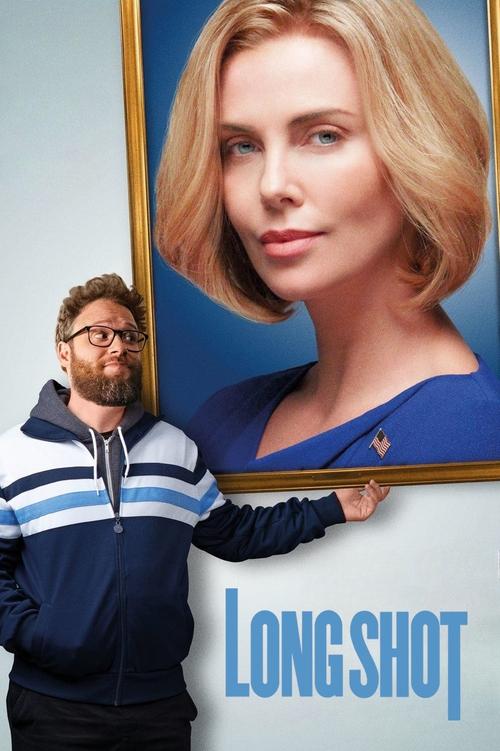
Long Shot (2019)
Directed by Jonathan Levine
No — Long Shot is not especially woke, scoring 37 out of 100 on our wokeness meter.
A romantic comedy in which the Secretary of State falls for a scruffy Brooklyn journalist, which is a premise that has been with us since roughly the invention of the motion picture.
Consciousness Markers
Charlotte Field is a powerful Secretary of State who becomes the first female president, and the film repeatedly frames her ambition against the condescension of male advisers, though it remains a conventional rom-com in which her arc is resolved through romance.
The cast includes O'Shea Jackson Jr. and Ravi Patel in supporting roles, and the film features a Black best friend and an Indian-American campaign staffer, though their presence is largely incidental rather than a stated representational project.
The Lance subplot explicitly stages a racial reckoning, with Fred's assumption that a Black man cannot be Republican or Christian called out as racist, and the film uses it to lecture Fred about his rigid principles.
Environmental conservation is a genuine plot engine: Charlotte's signature initiative is a global tree-preservation plan, and the villain's scheme hinges on blocking it, though the film treats it as political backdrop rather than a climate crusade.
Parker Wembley is a corrupt billionaire media mogul whose Republican politics and business interests drive the film's antagonism, and Fred quits his job in protest of the paper's acquisition by him, giving the film a mild eat-the-rich streak.
The film periodically pauses for moral instruction, as when Fred shames Charlotte into delivering her unvarnished environmental speech and later lectures her about principles, but the messaging is subordinate to the comedy.
There are no LGBTQ+ characters, relationships, or themes anywhere in the film.
The film contains no body-positivity themes or messaging; physical comedy about Fred's appearance is played for laughs rather than affirmation.
No characters are depicted with neurodivergent traits or conditions, and the topic is never raised.
The film is a fictional contemporary political comedy with no historical revisionism.
Why it received this score
A romantic comedy in which the Secretary of State falls for a scruffy Brooklyn journalist, which is a premise that has been with us since roughly the invention of the motion picture. Jonathan Levine directs with affection for the 1980s template, and the picture does what it sets out to do. The question before us is not whether it works but what it carries inside it.
Charlotte Field is a woman of enormous authority who is condescended to by male advisers, who outmaneuvers a sitting president, and who is ultimately sworn in as the first female president. This is not nothing. Yet the arc resolves in a marriage and a change of surname, so the empowerment arrives wrapped in the oldest packaging available. Environmental conservation does real narrative work here: a global tree-preservation initiative is the spine of the political plot and the reason a media mogul turns villain. The mogul himself, played by Andy Serkis with a haircut that constitutes its own act of aggression, supplies a mild eat-the-rich streak, though the film is more interested in his corruption than in his class position. Fred quits a job on principle. That is as far as the indictment goes.
The supporting cast includes a Black best friend and an Indian-American campaign staffer, present and largely unremarked upon. A subplot in which that best friend reveals himself to be both Republican and Christian produces the film's most self-conscious moment, a lecture about rigid principles delivered to our hero, who has just said something genuinely racist about it. It is a scene that wants credit for the lesson it teaches. Elsewhere the film pauses for moral instruction when Fred shames Charlotte into delivering her honest environmental speech. The messaging sits beneath the jokes, surfacing when convenient, retreating when the next gag arrives. It is a pleasant film with an occasional conscience, which is a category we have catalogued many times before.
Analysis generated by our Consciousness Algorithm
Part of


Synopsis
Journalist Fred Flarsky reunites with his childhood crush, Charlotte Field, now one of the most influential women in the world. As she prepares to make a run for the Presidency, Charlotte hires Fred as her speechwriter — much to the dismay of her trusted advisers.
Questions about Long Shot
Is Long Shot woke?
No — Long Shot is not especially woke, scoring 37 out of 100 on our wokeness meter. That earns it a verdict of Based.
Does Long Shot have any woke elements?
6 of the 10 markers register at 30 or above, led by Feminist Agenda (50), Racial Consciousness (40) and Representation Casting (40). On Feminist Agenda: Charlotte Field is a powerful Secretary of State who becomes the first female president, and the film repeatedly frames her ambition against the condescension of male advisers, though it remains a conventional rom-com in which her arc is resolved through romance.
How does Long Shot compare to other 2019 movies?
It ranks #57 of the 284 films from 2019 we've scored; their average is 22. The wokest is Black Christmas (79).
How is the Woke Score calculated?
An AI-assisted process researches the film and its reception, scores it 0–100 on ten markers, then combines those into one 0–100 Woke Score. It measures a specific set of 2020s cultural themes, not film quality.