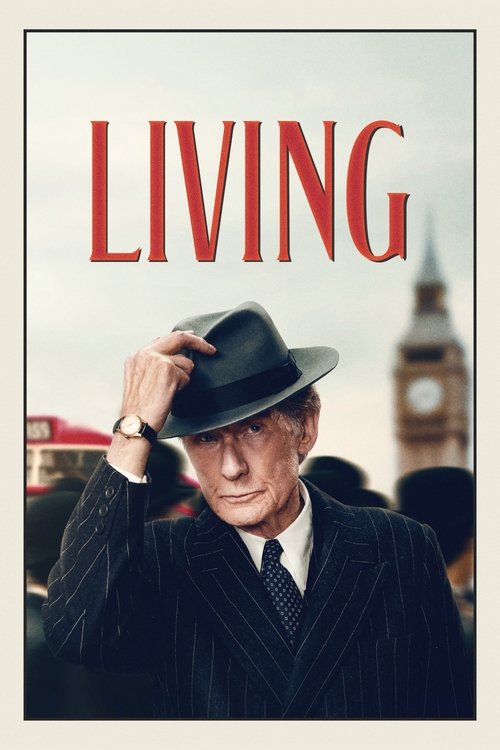
Living (2022)
Directed by Oliver Hermanus
No — Living is not woke, scoring 6 out of 100 on our wokeness meter.
Living arrives as a 2022 British period drama, an English-language remake of Kurosawa's Ikiru, and it conducts itself with the quiet decorum of a man who has ironed his own handkerchief.
Consciousness Markers
The film carries a gentle moral about doing good before you die, but it is deliberately understated and subdued rather than preachy or didactic.
A group of women led by Mrs. Smith petitions the council for a playground, and Miss Harris serves as a youthful foil, but these are natural story elements rather than a feminist thesis.
The cast is a uniformly white British ensemble (Nighy, Wood, Sharp, Burke) with no diverse casting choices made or commented upon.
No LGBTQ+ characters, themes, or subtext appear anywhere in the film.
The film engages no racial themes whatsoever; 1953 London is depicted as monolithically white without comment.
No environmental or climate concerns feature in the narrative.
The film critiques bureaucratic inertia and municipal paralysis, not capitalism or wealth inequality; no eat-the-rich sentiment.
No body positivity themes; the protagonist's terminal illness is treated as existential tragedy, not a body-image discourse.
No neurodivergent characters or themes are present.
A straightforward period drama set in 1953 London, presenting the era without historical revision or reframing.
Why it received this score
Living arrives as a 2022 British period drama, an English-language remake of Kurosawa's Ikiru, and it conducts itself with the quiet decorum of a man who has ironed his own handkerchief. Bill Nighy plays Mr. Williams, a London County Council bureaucrat in 1953 who learns he is dying and spends his remaining months attempting to matter. The film is patient, gray, and scrupulously well-mannered. It is also, from the standpoint of contemporary social consciousness, remarkably bare. The cast is uniformly white and no effort is made to pretend otherwise. Race goes unmentioned. Queerness goes unmentioned. The environment goes unmentioned, which is a small miracle given that the council spends its days approving construction. No character pauses to interrogate the moral status of capital. No one discusses a body with anything resembling affirmation.
The progressive content here is faint but detectable. A delegation of women, led by Mrs. Smith, petitions the council for a children's playground on a bomb site, and their request is batted from department to department until it dies in a pile of paper. Miss Harris, a young former subordinate, supplies the film's youthful pulse and its mild suggestion that women see the world more clearly than the men who outrank them. These are story elements, not a thesis. The film observes the women with sympathy and then returns to the men, who have paperwork.
If the film lectures at all, it does so in a whisper. Its moral, that we should do some good before the light goes out, is delivered through a playground and a snow-covered swing, never a monologue. The result is a dignified, melancholy piece of filmmaking with almost no interest in the cultural arguments of its own moment. On the sommelier's scale of social consciousness, this is a very dry vintage. It tastes of 1953, and it knows it. There is nothing to decant here but grief and good tailoring, and the film serves both without apology. A restrained pour. No notes worth filing under ideology, though the filing cabinet is beautifully shot.
{"thematic_tags": ["remake"]}
Analysis generated by our Consciousness Algorithm


Synopsis
London, 1953. Mr. Williams, a veteran civil servant, is an important cog within the city's bureaucracy as it struggles to rebuild in the aftermath of World War II. Buried under paperwork at the office and lonely at home, his life has long felt empty and meaningless. Then a devastating medical diagnosis forces him to take stock, and to try and grasp some fulfilment before it passes permanently beyond reach.
Questions about Living
Is Living woke?
No — Living is not woke, scoring 6 out of 100 on our wokeness meter. That earns it a verdict of Ultra Based.
Does Living have any woke elements?
Very few. None of the 10 markers reaches 30, the level where a marker counts as present; the highest is Lecture Energy at 10.
How does Living compare to other 2022 movies?
It ranks #190 of the 223 films from 2022 we've scored; their average is 22. The wokest is Bros (92).
How is the Woke Score calculated?
An AI-assisted process researches the film and its reception, scores it 0–100 on ten markers, then combines those into one 0–100 Woke Score. It measures a specific set of 2020s cultural themes, not film quality.