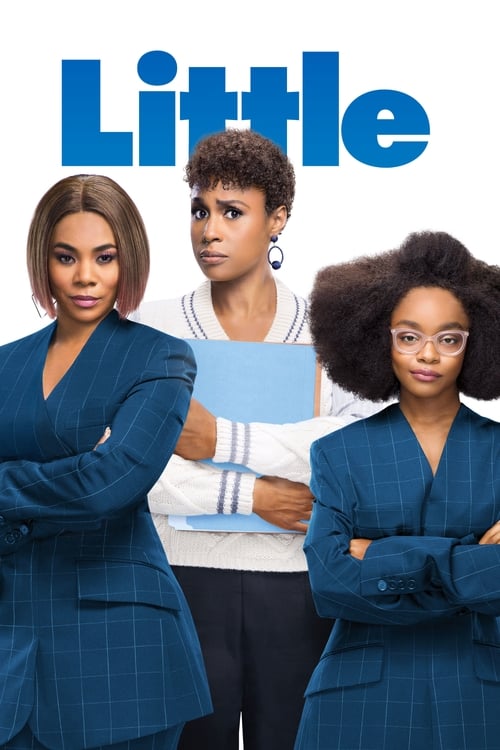
Little (2019)
Directed by Tina Gordon
Partly — Little is somewhat woke, scoring 57 out of 100 on our wokeness meter.
Little arrives as a body-swap comedy in the old Hollywood tradition, borrowing the architecture of Big and dressing it in the specific textures of 2019 studio product.
Consciousness Markers
A studio comedy headlined by a predominantly Black cast — Regina Hall, Issa Rae, and Marsai Martin — with Black talent in front of and behind the camera, a notable representation milestone for a mainstream Universal release.
A woman-directed, woman-written film centered on a female tech mogul and her female assistant, with a 'women supporting women' arc and a promotion earned on merit; feminist-adjacent but not doctrinaire.
The film sits within Black cinema with a Black cultural texture (the weave-pulling gag, the pep rally), but the plot is a body-swap comedy that never engages race as a theme.
The film carries gentle life lessons about kindness, friendship, and treating employees well, delivered lightly rather than as a sermon.
The boss-vs-employee cruelty is a setup for a personal redemption arc, not a critique of capitalism; the film ultimately celebrates business success and client wins.
Appearance-based bullying at school is depicted, but the film does not advance a body-positivity message.
No LGBTQ+ characters or themes appear in the narrative.
No environmental or climate themes are present.
No neurodivergent characters or themes are present.
No historical events or figures are revised or reinterpreted.
Why it received this score
Little arrives as a body-swap comedy in the old Hollywood tradition, borrowing the architecture of Big and dressing it in the specific textures of 2019 studio product. Regina Hall plays Jordan Sanders, a tech mogul who terrorizes her employees until a child with a toy wand wishes her back to thirteen. Marsai Martin inherits the role, and at fourteen she also carries an executive producer credit, the youngest person to hold that title on a major production. The film is headlined by a predominantly Black cast, with Black talent in front of and behind the camera, and Universal gave it a wide release. That fact alone registers as a milestone, though the film itself rarely pauses to admire it.
The gender politics are present but mild. A woman directs, women wrote it, and the central relationship between Jordan and her assistant April, played by Issa Rae, resolves into an arc of mutual support and earned promotion. April's idea wins the client on its merits. The cultural texture is unmistakably Black cinema, from the pep rally to the weave-pulling gag at the restaurant, yet race never becomes the subject. The plot has other business. Nor does the screenplay aim its fire at the corporate order it depicts. The cruelty of the boss is a character flaw to be cured, not a system to be dismantled. Business success, client wins, and the celebratory office party all arrive intact.
There are lessons, delivered softly. Be kind to the people who work for you. Value the friends who tolerate your worst behavior. The bullying subplot gestures at appearance-based cruelty without building a thesis around it. The result is a gentle, uneven comedy that the ReFrame Stamp recognized for its gender-balanced production, and which critics found agreeable but slight. It wants to be liked. It mostly is. The classification here is one of modest social consciousness, warmly intended, lightly applied, and never willing to raise its voice.
Analysis generated by our Consciousness Algorithm
Part of


Synopsis
Jordan Sanders, a take-no-prisoners tech mogul, wakes up one morning in the body of her 13-year-old self right before a do-or-die presentation. Her beleaguered assistant April is the only one in on the secret that her daily tormentor is now trapped in an awkward tween body, just as everything is on the line.
Questions about Little
Is Little woke?
Partly — Little is somewhat woke, scoring 57 out of 100 on our wokeness meter. That earns it a verdict of Woke-Adjacent.
What makes Little woke?
3 of the 10 markers register at 30 or above, led by Representation Casting (78), Feminist Agenda (50) and Racial Consciousness (35). On Representation Casting: A studio comedy headlined by a predominantly Black cast — Regina Hall, Issa Rae, and Marsai Martin — with Black talent in front of and behind the camera, a notable representation milestone for a mainstream Universal release.
How does Little compare to other 2019 movies?
It ranks #25 of the 284 films from 2019 we've scored; their average is 22. The wokest is Black Christmas (79).
How is the Woke Score calculated?
An AI-assisted process researches the film and its reception, scores it 0–100 on ten markers, then combines those into one 0–100 Woke Score. It measures a specific set of 2020s cultural themes, not film quality.