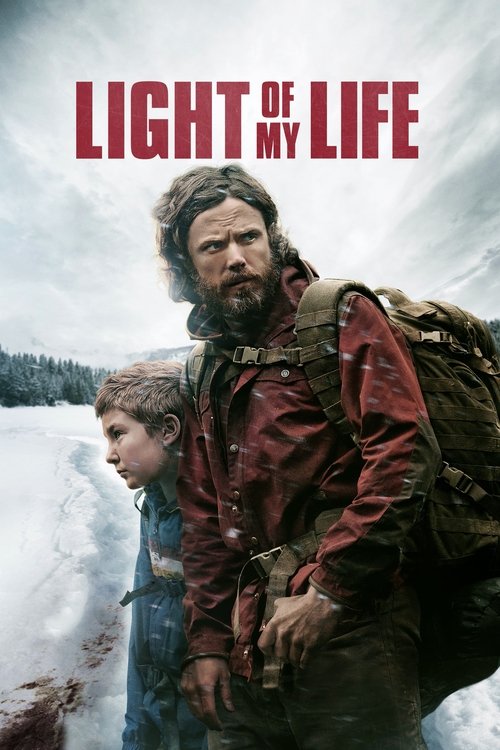
Light of My Life (2019)
Directed by Casey Affleck
No — Light of My Life is not especially woke, scoring 20 out of 100 on our wokeness meter.
Casey Affleck's Light of My Life arrives with a premise that does a great deal of work before a single line is spoken.
Consciousness Markers
The central conflict is driven by the threat of patriarchal violence (male bandits) against the last remaining females, framing the female existence as a vulnerable subject of societal collapse.
The film centers on a rare female character in a world where her gender is a critical plot point, providing a specific, if grim, form of representation.
The setting is post-apocalyptic due to a pandemic, but the focus remains on gender scarcity rather than environmental degradation.
The film operates as a survival drama, prioritizing action and atmosphere over didactic social commentary.
There is no discernible presence of LGBTQ+ themes or characters within the narrative summary.
The narrative focuses on gender and survival within a post-apocalyptic setting, with no specific focus on racial dynamics or injustice.
The conflict is rooted in survival against predatory individuals, not a critique of systemic economic structures or corporate power.
The film does not engage with or comment upon body image or body positivity.
There is no evidence of neurodivergent characters or themes in the provided summary.
The story takes place in a fictional, post-apocalyptic future, not a reinterpretation of a known historical event.
Why it received this score
Casey Affleck's Light of My Life arrives with a premise that does a great deal of work before a single line is spoken. A plague has removed most of the world's women, and a father, played by Affleck, keeps his daughter alive by dressing her as a boy. The scarcity is the engine. Every man they meet is a potential predator, and the film treats that arithmetic as a law of nature, not an argument to be won. It is a grim ledger, and the film keeps its pencil sharp.
The social consciousness here sits in the architecture, not the dialogue. The apocalypse is gendered: a pandemic strips away women, and what remains is a landscape of male violence organized around possession of the last few. That is a thesis about patriarchal order, delivered through genre mechanics instead of speeches. Anna Pniowsky's Rag is a rare thing in this kind of story, a young female character whose survival drives the plot and whose gender is the plot, not a decoration. The camera stays close to her, and to her father's fear. Nobody pauses to explain the theme. The film trusts the chiller to do the talking.
The environmental note is faint. This is a viral ruin, not a warming one, and the collapse is biological. The film prefers atmosphere to instruction, and it rarely raises its voice to make a point. The result is a slow, somber exercise that earns its dread honestly. It has a position. It simply declines to announce it, which in this climate is almost a courtesy.
Analysis generated by our Consciousness Algorithm


Synopsis
Years after a pandemic wipes out most of the female population, a father struggles to shield his daughter from a dangerous and predatory world.
Questions about Light of My Life
Is Light of My Life woke?
No — Light of My Life is not especially woke, scoring 20 out of 100 on our wokeness meter. That earns it a verdict of Based.
Does Light of My Life have any woke elements?
2 of the 10 markers register at 30 or above, led by Feminist Agenda (65) and Representation Casting (40). On Feminist Agenda: The central conflict is driven by the threat of patriarchal violence (male bandits) against the last remaining females, framing the female existence as a vulnerable subject of societal collapse.
How does Light of My Life compare to other 2019 movies?
It ranks #113 of the 284 films from 2019 we've scored; their average is 22. The wokest is Black Christmas (79).
How is the Woke Score calculated?
An AI-assisted process researches the film and its reception, scores it 0–100 on ten markers, then combines those into one 0–100 Woke Score. It measures a specific set of 2020s cultural themes, not film quality.