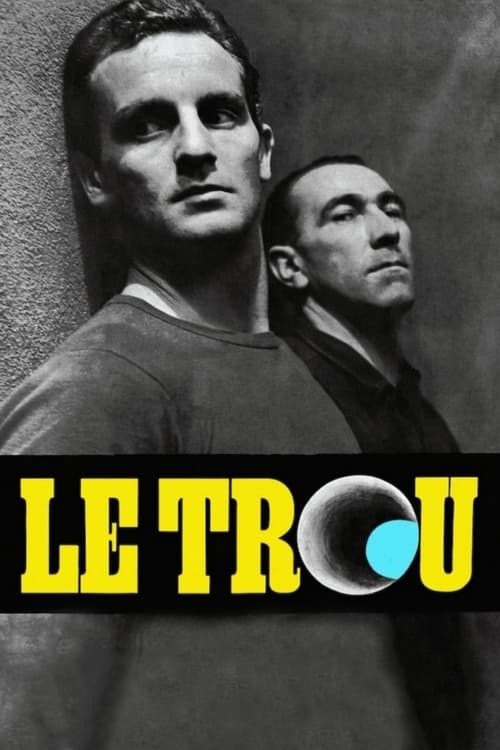
Le Trou (1960)
Directed by Jacques Becker
No — Le Trou is not woke, scoring 0 out of 100 on our wokeness meter.
Jacques Becker's Le Trou arrives from 1960 with no opening credits, no musical score until the final moments, and no interest whatsoever in telling us how to feel.
Consciousness Markers
The cast is entirely white French men, with non-professional actors chosen for authenticity rather than any diversity mandate. No representation-conscious casting is present.
The film contains no LGBTQ+ characters or themes whatsoever; the relationships are strictly those of male prison comrades.
Women appear only marginally (Gaspard's wife and sister-in-law) as plot devices; there is no feminist critique or agenda.
Race is entirely absent as a subject; the film concerns French inmates with no engagement with racial identity or politics.
No environmental or climate themes appear in this 1960 prison-escape procedural.
The film is a taut procedural about escape, not a critique of wealth, class, or capitalism.
No body-positivity themes; the prisoners' bodies are depicted only in the context of physical labor and vulnerability.
No neurodivergent characters or themes are present or explored.
While based on a true 1947 escape, the film makes no revisionist historical argument; it dramatizes the event faithfully without reinterpreting history through a modern ideological lens.
The film is famously spare and observational, with no musical score, no opening credits, and no didactic messaging or moral lecturing.
Why it received this score
Jacques Becker's Le Trou arrives from 1960 with no opening credits, no musical score until the final moments, and no interest whatsoever in telling us how to feel. Five men in La Sante Prison dig through a concrete floor with a bed frame. That is the film. The camera watches. The men work. A periscope is fashioned from a toothbrush, an hourglass from two stolen bottles, and we are asked to sit with the sound of scraping metal for four uninterrupted minutes. It is the least preachy prison picture ever assembled, largely because it declines to assemble a point.
For those of us who catalog the cultural temperature of a film, this one offers a barren field. The cast is entirely white French men, several of them actual participants in the 1947 escape, hired for authenticity instead of any representational calculus. Women drift through the margins as wives and sisters-in-law, present only to complicate a plot. Race, sexuality, class grievance, environmental anxiety, the politics of the body: none of it registers. The film holds no thesis about how we ought to live. It has a hole, and it has men who want to get through it.
What remains is loyalty and its failure. Gaspard, the newcomer, may or may not have informed on his cellmates, and Becker refuses to resolve the question. The final image leaves him alone in a fresh cell, dressed, unpunished, and thoroughly unreadable. A lesser film would sermonize here about the carceral state. This one simply closes the door. A thriller with no message reads, in the current climate, as either a museum piece or a provocation, depending on the viewer's appetite for silence.
Analysis generated by our Consciousness Algorithm

Synopsis
Four prison inmates have been hatching a plan to literally dig out of jail when another prisoner, Claude Gaspard, is moved into their cell. They take a risk and share their plan with the newcomer. Over the course of three days, the prisoners and friends break through the concrete floor using a bed post and begin to make their way through the sewer system – yet their escape is anything but assured.
Questions about Le Trou
Is Le Trou woke?
No — Le Trou is not woke, scoring 0 out of 100 on our wokeness meter. That earns it a verdict of Ultra Based.
Does Le Trou have any woke elements?
No. All 10 markers score zero.
How does Le Trou compare to other 1960 movies?
It ranks #12 of the 17 films from 1960 we've scored; their average is 7. The wokest is Rocco and His Brothers (29).
How is the Woke Score calculated?
An AI-assisted process researches the film and its reception, scores it 0–100 on ten markers, then combines those into one 0–100 Woke Score. It measures a specific set of 2020s cultural themes, not film quality.