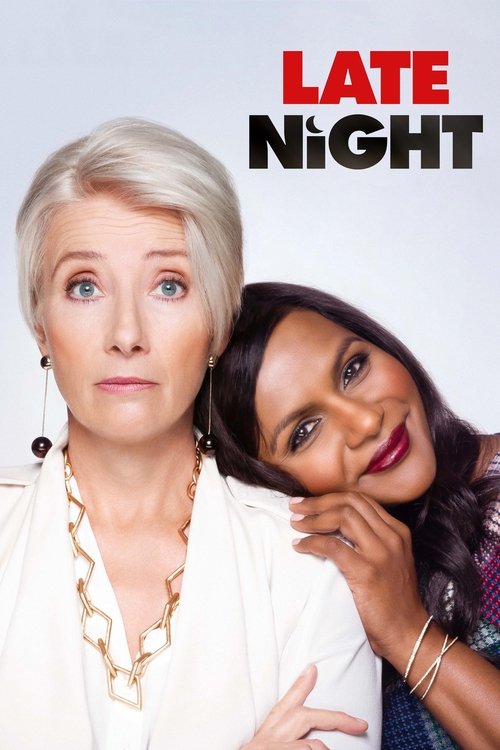
Late Night (2019)
Directed by Nisha Ganatra
Yes — Late Night is woke, scoring 68 out of 100 on our wokeness meter.
Late Night opens with a crisis of relevance and solves it with a hiring decision.
Consciousness Markers
The entire premise is a diversity hire: Molly Patel is brought on explicitly as the show's 'only female staff writer' to 'smooth over diversity concerns,' and the film ends with the writers' room visibly diversified. Representation is the plot engine, not background texture.
Centered on a woman fighting for relevance in a male-dominated comedy institution, the token female writer, the sexist writers' room, and the misogynistic replacement comic. Gender equity in the workplace is a core thesis.
Molly's Indian-American identity and her status as a 'diversity hire' are foregrounded, and a reporter publicly accuses Katherine of hiring only elite WASPs. Race and workplace inclusion are directly dramatized.
The film carries explicit social commentary about diversity and representation, but critics noted it argues 'by example' rather than by preaching, keeping the sermonizing moderate.
There is mild critique of network management, ratings-chasing, and corporate media priorities, but no sustained anti-capitalist argument.
Katherine's husband Walter has Parkinson's disease and hides his tremor from others; the film treats the condition with sensitivity, though Parkinson's is a neurodegenerative illness rather than the modern 'neurodivergence' framing.
No LGBTQ+ characters, relationships, or themes appear in the narrative.
No environmental or climate themes are present.
No body-positivity themes or body-image commentary appear.
The film is a contemporary fictional workplace comedy with no historical revisionism.
Why it received this score
Late Night opens with a crisis of relevance and solves it with a hiring decision. Emma Thompson plays Katherine Newbury, a British host of a long-running American talk show whose ratings have sagged and whose job is in peril. Her producer is instructed to find a woman. What he finds is Molly Patel, a chemical plant employee and amateur comic, installed on a thirteen-week trial because the show has no female writers and the optics are poor. This is the engine of the picture. Representation is not background texture here; it is the plot, the conflict, and the resolution. The writers' room ends the film visibly remade, and we are meant to notice.
The gender material is equally load-bearing. Katherine has spent decades as the lone woman in a boys' club of her own construction, and the film takes a dim view of the men around her, especially the younger comic groomed to replace her, whose vulgarity and misogyny are presented without ambiguity. Race receives similar attention. Molly's Indian-American identity is foregrounded from her first scene, and a reporter publicly accuses Katherine of staffing the show exclusively with elite WASPs. Corporate management gets a mild drubbing, mostly for chasing ratings over craft, though the film stops well short of any sustained argument about capital.
The omissions are nearly as telling as the inclusions. There is no LGBTQ material, nothing about climate, and no engagement with body image. Katherine's husband has Parkinson's disease, handled with genuine tenderness, but a neurodegenerative illness is not the same thing as the contemporary neurodivergence framework, and the film does not pretend otherwise. The commentary arrives by example, as several critics observed, which keeps the sermonizing at a moderate register. It is a competent comedy of manners with a thesis, and it states the thesis plainly. Whether that amounts to an argument or merely a premise is a question the film never asks.
Analysis generated by our Consciousness Algorithm

Synopsis
A legendary late-night talk show host's world is turned upside down when she hires her only female staff writer. Originally intended to smooth over diversity concerns, her decision has unexpectedly hilarious consequences as the two women separated by culture and generation are united by their love of a biting punchline.
Questions about Late Night
Is Late Night woke?
Yes — Late Night is woke, scoring 68 out of 100 on our wokeness meter. That earns it a verdict of Woke.
What makes Late Night woke?
4 of the 10 markers register at 30 or above, led by Representation Casting (85), Feminist Agenda (80) and Racial Consciousness (75). On Representation Casting: The entire premise is a diversity hire: Molly Patel is brought on explicitly as the show's 'only female staff writer' to 'smooth over diversity concerns,' and the film ends with the writers' room visibly diversified.
How does Late Night compare to other 2019 movies?
It ranks #6 of the 284 films from 2019 we've scored; their average is 22. The wokest is Black Christmas (79).
How is the Woke Score calculated?
An AI-assisted process researches the film and its reception, scores it 0–100 on ten markers, then combines those into one 0–100 Woke Score. It measures a specific set of 2020s cultural themes, not film quality.