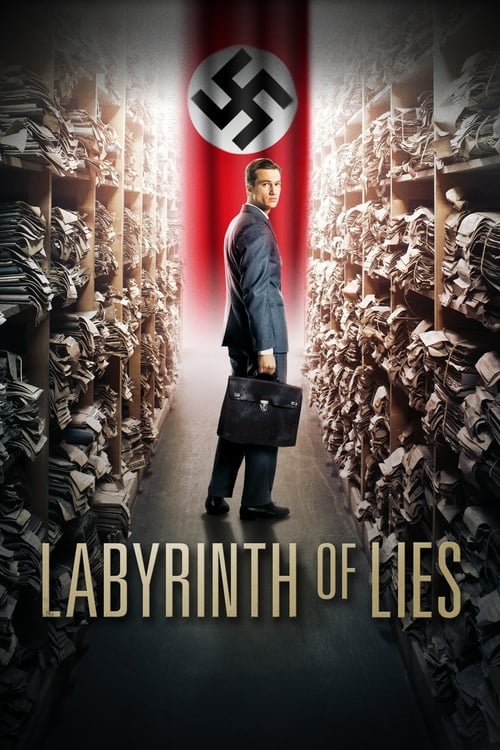
Labyrinth of Lies (2014)
Directed by Giulio Ricciarelli
No — Labyrinth of Lies is not woke, scoring 0 out of 100 on our wokeness meter.
Labyrinth of Lies travels from 2014 back to 1958 Frankfurt, where a young prosecutor named Johann Radmann trips over an inconvenience the young republic would prefer stayed buried: former Auschwitz personnel now teaching school and staffing the judiciary.
Consciousness Markers
The cast is composed of German actors in a historically grounded postwar German setting; there is no modern diversity-casting agenda.
The film contains no LGBTQ+ themes or characters.
Marlene has a supporting role, but the film is not structured around feminist themes or gender politics.
The film addresses Nazi crimes and Holocaust memory, but not modern racial-consciousness framing.
There is no climate or environmental theme.
The film critiques institutional complicity and postwar careerism, not capitalism or wealth as such.
There is no body-positivity theme or related messaging.
There is no neurodivergence theme or representation.
The film is a historical drama based on real events, not a revisionist reframing of history in the modern woke sense.
Its moral seriousness is historical and dramatic rather than modern preachy lecture energy.
Why it received this score
Labyrinth of Lies travels from 2014 back to 1958 Frankfurt, where a young prosecutor named Johann Radmann trips over an inconvenience the young republic would prefer stayed buried: former Auschwitz personnel now teaching school and staffing the judiciary. The film proceeds with the patience of a filing cabinet. The cast is German, the rooms are gray, the period details are correct. At no point does anyone halt the story to explain modern social theory to the audience, which in this century of cinema that treats viewers as slow students counts as an unexpected kindness. It is a history lesson, yes. But it is the old kind, taught through evidence.
Marlene, a seamstress who becomes a dress designer on the back of Radmann's connections, is the film's one substantial female character, and the film makes no case for her beyond what the plot requires. Their romance curdles when he reveals her father's party membership. That is the film's real subject: the compromises ordinary people made and then declined to remember. No sermon arrives to sort the characters into heroes and villains. Radmann's own father was in the party, and this discovery does not produce a speech. It produces silence, and a man walking away from a job.
The moral seriousness on display is historical and dramatic. The film indicts institutional complicity, careerism, and the bureaucratic habit of protecting monsters because they sign the right forms. That is an argument about cowardice, not about markets or identity or the climate. Its final scene, the opening of the Auschwitz trial, earns its weight through accumulated detail. Nothing is explained twice. The whole enterprise is grave, well behaved, and entirely unconcerned with instructing its audience how to live. A sommelier would call it austere. We call it a film that knows what it is about.
Classification: temperate. No additives detected.
Thematic tags: true_story. The film is based on real events, specifically the Frankfurt Auschwitz trials and the work of Fritz Bauer. No entries appear for musical sequel, remake, superhero, or box office coronation, and the Academy shortlist, while respectable, is not an Oscar.
Body count of social instruction: none. The film concerns itself with the dead, the guilty, and the paperwork between them. It leaves our own era mercifully out of it.
Analysis generated by our Consciousness Algorithm
Part of


Synopsis
A young prosecutor in postwar West Germany investigates a massive conspiracy to cover up the Nazi pasts of prominent public figures.
Questions about Labyrinth of Lies
Is Labyrinth of Lies woke?
No — Labyrinth of Lies is not woke, scoring 0 out of 100 on our wokeness meter. That earns it a verdict of Ultra Based.
Does Labyrinth of Lies have any woke elements?
No. All 10 markers score zero.
How does Labyrinth of Lies compare to other 2014 movies?
It ranks #271 of the 303 films from 2014 we've scored; their average is 13. The wokest is Selma (68).
How is the Woke Score calculated?
An AI-assisted process researches the film and its reception, scores it 0–100 on ten markers, then combines those into one 0–100 Woke Score. It measures a specific set of 2020s cultural themes, not film quality.