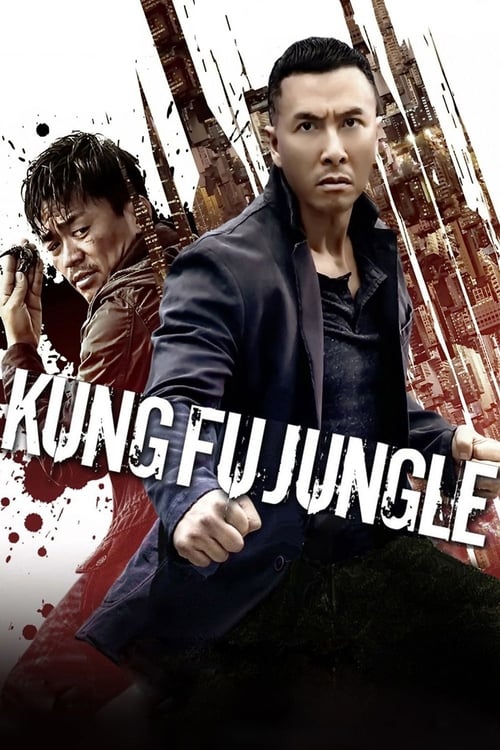
Kung Fu Jungle (2014)
Directed by Teddy Chen
No — Kung Fu Jungle is not woke, scoring 3 out of 100 on our wokeness meter.
Teddy Chan's Kung Fu Jungle arrives from 2014 with no ambitions beyond the arrangement of limbs in violent congress.
Consciousness Markers
Charlie Yeung's Inspector Luk is a competent female authority figure driving the investigation, but the film never frames this as a statement about gender.
The cast is entirely Hong Kong and mainland Chinese performers, which is the natural default for a Hong Kong-produced martial arts film rather than a deliberate diversity statement.
No LGBTQ+ characters, themes, or subtext appear anywhere in the film.
Race is not a subject of the film; the story is a straightforward serial-killer manhunt within a homogeneous cultural setting.
No environmental themes or climate concerns are present.
The film has no economic critique; its antagonist is motivated by personal obsession with martial mastery, not class or capital.
Bodies are presented purely as instruments of combat prowess, with no body-positivity framing.
The killer's obsession is treated as villainous pathology, not as neurodivergent identity or advocacy.
The film is a contemporary fictional thriller with no historical subject matter to revise.
The film is a propulsive action thriller that delivers fight choreography rather than moral instruction.
Why it received this score
Teddy Chan's Kung Fu Jungle arrives from 2014 with no ambitions beyond the arrangement of limbs in violent congress. Donnie Yen plays Hahou Mo, a police self-defense instructor imprisoned for involuntary manslaughter, who bargains his freedom by offering to track a serial killer murdering the city's retired martial arts masters. Wang Baoqiang plays the killer with a mournful dedication the screenplay never troubles to interrogate. The result won the Hong Kong Film Award for Best Action Choreography, which tells you where the film's priorities live and how well it serves them.
The cultural inventory is sparse. The cast is entirely Hong Kong and mainland Chinese, which is the ordinary staffing of a Hong Kong co-production and not the product of any deliberate casting doctrine. Race never surfaces as a subject, since the story unfolds inside a homogeneous milieu and the manhunt is the only engine. The antagonist kills for private reasons: grief for a dead wife, an obsession with martial mastery. No economic grievance animates him, no environmental dread shadows the frame, and no institution stands indicted. Bodies exist here as instruments of combat, measured by what they can absorb and deliver, and the film extends no commentary on how we ought to regard them. The killer's fixation is presented as pathology, plain and unsympathetic, with no invitation to reframe it as identity.
One thread resists the general flatness. Charlie Yeung's Inspector Luk runs the investigation with competence and authority, and the film never once stops to applaud itself for the arrangement. That gesture, if it is a gesture, earns a modest credit. Elsewhere the film preaches nothing. It punches, pursues, and concludes on a highway with a gunshot and a reinstated hero. We are asked for our attention during the fights and nothing else. A clean ledger, and a rare pleasure.
Analysis generated by our Consciousness Algorithm


Synopsis
A martial arts instructor working at a police academy gets imprisoned after killing a man by accident. But when a vicious killer starts targeting martial arts masters, the instructor offers to help the police in return for his freedom.
Questions about Kung Fu Jungle
Is Kung Fu Jungle woke?
No — Kung Fu Jungle is not woke, scoring 3 out of 100 on our wokeness meter. That earns it a verdict of Ultra Based.
Does Kung Fu Jungle have any woke elements?
Very few. None of the 10 markers reaches 30, the level where a marker counts as present; the highest is Feminist Agenda at 10.
How does Kung Fu Jungle compare to other 2014 movies?
It ranks #256 of the 303 films from 2014 we've scored; their average is 13. The wokest is Selma (68).
How is the Woke Score calculated?
An AI-assisted process researches the film and its reception, scores it 0–100 on ten markers, then combines those into one 0–100 Woke Score. It measures a specific set of 2020s cultural themes, not film quality.