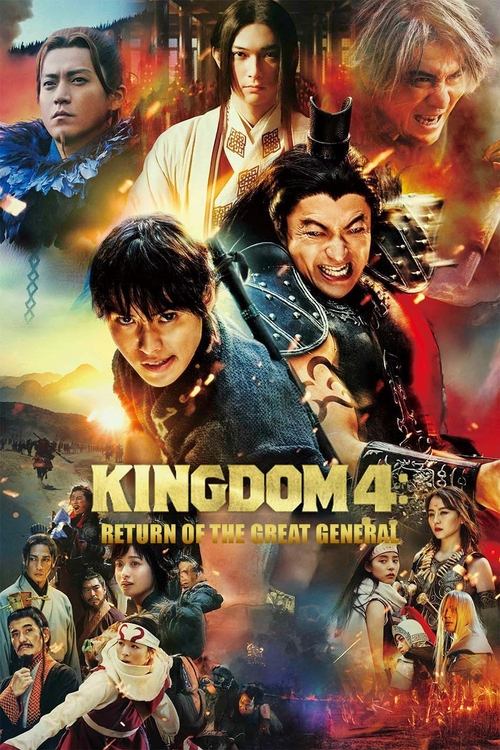
Kingdom: Return of the Great General (2024)
Directed by Shinsuke Sato
No — Kingdom: Return of the Great General is not woke, scoring 12 out of 100 on our wokeness meter.
Kingdom: Return of the Great General arrives as the fourth entry in Shinsuke Sato's adaptation of Yasuhisa Hara's manga, and it dispenses with preamble quickly.
Consciousness Markers
Features female warriors and strategists (Kyoukai, Ten, Yotanwa, Kyou) in a male-dominated war setting, but without explicit feminist messaging or agenda.
All-Japanese cast portraying ancient Chinese figures; no intentional diversity casting or representation of marginalized groups in a modern sense.
No LGBTQ+ characters, themes, or subtext.
No engagement with racial consciousness or racial justice themes.
No environmental or climate change themes.
No anti-capitalist or class-warfare messaging.
No body positivity themes or messaging.
No neurodivergence themes or representation.
Fictionalized adaptation of a manga set in the Warring States period; no progressive reinterpretation of historical events.
No modern social or political lecturing; the film is a straightforward war epic.
Why it received this score
Kingdom: Return of the Great General arrives as the fourth entry in Shinsuke Sato's adaptation of Yasuhisa Hara's manga, and it dispenses with preamble quickly. A recap, then a war. The Battle of Mayang grinds on, Shin's Hi-Shin Unit is mauled by a warrior who calls himself the War God, and General Ouki rides out to salvage a collapsing line. The cast is entirely Japanese, performing figures from ancient China with the serene confidence of an industry that has done this for decades. Nobody involved appears to have mistaken the exercise for a statement about anything. It is a war film about war.
The women of the piece do carry swords. Kyoukai fights Hoken to a standstill longer than any man manages. Ten serves as a strategist in the Qin command post, trading observations with the enemy's aide. Yotanwa arrives at the palace bearing grim intelligence. And General Kyou, one of Qin's Six Great Generals, is revealed in a quiet flashback to have been a woman, and Ouki's intended. That is a notable volume of female competence for a genre that rarely bothers. Yet the film never pauses to congratulate itself. Kyou's gender surfaces as a plot turn, not a sermon, and the women are permitted to be warriors first. The result is a mild current of progressive sensibility that never announces itself.
Elsewhere the ledger is bare. There is no climate anxiety, no indictment of capital, no discourse on bodies or brains, no racial reckoning, no revisionist reading of the Warring States period. The film's moral universe is older and simpler: loyalty, sacrifice, the debt a soldier owes the dead. When Ouki dies, he dies on horseback, handing down his glaive and a few plain instructions about learning war from war itself. No lesson is extracted for our benefit. It is a film that trusts its carnage to speak. We are left with the rare pleasure of a blockbuster that has nothing to teach us, and no apparent wish to try.
Analysis generated by our Consciousness Algorithm
Part of


Synopsis
Depicts a continuation of the "Battle of Mayang", an all-out war against the neighboring country Zhao that Shin and Wang Ki fought in in the previous work "Flame of Fate".
Questions about Kingdom: Return of the Great General
Is Kingdom: Return of the Great General woke?
No — Kingdom: Return of the Great General is not woke, scoring 12 out of 100 on our wokeness meter. That earns it a verdict of Ultra Based.
Does Kingdom: Return of the Great General have any woke elements?
Very few. None of the 10 markers reaches 30, the level where a marker counts as present; the highest is Feminist Agenda at 20.
How does Kingdom: Return of the Great General compare to other 2024 movies?
It ranks #120 of the 189 films from 2024 we've scored; their average is 22. The wokest is The Six Triple Eight (92).
How is the Woke Score calculated?
An AI-assisted process researches the film and its reception, scores it 0–100 on ten markers, then combines those into one 0–100 Woke Score. It measures a specific set of 2020s cultural themes, not film quality.