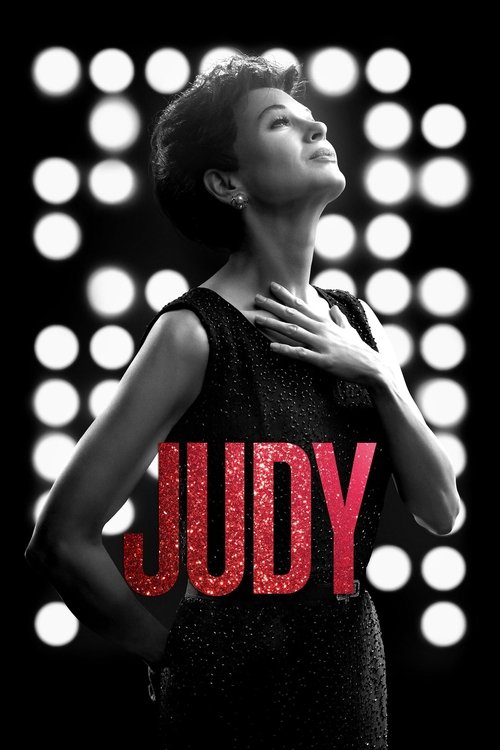
Judy (2019)
Directed by Rupert Goold
No — Judy is not especially woke, scoring 23 out of 100 on our wokeness meter.
Judy arrives on screen the way a difficult vintage arrives at the table: with a reputation, a price, and the faint promise of vinegar.
Consciousness Markers
The film devotes a warm, significant sequence to Judy's bond with two adoring gay fans at their flat, and the TMDB keywords flag a 'gay theme,' reflecting Garland's enduring status as a gay icon.
The narrative foregrounds the exploitation and bodily control of a female star by a patriarchal studio system, though it frames this as personal tragedy rather than explicit feminist argument.
The film critiques the MGM studio machine that drugged and overworked a child performer, but this reads as an indictment of personal cruelty rather than a systemic anti-capitalist thesis.
The studio's control over Judy's weight and appearance is depicted as abusive, offering a mild critique of body-shaming, but it is not framed through a body-positivity lens.
The film is a melancholy character drama that observes rather than preaches, with minimal direct moral instruction to the audience.
The cast is almost entirely white British and American performers, with no notable diverse or color-conscious casting choices in the ensemble.
No racial themes, commentary, or race-conscious narrative elements appear in the film.
There is no environmental or climate-related content whatsoever.
No neurodivergent characters or themes are present or explored.
The film is a conventional biographical dramatization of Garland's final year, not a revisionist reinterpretation of history for ideological ends.
Why it received this score
Judy arrives on screen the way a difficult vintage arrives at the table: with a reputation, a price, and the faint promise of vinegar. Rupert Goold's film follows Garland through her final London engagement, a run of sold-out nights at the Talk of the Town that curdles into missed cues, missed mornings, and a voice that will not hold. Renée Zellweger does the heavy lifting, and the film around her mostly stays out of the way. It is a melancholy thing, patient and sad, content to watch a woman run out of road.
The most generous passage in the picture belongs to two gay fans, Dan and Stan, who take Judy back to their flat after a show. She sings "Get Happy" at the piano, they trade stories about being hard to love, and for a few minutes the film stops keeping score. That sequence accounts for the modest social awareness on display here, and it is offered without a thesis attached. Elsewhere the film turns its attention to the MGM machine that fed a teenage girl amphetamines and denied her sleep. Louis B. Mayer looms as a predator who happens to own a studio. The indictment lands on a man, not on the arrangement that made him comfortable.
There is a case to be made about a female star whose body and weight were managed by committee, and the film makes it quietly, as tragedy instead of argument. It never lectures. It never organizes. It simply lets the damage accumulate and asks us to watch a legend sing through it. The result is a restrained, well-mannered piece of biography, more interested in a person than in a position. The orchestra plays, the lights come down, and the sermon never arrives.
Analysis generated by our Consciousness Algorithm


Synopsis
Thirty years after starring in 'The Wizard of Oz', beloved actress and singer Judy Garland arrives in London to perform sold-out shows at the Talk of the Town nightclub. While there, she reminisces with friends and fans and begins a whirlwind romance with musician Mickey Deans, her soon-to-be fifth husband.
Questions about Judy
Is Judy woke?
No — Judy is not especially woke, scoring 23 out of 100 on our wokeness meter. That earns it a verdict of Based.
Does Judy have any woke elements?
2 of the 10 markers register at 30 or above, led by LGBTQ+ Themes (45) and Feminist Agenda (32). On LGBTQ+ Themes: The film devotes a warm, significant sequence to Judy's bond with two adoring gay fans at their flat, and the TMDB keywords flag a 'gay theme,' reflecting Garland's enduring status as a gay icon.
How does Judy compare to other 2019 movies?
It ranks #95 of the 284 films from 2019 we've scored; their average is 22. The wokest is Black Christmas (79).
How is the Woke Score calculated?
An AI-assisted process researches the film and its reception, scores it 0–100 on ten markers, then combines those into one 0–100 Woke Score. It measures a specific set of 2020s cultural themes, not film quality.