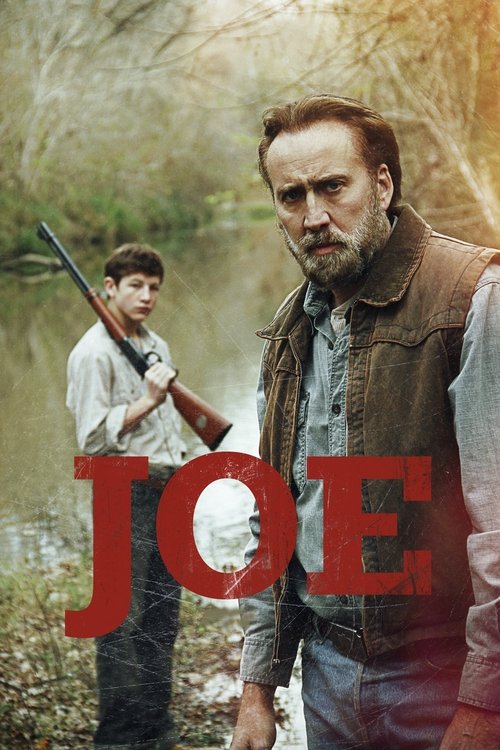
Joe (2014)
Directed by David Gordon Green
No — Joe is not woke, scoring 0 out of 100 on our wokeness meter.
David Gordon Green's Joe arrives with mud on its boots and nothing on its mind but the slow ruin of men in East Texas.
Consciousness Markers
The cast is largely white and rural Texan; there is no evident diversity-driven casting agenda.
No LGBTQ+ characters, themes, or subtext are present.
Female characters exist mainly within the story's grim social landscape; no feminist agenda is articulated.
The film does not engage with race or racial justice themes.
Although the protagonist works on a tree-poisoning crew, the film makes no climate-crusade argument.
Poverty and exploitation appear as local drama, not as an eat-the-rich ideological critique.
No body-positivity themes or messaging are present.
No neurodivergence themes or representation are present.
The film is a fictional Southern Gothic drama and does not revise historical narratives.
The film is gritty and character-driven rather than preachy or lecture-like.
Why it received this score
David Gordon Green's Joe arrives with mud on its boots and nothing on its mind but the slow ruin of men in East Texas. Nicolas Cage plays Joe Ransom, foreman of a tree-poisoning crew, and the picture concerns his wary mentorship of a fifteen-year-old named Gary whose father is a drunken catastrophe. The camera lingers on dirt roads, dog fights, and the specific gray of a sky that has given up. This is a Southern Gothic, which is to say it is interested in damage, not in reform. Nobody on screen is trying to instruct anybody, and that is the entire point.
We search, as is our duty, for signs of contemporary social instruction, and we come up empty. The cast is white, rural, and drawn from the actual margins of Texas life. The late Gary Poulter, who plays Wade, was homeless and alcoholic and had never acted, a piece of casting driven by authenticity, not by any representational checklist. Women appear as prostitutes, bartenders, and bystanders, and the film offers no thesis about them. Race does not enter the frame as an argument. The tree-poisoning job is a job, not a parable about the planet. Poverty saturates every scene and never once becomes a sermon about the wealthy. There is no lecture, no lesson, no closing card telling us how to feel about any of it.
The film leaves behind craft and bleakness, little else. Joe kills a man, takes a bullet, and dies in the arms of a boy who will inherit his truck, his dog, and the woods he once poisoned. The ending offers a small green shoot of redemption, but it is earned through blood, not through a curriculum. For the classification ledger, this is a dry vintage with no additives, a zero across the board. We note it, we file it, and we reach for the next bottle.
Analysis generated by our Consciousness Algorithm
Part of


Synopsis
The rough-hewn boss of a lumber crew courts trouble when he steps in to protect the youngest member of his team from an abusive father.
Questions about Joe
Is Joe woke?
No — Joe is not woke, scoring 0 out of 100 on our wokeness meter. That earns it a verdict of Ultra Based.
Does Joe have any woke elements?
No. All 10 markers score zero.
How does Joe compare to other 2014 movies?
It ranks #271 of the 303 films from 2014 we've scored; their average is 13. The wokest is Selma (68).
How is the Woke Score calculated?
An AI-assisted process researches the film and its reception, scores it 0–100 on ten markers, then combines those into one 0–100 Woke Score. It measures a specific set of 2020s cultural themes, not film quality.