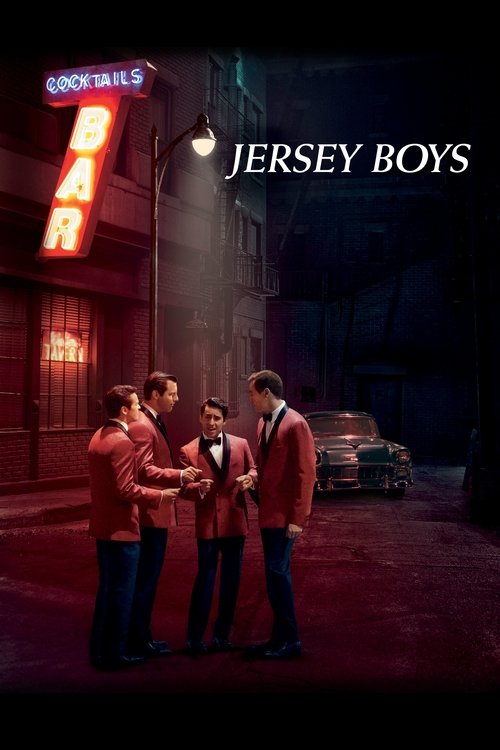
Jersey Boys (2014)
Directed by Clint Eastwood
No — Jersey Boys is not woke, scoring 2 out of 100 on our wokeness meter.
Clint Eastwood's Jersey Boys arrives with a curious burden: it is a film about a doo-wop quartet from Belleville, New Jersey, and it has no interest whatsoever in instructing its audience on how to feel about them.
Consciousness Markers
The cast is a predominantly white Italian-American ensemble playing a real white Italian-American band; no deliberate diversity casting or color-conscious choices are present.
There are no LGBTQ+ characters, themes, or subtext anywhere in the film.
Women appear only as wives, girlfriends, and daughters orbiting the male protagonists; the film offers no feminist critique or female agency.
The narrative is entirely centered on white working-class New Jersey musicians and engages no racial themes or commentary.
No environmental or climate content of any kind.
The mob-debt and record-industry exploitation plotlines are personal and criminal rather than a systemic eat-the-rich critique.
No body-positivity themes or messaging.
No neurodivergent characters or themes.
The film takes documented artistic license with timelines and events, but this is standard biopic compression, not a modern social-justice reframing of history.
Eastwood's direction is a straightforward jukebox biopic with no preachy or didactic messaging.
Why it received this score
Clint Eastwood's Jersey Boys arrives with a curious burden: it is a film about a doo-wop quartet from Belleville, New Jersey, and it has no interest whatsoever in instructing its audience on how to feel about them. The Four Seasons rise, bicker, sign bad contracts, and hand their earnings to a loan shark. Eastwood, working from the Tony-winning stage musical, keeps the camera steady and the sentiment unforced. The result trusts its songs and its grievances to carry the weight, which is an increasingly rare posture in a studio picture.
What we get instead of messaging is texture. The backstage squabbles over towels and underwear, the mobbed-up loan that swallows a decade of touring, the estranged daughter who dies offscreen while her father is finally solvent. These are the mechanics of a specific American story, told without a thesis attached. The film's women exist as wives, girlfriends, and daughters orbiting the men, and the film neither pretends otherwise nor apologizes for it. The cast was pulled from the stage production, not the celebrity pool, a decision that reads as craft instead of statement. Christopher Walken drifts through as a mobster of genteel menace, and the music, when it finally arrives, is permitted to simply be music.
Eastwood's direction is unhurried to the point of lethargy, and the narrative compression does violence to the historical record in the ordinary biopic manner: timelines collapsed, an arrest relocated for thematic symmetry, a bandmate's tenure stretched for dramatic convenience. This is the standard cost of adaptation, not a reframing of history in service of a present-day argument. Nothing in the film lectures, and nothing in it flatters the viewer for arriving already informed. A quiet, decent, entirely unremarkable piece of filmmaking, and one that will offend no one who came for the falsetto.
Analysis generated by our Consciousness Algorithm
Part of


Synopsis
A musical biopic of the Four Seasons—the rise, the tough times and personal clashes, and the ultimate triumph of a group of friends whose music became symbolic of a generation. Far from a mere tribute concert, it gets to the heart of the relationships at the centre of the group, with a special focus on frontman Frankie Valli, the small kid with the big falsetto.
Questions about Jersey Boys
Is Jersey Boys woke?
No — Jersey Boys is not woke, scoring 2 out of 100 on our wokeness meter. That earns it a verdict of Ultra Based.
Does Jersey Boys have any woke elements?
No. All 10 markers score zero.
How does Jersey Boys compare to other 2014 movies?
It ranks #266 of the 303 films from 2014 we've scored; their average is 13. The wokest is Selma (68).
How is the Woke Score calculated?
An AI-assisted process researches the film and its reception, scores it 0–100 on ten markers, then combines those into one 0–100 Woke Score. It measures a specific set of 2020s cultural themes, not film quality.