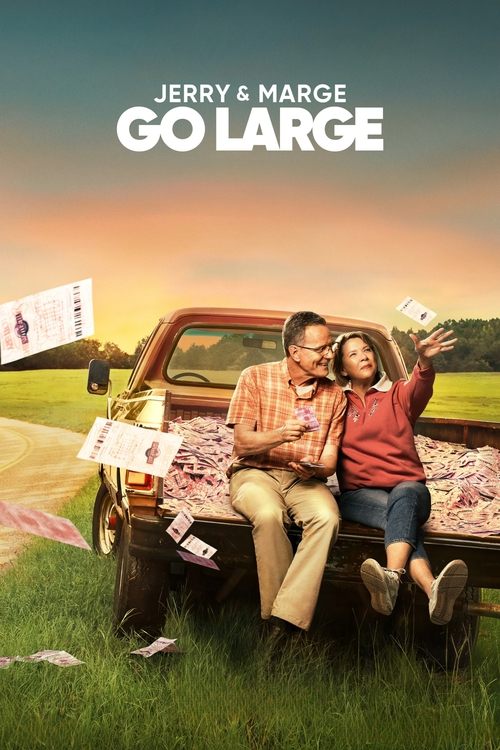
Jerry & Marge Go Large (2022)
Directed by David Frankel
No — Jerry & Marge Go Large is not woke, scoring 17 out of 100 on our wokeness meter.
Jerry and Marge Go Large concerns a retired Michigan factory worker who finds a statistical flaw in a Massachusetts lottery and, with his wife, extracts twenty-seven million dollars from it.
Consciousness Markers
The supporting cast includes Larry Wilmore and Cheech Manohar, but the film does not foreground diversity or make representation a thematic point.
Marge is a genuine co-protagonist with agency in the scheme, but the film frames this as a marriage partnership rather than a feminist statement.
There is a mild moral about community over selfishness, including Jerry's confrontation with Tyler, but the film remains a light crowd-pleaser rather than a sermon.
No LGBTQ+ characters, relationships, or themes are present.
The story is set in a small Michigan town and does not engage with race or racial inequality.
No environmental or climate themes are present.
The film offers no systemic anti-capitalist critique; it celebrates legal lottery winnings and a community investment corporation.
No body-positivity themes or messaging are present.
Jerry's mathematical skill is not framed as neurodivergence, and no neurodivergent themes are explored.
The film is based on a true story but does not revise or reinterpret history in a politically charged way.
Why it received this score
Jerry and Marge Go Large concerns a retired Michigan factory worker who finds a statistical flaw in a Massachusetts lottery and, with his wife, extracts twenty-seven million dollars from it. This is a true story, which spares the filmmakers the labor of invention and burdens them instead with the labor of restraint. They decline the burden. Instead we get a warm, well-lit comedy about arithmetic and civic renewal, performed by two actors of genuine stature who appear to be enjoying a paid vacation in Georgia standing in for New England.
Annette Bening's Marge is no ornament. She co-signs the checks, works the second ticket machine, and delivers the film's few sharp lines. The picture treats this as a marriage, however, not a manifesto. Her competence is domestic furniture, arranged for our comfort. The supporting cast includes Larry Wilmore and Cheech Manohar, whose presence registers as casting rather than argument. The town of Evart is white, struggling, and entirely unexamined as a social phenomenon. Race does not enter the frame. Neither does class, except as a backdrop for the reopening of a jazz festival.
The film's one moral is that community beats selfishness, delivered through a confrontation with a smug Harvard undergraduate who serves as the villain precisely because he wants the money for himself. It is a soft sermon, and it lands softly. Capitalism survives the encounter unscathed, since the heroes incorporate, sell shares, and pay dividends. There is no body politics, no queer subtext, no neurodivergent framing of Jerry's gift for numbers, no climate anxiety, and no revision of the historical record. This is a modest, forgettable, and thoroughly pleasant film about rich retirees. The sommelier notes it, sighs, and moves to the next bottle.
Analysis generated by our Consciousness Algorithm
Part of


Synopsis
The remarkable true story of how retiree Jerry Selbee discovers a mathematical loophole in the Massachusetts lottery and, with the help of his wife, Marge, wins $27 million dollars and uses the money to revive their small Michigan town.
Questions about Jerry & Marge Go Large
Is Jerry & Marge Go Large woke?
No — Jerry & Marge Go Large is not woke, scoring 17 out of 100 on our wokeness meter. That earns it a verdict of Ultra Based.
Does Jerry & Marge Go Large have any woke elements?
Very few. None of the 10 markers reaches 30, the level where a marker counts as present; the highest is Representation Casting at 25.
How does Jerry & Marge Go Large compare to other 2022 movies?
It ranks #102 of the 223 films from 2022 we've scored; their average is 22. The wokest is Bros (92).
How is the Woke Score calculated?
An AI-assisted process researches the film and its reception, scores it 0–100 on ten markers, then combines those into one 0–100 Woke Score. It measures a specific set of 2020s cultural themes, not film quality.