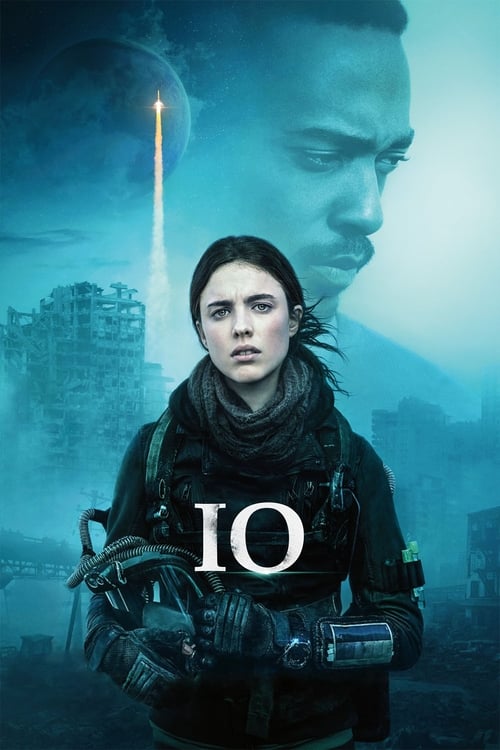
IO (2019)
Directed by Jonathan Helpert
No — IO is not especially woke, scoring 20 out of 100 on our wokeness meter.
IO arrives from 2019 with the weary dignity of a film that has been left behind.
Consciousness Markers
The premise is an ecologically ruined Earth with toxic air and a bee-based restoration plan, but it serves as sci-fi backdrop rather than activist lecture.
A female scientist leads and a Black actor co-stars in a genre historically skewed white and male, though the film makes no explicit point of this casting.
The protagonist is a woman scientist driving the narrative, but the film treats this as character rather than a feminist thesis.
A mild environmental-humanist message about Earth's beauty is delivered quietly rather than preached.
No LGBTQ+ characters, relationships, or themes are present.
Race is never addressed, and Anthony Mackie's casting carries no racial commentary or thematic weight.
No critique of capitalism, wealth, or class structures appears in the film.
No body-positivity themes or messaging are present.
No neurodivergent characters or themes are depicted.
The film is not historical and offers no revisionist historical framing.
Why it received this score
IO arrives from 2019 with the weary dignity of a film that has been left behind. Margaret Qualley plays Sam Walden, a young scientist living at altitude with a colony of bees, attempting to reseed an atmosphere that has turned against its occupants. The air is toxic. The wealthy have gone to a station near Jupiter. What remains is a woman, a hive, and a great deal of silence. The film treats its ecological ruin as furniture, not sermon. There is a ruined planet here, and there is a plan involving pollination, and the camera regards both with the patience of someone waiting for a bus that may not come.
The casting gestures toward a broader horizon. A woman carries the narrative, and Anthony Mackie appears as the traveler Micah, in a genre that has historically reserved such roles for men of a paler and more talkative disposition. The film never remarks on this. It simply proceeds, which is its own kind of restraint. Race goes unmentioned. Queerness goes unmentioned. Class critique, body politics, neurodivergence, all absent. The environmental message sits at the edge of the frame, humming like a refrigerator, never rising to a speech.
The final act sends Sam into a city submerged in poison, where she visits an art museum and then removes her mask to breathe what should kill her. She survives, or the film implies she does, adapted like her new queen bee. A child appears on a beach. A letter explains that Earth is beautiful and that the departed will learn to fear it. It is a soft landing for a hard idea. The film wants us to feel something about the planet, and it says so quietly, once, and then stops. A modest artifact. Its convictions are real but they are not loud, and loudness, in this taxonomy, is where the trouble usually begins.
Analysis generated by our Consciousness Algorithm


Synopsis
As a young scientist searches for a way to save a dying Earth, she finds a connection with a man who's racing to catch the last shuttle off the planet.
Questions about IO
Is IO woke?
No — IO is not especially woke, scoring 20 out of 100 on our wokeness meter. That earns it a verdict of Based.
Does IO have any woke elements?
2 of the 10 markers register at 30 or above, led by Climate Crusade (40) and Representation Casting (35). On Climate Crusade: The premise is an ecologically ruined Earth with toxic air and a bee-based restoration plan, but it serves as sci-fi backdrop rather than activist lecture.
How does IO compare to other 2019 movies?
It ranks #113 of the 284 films from 2019 we've scored; their average is 22. The wokest is Black Christmas (79).
How is the Woke Score calculated?
An AI-assisted process researches the film and its reception, scores it 0–100 on ten markers, then combines those into one 0–100 Woke Score. It measures a specific set of 2020s cultural themes, not film quality.