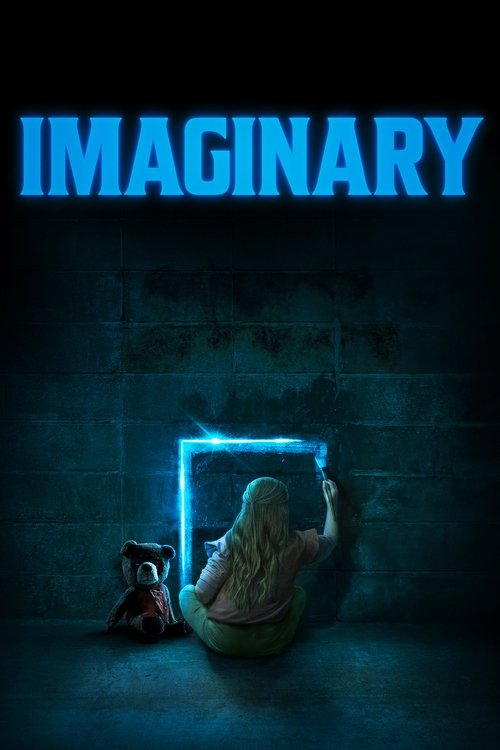
Imaginary (2024)
Directed by Jeff Wadlow
No — Imaginary is not woke, scoring 9 out of 100 on our wokeness meter.
Jeff Wadlow's Imaginary arrives as a modest Blumhouse proposition: a stepmother, a haunted teddy bear, and a portal behind the drywall.
Consciousness Markers
DeWanda Wise headlines as the stepmother and Verónica Falcón appears as the therapist, giving the Blumhouse horror a notably diverse principal cast, though the film never comments on this casting.
The narrative is driven by a stepmother-stepdaughter bond and features several women in central roles, but it offers no feminist thesis or commentary; the women are simply the horror's protagonists.
Jessica's father Ben is described as mentally ill and institutionalized, and a child psychologist features in the plot, but mental illness functions as a horror trope rather than a positive neurodivergence representation.
The film is a straightforward scare machine with no preachy messaging or moralizing monologues.
No LGBTQ+ characters, relationships, or themes appear anywhere in the film.
Race is never addressed, thematized, or made relevant to the plot despite the Black lead.
No environmental or climate themes are present.
No economic critique or class commentary exists in this supernatural horror.
No body-positive themes or messaging appear.
The film engages no historical events or figures to revise.
Why it received this score
Jeff Wadlow's Imaginary arrives as a modest Blumhouse proposition: a stepmother, a haunted teddy bear, and a portal behind the drywall. DeWanda Wise anchors the proceedings as Jessica, a children's author who moves her new family into the house where her own childhood went sideways, and the film deserves a nod for assembling a principal cast that does not look like the genre's default settings. Verónica Falcón turns up as the child psychologist, dispensing exposition with professional calm. The movie never remarks on any of this, which is to its credit. Diversity that simply exists on screen is not a thesis. It is casting.
The domestic architecture here is a stepmother and two stepdaughters, which places women at the center of the terror and keeps them there. Whether that constitutes a statement about anything is doubtful. Jessica saves the day with scissors and maternal resolve, Taylor sulks convincingly as the resentful teenager, and little Alice befriends the wrong stuffed animal. Nobody delivers a speech about patriarchy. Nobody needs to. The film is far too busy explaining the mechanics of the Never Ever, a dimension where abandoned imaginary friends nurse their grudges, to bother with moral instruction. Ben, the institutionalized father, supplies the closest thing to psychological texture, and mental illness earns its keep as a plot device, not a cause.
What remains is a scare machine running on fumes. The critical consensus was unkind, the Cinemascore landed at a C+, and the box office was respectable without being remarkable. There is no sermonizing, no lecture, no lesson about the way we live now. Just a spider with unsettling eyes and a bear who wants his friend back. We classify it, we note its faint progressive currents, and we move on to the next screening.
Analysis generated by our Consciousness Algorithm
Part of


Synopsis
When Jessica moves back into her childhood home with her family, her youngest stepdaughter Alice develops an eerie attachment to a stuffed bear named Chauncey she finds in the basement. Alice starts playing games with Chauncey that begin playful and become increasingly sinister. As Alice’s behavior becomes more and more concerning, Jessica intervenes only to realize Chauncey is much more than the stuffed toy bear she believed him to be.
Questions about Imaginary
Is Imaginary woke?
No — Imaginary is not woke, scoring 9 out of 100 on our wokeness meter. That earns it a verdict of Ultra Based.
Does Imaginary have any woke elements?
1 of the 10 markers register at 30 or above, led by Representation Casting (30). On Representation Casting: DeWanda Wise headlines as the stepmother and Verónica Falcón appears as the therapist, giving the Blumhouse horror a notably diverse principal cast, though the film never comments on this casting.
How does Imaginary compare to other 2024 movies?
It ranks #142 of the 189 films from 2024 we've scored; their average is 22. The wokest is The Six Triple Eight (92).
How is the Woke Score calculated?
An AI-assisted process researches the film and its reception, scores it 0–100 on ten markers, then combines those into one 0–100 Woke Score. It measures a specific set of 2020s cultural themes, not film quality.