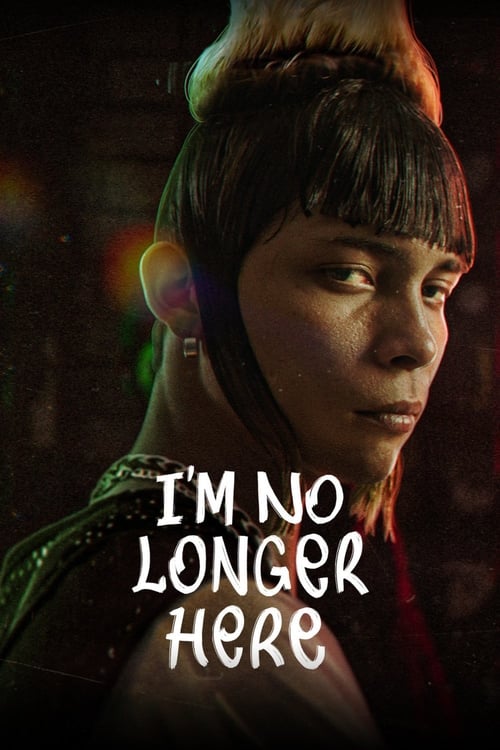
I'm No Longer Here (2019)
Directed by Luis Fernando Frías de la Parra
No — I'm No Longer Here is not especially woke, scoring 23 out of 100 on our wokeness meter.
Luis Fernando Frías de la Parra's 'I'm No Longer Here' follows Ulises, a seventeen-year-old leader of a Monterrey street gang devoted to Kolombia, a subculture built on slowed-down cumbia, baggy clothes, and elaborate homemade haircuts.
Consciousness Markers
The film authentically casts Mexican and Latino performers to tell a Mexican immigrant story, centering non-white, non-Anglophone perspectives. However, this representation is organic to the narrative rather than a self-conscious casting statement.
The film engages the immigrant experience, depicting the marginalization, xenophobia, and precarity Ulises faces as an undocumented Mexican in Queens. This is treated as lived experience rather than an explicit racial-justice thesis.
The film portrays slum poverty, exploited day laborers, and a criminal economy born of desperation, offering implicit economic critique. It stops well short of an explicit eat-the-rich agenda.
The film is poetic, observational, and nonlinear, favoring mood and imagery over didactic messaging. It rarely lectures its audience.
The narrative is overwhelmingly male-centric, following Ulises and his gang. Female characters (his mother, Lin, Chaparra) exist in supporting roles without any feminist framing or commentary.
No LGBTQ+ characters, themes, or subtext appear in the film.
No environmental or climate themes are present.
No body-positivity themes or messaging are present.
No neurodivergence themes or characters are present.
The film is a fictional contemporary drama with no historical revisionism.
Why it received this score
Luis Fernando Frías de la Parra's 'I'm No Longer Here' follows Ulises, a seventeen-year-old leader of a Monterrey street gang devoted to Kolombia, a subculture built on slowed-down cumbia, baggy clothes, and elaborate homemade haircuts. A misunderstanding with a cartel sends him north to Queens, where he cleans a rooftop, fails at manual labor, and slowly comes apart in a country that has no use for him. It is a sad, drifting film, shot with patience and a great deal of silence.
The film's cultural awareness is real but unforced. Its cast is Mexican and Latino throughout, telling a Mexican story in Spanish, and the immigrant experience it depicts is one of xenophobia, wage theft, and quiet erasure. None of it arrives as a thesis. The poverty of the slum and the criminal economy it breeds sit in the frame as conditions, not arguments, and the film never stops to explain them. Women orbit a story that belongs to boys: a mother, a friend, a Colombian sex worker. The picture is not conducting a seminar on identity, economics, or the environment. It is conducting one about a teenager who cannot go home.
This restraint is the point. The film prefers mood to messaging, and its nonlinear structure keeps the audience at a respectful distance. It observes poverty and deportation without turning either into a lesson. For a viewer who grades such things, the result is a work of genuine social texture and almost no sermonizing, a rare combination. The battery on the MP3 player dies. The music stops. Nothing is explained to us, and that is the achievement.
Analysis generated by our Consciousness Algorithm


Synopsis
In Monterrey, Mexico, a young street gang spends their days dancing to slowed-down cumbia and attending parties. After a mix-up with a local cartel, their leader is forced to migrate to the U.S. but quickly longs to return home.
Questions about I'm No Longer Here
Is I'm No Longer Here woke?
No — I'm No Longer Here is not especially woke, scoring 23 out of 100 on our wokeness meter. That earns it a verdict of Based.
Does I'm No Longer Here have any woke elements?
2 of the 10 markers register at 30 or above, led by Racial Consciousness (45) and Representation Casting (45). On Racial Consciousness: The film engages the immigrant experience, depicting the marginalization, xenophobia, and precarity Ulises faces as an undocumented Mexican in Queens.
How does I'm No Longer Here compare to other 2019 movies?
It ranks #95 of the 284 films from 2019 we've scored; their average is 22. The wokest is Black Christmas (79).
How is the Woke Score calculated?
An AI-assisted process researches the film and its reception, scores it 0–100 on ten markers, then combines those into one 0–100 Woke Score. It measures a specific set of 2020s cultural themes, not film quality.