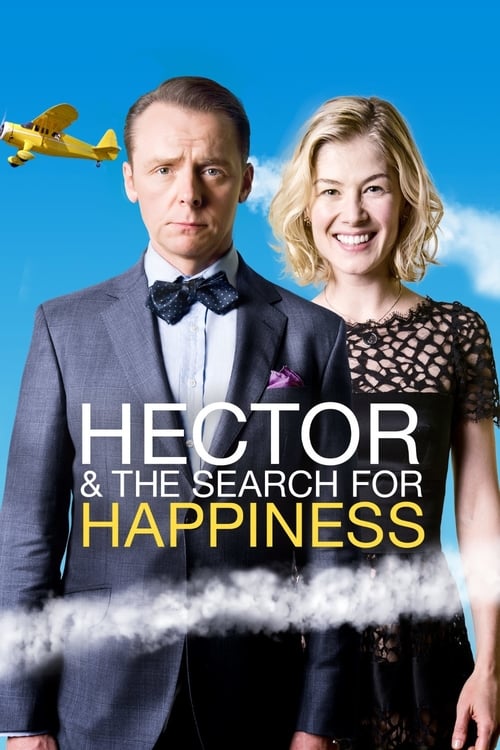
Hector and the Search for Happiness (2014)
Directed by Peter Chelsom
No — Hector and the Search for Happiness is not woke, scoring 11 out of 100 on our wokeness meter.
The film is a global wellness brochure.
Consciousness Markers
A brief subplot reveals that Marcel is Michael's lover and that the two are happy together, a small but concrete incidental inclusion of a same-sex couple.
Professor Coreman delivers explicit lectures on the science of happiness and the 'happiness of pursuit,' giving the film a modest thesis-driven, preachy streak.
The cast is led by white stars (Pegg, Pike, Collette, Plummer, Reno) with non-white characters like Ying Li and African villagers largely serving as exoticized backdrop to a Westerner's journey of self-discovery.
The narrative is a man's global quest for self-actualization, and Clara's arc resolves around her desire to become a mother rather than any feminist agency.
The film travels through China and Africa but treats these settings as colorful scenery for Hector's enlightenment, with no engagement with race or racial dynamics.
A cranky businessman and a drug lord appear as minor obstacles, but the film offers no systemic critique of wealth or capitalism.
No environmental or climate themes appear anywhere in the film.
No body positivity themes or messaging are present.
Hector is described as 'quirky,' but this is a personality trait rather than any depiction of neurodivergence.
The film is a contemporary fictional story with no historical revisionism.
Why it received this score
The film is a global wellness brochure. Hector, a psychiatrist, abandons his practice to tour China, Africa, and Santa Monica in search of the secret formula. Simon Pegg is charming. The film mistakes a passport for a personality. Non-white characters exist as scenery: Ying Li, the sweet potato villagers, the kidnappers with the rat. They populate Hector's enlightenment without ever being asked for their own. The cast is led by white stars, and the world beyond them is a colorful set dressing for a Westerner's private reckoning.
The film's progressive gestures are small and largely incidental. Marcel turns out to be Michael's lover, and the two are happy together, a brief inclusion that registers and then evaporates. Clara's arc resolves into a desire for motherhood, closing the loop on a story that was always about a man finding himself. China and Africa serve as backdrops, never as places with their own textures or racial dynamics. A cranky businessman and a drug lord appear as obstacles, but the screenplay offers no argument about wealth itself. No environment enters the frame as a concern. No bodies are celebrated. No minds are examined beyond the label quirky, which here means eccentric and nothing more. History does not intrude, because there is none to revise.
Where the film does show conviction is in its lecturing. Professor Coreman, played with grim authority by Christopher Plummer, explains the happiness of pursuit, the brain scans, the colored flags. The film has a thesis and it intends to share it. Reviews were mixed, returns were modest, and the whole enterprise remains a search for a feeling the screenplay keeps describing instead of producing. We are told happiness is every emotion at once. We are shown a man on a plane.
Analysis generated by our Consciousness Algorithm


Synopsis
Hector is a quirky psychiatrist who has become increasingly tired of his humdrum life. As he tells his girlfriend, Clara, he feels like a fraud: he hasn’t really tasted life, and yet he’s offering advice to patients who are just not getting any happier. So Hector decides to break out of his deluded and routine driven life. Armed with buckets of courage and child-like curiosity, he embarks on a global quest in hopes of uncovering the elusive secret formula for true happiness. And so begins a larger than life adventure with riotously funny results.
Questions about Hector and the Search for Happiness
Is Hector and the Search for Happiness woke?
No — Hector and the Search for Happiness is not woke, scoring 11 out of 100 on our wokeness meter. That earns it a verdict of Ultra Based.
Does Hector and the Search for Happiness have any woke elements?
Very few. None of the 10 markers reaches 30, the level where a marker counts as present; the highest is LGBTQ+ Themes at 25.
How does Hector and the Search for Happiness compare to other 2014 movies?
It ranks #124 of the 303 films from 2014 we've scored; their average is 13. The wokest is Selma (68).
How is the Woke Score calculated?
An AI-assisted process researches the film and its reception, scores it 0–100 on ten markers, then combines those into one 0–100 Woke Score. It measures a specific set of 2020s cultural themes, not film quality.