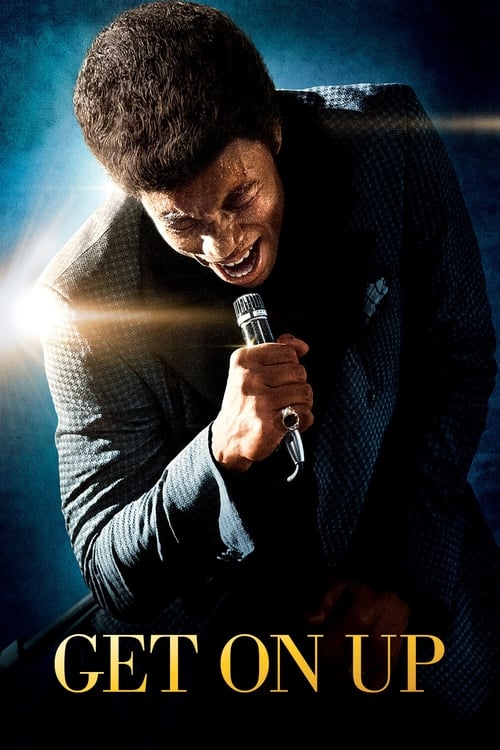
Get On Up (2014)
Directed by Tate Taylor
No — Get On Up is not especially woke, scoring 26 out of 100 on our wokeness meter.
Get On Up arrives in 2014 as a sturdy, well-upholstered biographical musical, directed by Tate Taylor and carried almost entirely on the shoulders of Chadwick Boseman, who dances every step himself and sings over James Brown's own live recordings.
Consciousness Markers
A predominantly Black ensemble led by Chadwick Boseman portrays a Black icon and his world; the representation is inherent to the subject rather than a self-conscious casting statement.
The film engages Black pride, the Boston Garden concert after King's assassination, 'Say It Loud – I'm Black and I'm Proud,' and the 'white devil' warning, though as biography rather than modern activism.
Occasional sermonizing moments, such as the plea for togetherness in Boston, but the film is largely a performance-driven biopic rather than a lecture.
The music industry's exploitation of artists and Brown's own harsh treatment of his salaried band hint at economic critique, but no systemic anti-capitalist argument is made.
Women appear as wives, mothers, and aunts, but the film centers a male genius and depicts his domestic abuse without a feminist critique.
The biopic takes factual liberties and fabricates incidents, but it does not reinterpret history through a modern progressive lens.
Little Richard appears as a character, but his sexuality is never addressed; no LGBTQ+ themes are present.
No environmental or climate content whatsoever.
No body-positivity themes are present.
No neurodivergence themes are present.
Why it received this score
Get On Up arrives in 2014 as a sturdy, well-upholstered biographical musical, directed by Tate Taylor and carried almost entirely on the shoulders of Chadwick Boseman, who dances every step himself and sings over James Brown's own live recordings. The film shuffles its chronology, lets its subject address the camera directly, and otherwise follows the familiar arc from Augusta poverty to the Apollo to the strip mall and the shotgun. It is a performance showcase, and it knows it.
The cultural accounting here is largely inherited from the subject. A predominantly Black ensemble portrays a Black icon and the world that made him, and the film treats that as simple fact instead of a casting announcement, which is the correct instinct. Racial consciousness runs through the material because Brown's life ran through it: the Boston Garden concert staged the night after Martin Luther King's assassination, the plea for calm delivered to a restive crowd, the recording of "Say It Loud, I'm Black and I'm Proud," and Little Richard's roadside warning about the white devil. None of it is reframed for a contemporary audience. It is biography, and it stays biography.
The deficiencies are equally clear. Brown's violence toward his wives is staged and then abandoned, with no feminist reckoning attached to it; women function as mothers, aunts, and casualties. Little Richard appears and his sexuality goes unmentioned, a conspicuous omission. The music business chews up its artists and Brown fines his own salaried band for infractions, though the film never builds an argument out of it. There is no environmental content, no body positivity, no neurodivergence. The sermonizing is limited to a few earnest appeals for togetherness. The result is a handsome, occasionally electric portrait of a difficult man, content to admire the genius without auditing the era.
Analysis generated by our Consciousness Algorithm
Part of


Synopsis
A chronicle of James Brown's rise from extreme poverty to become one of the most influential musicians in history.
Questions about Get On Up
Is Get On Up woke?
No — Get On Up is not especially woke, scoring 26 out of 100 on our wokeness meter. That earns it a verdict of Based.
Does Get On Up have any woke elements?
2 of the 10 markers register at 30 or above, led by Racial Consciousness (55) and Representation Casting (55). On Racial Consciousness: The film engages Black pride, the Boston Garden concert after King's assassination, 'Say It Loud – I'm Black and I'm Proud,' and the 'white devil' warning, though as biography rather than modern activism.
How does Get On Up compare to other 2014 movies?
It ranks #30 of the 303 films from 2014 we've scored; their average is 13. The wokest is Selma (68).
How is the Woke Score calculated?
An AI-assisted process researches the film and its reception, scores it 0–100 on ten markers, then combines those into one 0–100 Woke Score. It measures a specific set of 2020s cultural themes, not film quality.