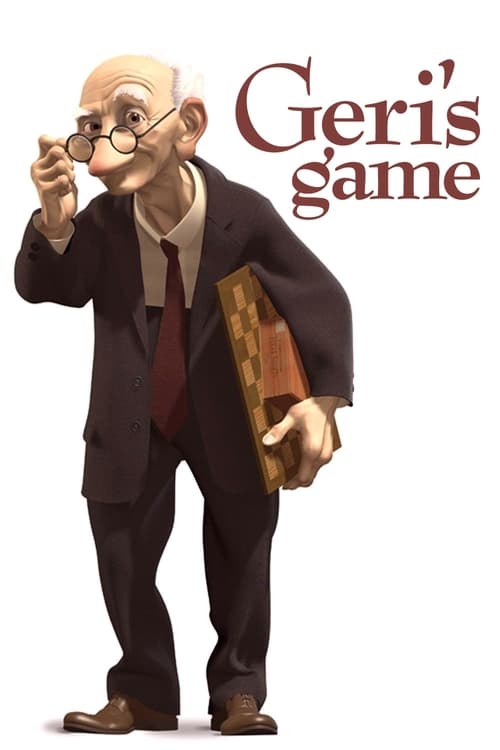
Geri's Game (1997)
Directed by Jan Pinkava
No — Geri's Game is not woke, scoring 0 out of 100 on our wokeness meter.
Geri's Game arrives from 1997, a wordless vignette in which an elderly man in a park plays chess against himself, loses to the more aggressive half of his own personality, fakes a cardiac event, rotates the board, and collects his dentures as a prize.
Consciousness Markers
The sole human character is an elderly white man; there is no meaningful casting diversity or representation commentary.
No LGBTQ+ characters, themes, or subtext are present.
The short has no feminist themes or gender-conscious narrative.
There is no engagement with race or racial identity.
No environmental or climate themes appear in the film.
The short contains no critique of capitalism, wealth, or class.
No body-positivity themes are present; dentures are used as a comic prop, not a body-image statement.
Geri's solitary chess game is not framed as neurodivergence or mental-health advocacy.
The film is a fictional short with no historical revisionism.
It is a wordless comic vignette with no didactic messaging.
Why it received this score
Geri's Game arrives from 1997, a wordless vignette in which an elderly man in a park plays chess against himself, loses to the more aggressive half of his own personality, fakes a cardiac event, rotates the board, and collects his dentures as a prize. It is a comic contraption, tightly wound and entirely free of messaging. Pixar's first human protagonist, we are told, and the studio spent a year on cloth simulation to prove it. The jacket moves. The skin holds. Nothing else is being argued.
This is a film with no interest in the culture wars, largely because the culture wars had not yet been scheduled. Its single character is an old white man. Its themes are vanity, cunning, and the small humiliations of age. There is no commentary on representation, no engagement with identity, no structural critique of the park, the chessboard, or the socioeconomic conditions that produced either. The dentures function as a punchline, not a statement about aging bodies. The solitary game reads as comedy, not as a portrait of isolation or mental health. We are watching a man trick himself and enjoy it.
The restraint is almost quaint now. A modern short of this length might pause to explain what it means. Geri's Game simply does the trick and takes its bow, having secured an Academy Award for its trouble. It lectures no one. It represents no one in particular. It exists to demonstrate that a computer could render a suit jacket that wrinkles convincingly, and it succeeds at that modest ambition with total confidence. A clean ledger. Zero on every count we keep.
Analysis generated by our Consciousness Algorithm
Part of

Synopsis
An aging codger named Geri plays a daylong game of chess in the park against himself. Somehow, he begins losing to his livelier opponent. But just when the game's nearly over, Geri manages to turn the tables.
Questions about Geri's Game
Is Geri's Game woke?
No — Geri's Game is not woke, scoring 0 out of 100 on our wokeness meter. That earns it a verdict of Ultra Based.
Does Geri's Game have any woke elements?
No. All 10 markers score zero.
How does Geri's Game compare to other 1997 movies?
It ranks #95 of the 109 films from 1997 we've scored; their average is 12. The wokest is Happy Together (65).
How is the Woke Score calculated?
An AI-assisted process researches the film and its reception, scores it 0–100 on ten markers, then combines those into one 0–100 Woke Score. It measures a specific set of 2020s cultural themes, not film quality.