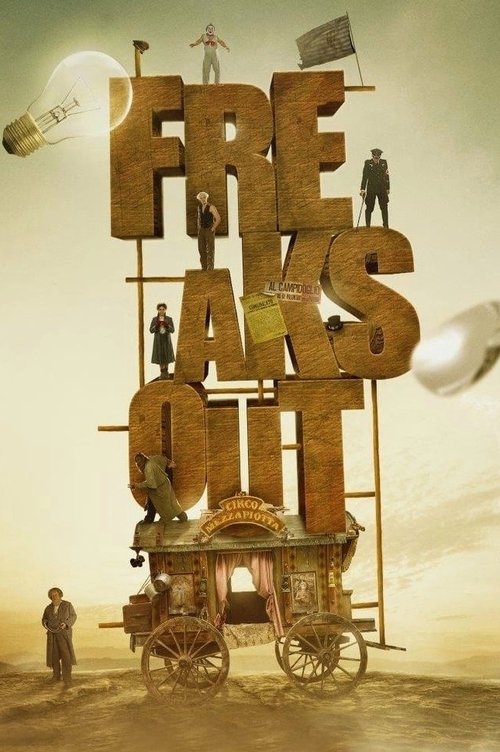
Freaks Out (2021)
Directed by Gabriele Mainetti
No — Freaks Out is not especially woke, scoring 30 out of 100 on our wokeness meter.
Gabriele Mainetti's "Freaks Out" arrives as a 2021 Italian historical fantasy in which four circus performers with unconventional powers wander a war-torn Rome while the Reich closes in.
Consciousness Markers
The ensemble is built around performers with visible physical differences (a little-person actor, a hypertrichosis performer) and a young woman as the lead, giving atypical bodies prominent heroic roles rather than background decoration.
Matilde is the central protagonist who survives an attempted rape, wrestles with her own power, and ultimately saves the group, though the film frames this as character drama rather than an explicit feminist thesis.
The entire premise celebrates the 'freaks' as heroes and casts the physically 'normal' Nazi villain as the monster, implicitly valorizing bodies outside conventional norms.
Mario is portrayed as a person with an intellectual disability who is nonetheless a capable, sympathetic member of the heroic group, though the film does not frame this in modern neurodivergence language.
The film centers Jewish persecution, the Holocaust, and Italian anti-fascist resistance, but treats these as historical moral stakes rather than modern racial-justice commentary.
The anti-Nazi message is unmistakable but delivered through pulpy genre spectacle rather than direct moralizing or audience address.
The film is a fantastical alternate-history WWII in which super-powered circus performers defeat the Reich, but this is genre invention rather than ideological rewriting of the historical record.
No LGBTQ+ characters, relationships, or themes appear anywhere in the narrative.
No environmental or climate themes are present.
The antagonists are Nazis and fascists; there is no critique of capitalism or wealth as such.
Why it received this score
Gabriele Mainetti's "Freaks Out" arrives as a 2021 Italian historical fantasy in which four circus performers with unconventional powers wander a war-torn Rome while the Reich closes in. The ensemble is assembled with an eye toward bodies that cinema usually relegates to the margins: a young woman who conducts electricity through her skin, a man covered head to toe in hair, an albino who commands insects, and a performer of short stature with a metal-bending gift. Their physical differences are not decoration. They are the engine of the plot, and the film treats their strangeness as the source of whatever heroism it can muster. The camera regards them with affection, and the effect is a quiet argument about who gets to be the protagonist.
Aurora Giovinazzo's Matilde carries the emotional weight. She survives an attempted assault, wrestles with a power she cannot control, and eventually becomes the one who saves everyone. The film frames this as character drama, not as a thesis, which keeps the sermonizing to a minimum. Franz Rogowski's six-fingered Nazi pianist is the counterweight: physically "normal" by conventional measure and monstrous in every other respect. The inversion is deliberate, and it lands. The anti-fascist stakes are unmistakable, though they arrive through pulpy spectacle instead of direct address. Nobody turns to the camera to explain the moral.
Where the film holds back is in the modern vocabulary. Its politics are the politics of 1943 Italy, not of a contemporary culture-war syllabus. There is no environmental thread, no economic critique, and no LGBTQ presence. The disability and body themes are present but embedded in genre mechanics, doing their work through casting and plot instead of commentary. The result is a film that feels progressive in an older, humanist register, and largely indifferent to the categories that dominate current discourse. It is a strange, overlong, genuinely moving piece of pulp, and it earns its sentiment the hard way.
Analysis generated by our Consciousness Algorithm


Synopsis
Four super-powered circus freaks find themselves trapped in war-torn Rome after their foster father is captured by the Nazis.
Questions about Freaks Out
Is Freaks Out woke?
No — Freaks Out is not especially woke, scoring 30 out of 100 on our wokeness meter. That earns it a verdict of Based.
Does Freaks Out have any woke elements?
3 of the 10 markers register at 30 or above, led by Representation Casting (40), Body Positivity (35) and Feminist Agenda (35). On Representation Casting: The ensemble is built around performers with visible physical differences (a little-person actor, a hypertrichosis performer) and a young woman as the lead, giving atypical bodies prominent heroic roles rather than background decoration.
How does Freaks Out compare to other 2021 movies?
It ranks #63 of the 242 films from 2021 we've scored; their average is 23. The wokest is The Forever Purge (83).
How is the Woke Score calculated?
An AI-assisted process researches the film and its reception, scores it 0–100 on ten markers, then combines those into one 0–100 Woke Score. It measures a specific set of 2020s cultural themes, not film quality.