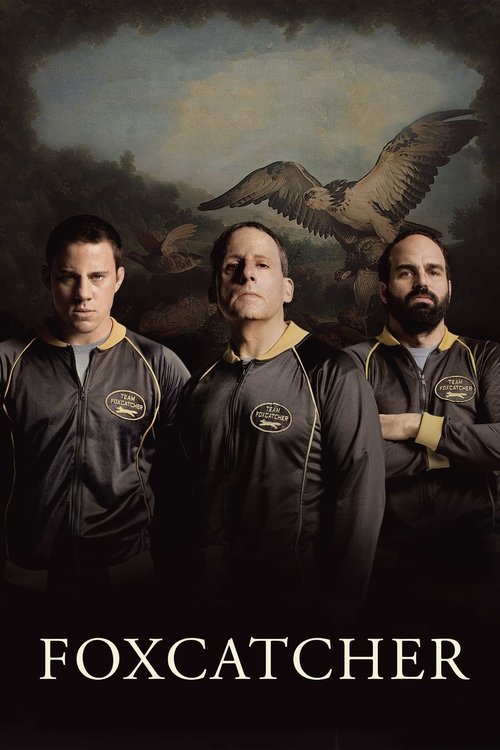
Foxcatcher (2014)
Directed by Bennett Miller
No — Foxcatcher is not woke, scoring 6 out of 100 on our wokeness meter.
Foxcatcher is a cold study of inherited money, Olympic wrestling, and psychological erosion.
Consciousness Markers
The film depicts the corrupting decadence of the du Pont fortune, but frames it as individual pathology and moral decay rather than a systemic anti-capitalist critique.
Critics noted subtextual 'homosexual undertones' in the intense du Pont/Mark relationship, but the film never develops this as an explicit theme, and the real Mark Schultz publicly objected to the reading.
A slow, chilly character study that observes rather than preaches; it offers no explicit moral instruction to the audience.
The cast is almost entirely white, reflecting the real demographics of elite American wrestling in the 1980s. No deliberate diverse or color-conscious casting choices are present.
A story about male wrestlers and male mentorship; women (Jean du Pont, Nancy Schultz) are peripheral figures with no feminist framing or agency-driven arc.
No engagement with race or racial dynamics whatsoever; the narrative is entirely within a white, wealthy milieu.
No environmental or climate themes appear in the film.
No body-positivity themes; the film's physical focus is on athletic training and weight-cutting, not body acceptance.
du Pont is portrayed as psychologically disturbed and isolated, but the film does not frame this through a modern neurodivergence-affirming lens.
A loose but straightforward dramatization of real events; no revisionist reframing of history for ideological purposes.
Why it received this score
Foxcatcher is a cold study of inherited money, Olympic wrestling, and psychological erosion. Bennett Miller treats John du Pont's estate as a museum of private obsessions and public vanity. Steve Carell plays du Pont as a man forever rehearsing authority, Mark Ruffalo supplies Dave Schultz with a steady warmth, and Channing Tatum turns Mark into an inarticulate engine of resentment. The cast is almost entirely white and male, which fits the historical milieu. There is no color-conscious casting, no feminist reclamation, and no racial framework. Women appear as wives and mothers at the edge of the frame. That is a description, not an accusation.
The social consciousness here is faint and mostly incidental. A few charged scenes around du Pont and Mark carry subtextual hints that some critics read as homoerotic, but the film never makes that a declared theme, and the real Mark Schultz publicly objected. The du Pont fortune is shown as corrosive, a gilded hothouse that produces isolation and cruelty. Miller treats this as one family's pathology and one man's decay, not as a systemic indictment of capital. There is no climate sermon, no body acceptance, no neurodivergence vocabulary, and no revised history. The story is strange enough without ideological remodeling.
Miller's tone is chilly and observational. The film does not lecture. It withholds diagnosis and lets the viewer watch money do its quiet damage. The result is a serious, controlled drama about a murder and the vanity that preceded it. For viewers compiling cultural markers, it is a sparse ledger. The film's few progressive ripples come from implication and atmosphere, not from speeches. It remains an austere vintage: expensive, static, and uninterested in flattering anyone's politics.
Analysis generated by our Consciousness Algorithm


Synopsis
The greatest Olympic Wrestling Champion brother team joins Team Foxcatcher led by multimillionaire sponsor John E. du Pont as they train for the 1988 games in Seoul - a union that leads to unlikely circumstances.
Questions about Foxcatcher
Is Foxcatcher woke?
No — Foxcatcher is not woke, scoring 6 out of 100 on our wokeness meter. That earns it a verdict of Ultra Based.
Does Foxcatcher have any woke elements?
Very few. None of the 10 markers reaches 30, the level where a marker counts as present; the highest is Eat the Rich at 15.
How does Foxcatcher compare to other 2014 movies?
It ranks #185 of the 303 films from 2014 we've scored; their average is 13. The wokest is Selma (68).
How is the Woke Score calculated?
An AI-assisted process researches the film and its reception, scores it 0–100 on ten markers, then combines those into one 0–100 Woke Score. It measures a specific set of 2020s cultural themes, not film quality.