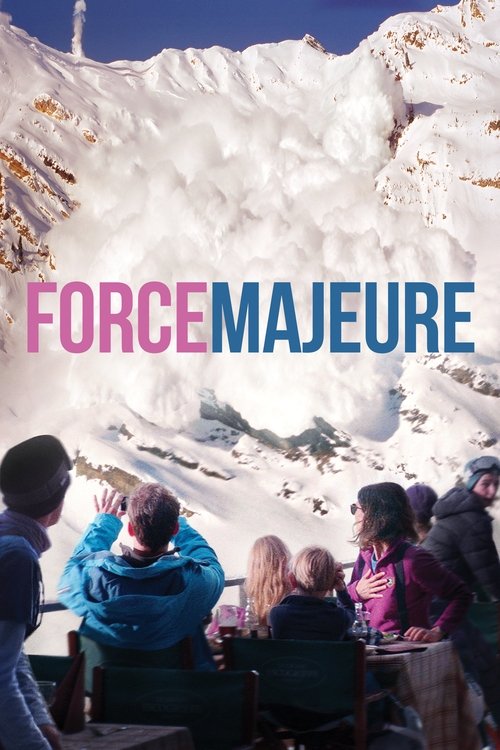
Force Majeure (2014)
Directed by Ruben Östlund
No — Force Majeure is not woke, scoring 10 out of 100 on our wokeness meter.
Ruben Östlund's Force Majeure is a controlled experiment in marital humiliation, set against the indifferent grandeur of the French Alps.
Consciousness Markers
The film interrogates traditional masculinity and the husband's failure to protect his family, and includes a pointed 'women and children first' moment, but it observes gender dynamics rather than advocating a feminist program.
The luxury Alpine resort setting and the affluent family's bourgeois pretensions are gently satirized, but the film offers no systemic critique of capitalism or wealth.
Östlund's approach is observational and cringe-comedic, showing social embarrassment rather than delivering moral instruction to the audience.
A Swedish/Norwegian production with an almost entirely white Scandinavian cast; the presence of an American actor (Brady Corbet) is incidental and carries no representational intent.
No LGBTQ+ characters, relationships, or themes appear anywhere in the film.
No engagement with race, racism, or racial identity; the story is entirely about a white Scandinavian family's marital crisis.
The avalanche is a controlled, man-made event used as a psychological trigger; there is no environmental or climate theme.
No body-diversity or body-positivity themes are present.
No neurodivergent characters or themes are depicted.
The film is a contemporary fictional drama with no historical revisionism of any kind.
Why it received this score
Ruben Östlund's Force Majeure is a controlled experiment in marital humiliation, set against the indifferent grandeur of the French Alps. A Swedish family sits at a luxury resort restaurant. A controlled avalanche rolls toward the deck. The husband, Tomas, grabs his phone and runs. His wife, Ebba, remains with the children. What follows is not a plot so much as a forensic examination of a man who cannot admit what the camera already recorded. The film has a feminist pulse in its attention to Ebba's anger and the later bus scene where Mats insists women and children exit first, but it studies gender roles without issuing a manifesto. It watches. It waits. It lets the silence do the work.
The broader cultural markers are mostly absent. The cast is white Scandinavian, with Brady Corbet drifting through as an American curiosity and no representational intent behind him. There are no LGBTQ themes, no engagement with race, no climate allegory (the avalanche is a controlled event, a psychological trigger, not a dying planet), no body positivity, no neurodivergence, and no historical revisionism. The luxury resort and its affluent guests receive a gentle satirical nudge, yet the film offers no systemic critique of wealth. It is too busy watching a marriage decompose in real time.
The lecture energy is low. Östlund prefers the cringe to the sermon, showing social embarrassment until it becomes its own argument. The result is a film of limited progressive sensibility, a film that interrogates masculinity and bourgeois pretension but refuses to instruct. It remains a cold, funny, uncomfortable artifact of European art cinema. We file it under domestic psychodrama, not cultural crusade.
Analysis generated by our Consciousness Algorithm


Synopsis
While holidaying in the French Alps, a Swedish family deals with acts of cowardliness as an avalanche breaks out.
Questions about Force Majeure
Is Force Majeure woke?
No — Force Majeure is not woke, scoring 10 out of 100 on our wokeness meter. That earns it a verdict of Ultra Based.
Does Force Majeure have any woke elements?
1 of the 10 markers register at 30 or above, led by Feminist Agenda (30). On Feminist Agenda: The film interrogates traditional masculinity and the husband's failure to protect his family, and includes a pointed 'women and children first' moment, but it observes gender dynamics rather than advocating a feminist program.
How does Force Majeure compare to other 2014 movies?
It ranks #130 of the 303 films from 2014 we've scored; their average is 13. The wokest is Selma (68).
How is the Woke Score calculated?
An AI-assisted process researches the film and its reception, scores it 0–100 on ten markers, then combines those into one 0–100 Woke Score. It measures a specific set of 2020s cultural themes, not film quality.