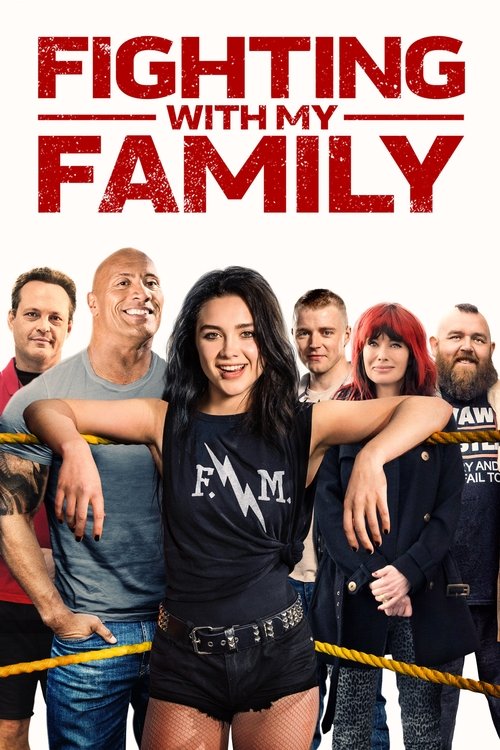
Fighting with My Family (2019)
Directed by Stephen Merchant
No — Fighting with My Family is not especially woke, scoring 23 out of 100 on our wokeness meter.
Stephen Merchant's account of Saraya Knight, the Norwich wrestler who became Paige, arrives with the tidy shape of a sports drama and the even tidier sponsorship of WWE Studios.
Consciousness Markers
Paige fights her way through the male-dominated WWE machine, endures the dismissive 'Divas' division, and is pressured to look like the models and cheerleaders around her. The arc of a woman proving herself on her own terms carries a genuine feminist undercurrent, though it is delivered as crowd-pleasing sports drama rather than polemic.
The cast is overwhelmingly white British, though Thea Trinidad (AJ Lee) and several WWE performers of color appear in supporting roles. Diversity is incidental to the WWE setting rather than a casting statement.
Paige's struggle to fit the polished model/cheerleader mold and her eventual re-embrace of her natural hair and skin tone gestures at self-acceptance and rejecting imposed beauty standards, though it is framed as individuality rather than a body-positivity thesis.
The film carries a gentle 'be yourself' and 'family first' message, but it is delivered through rousing sports-movie beats rather than preachy sermonizing.
No LGBTQ+ characters, themes, or subtext appear anywhere in the film.
The film is a story about a white working-class Norwich family and engages no racial themes whatsoever.
No environmental or climate content of any kind.
The film is effectively a WWE Studios production celebrating the WWE brand; there is no critique of wealth, corporations, or capitalism.
No neurodivergent characters or themes are present.
The film takes standard biopic liberties (fictional coach, compressed timeline), but it does not reinterpret history through a modern ideological lens.
Why it received this score
Stephen Merchant's account of Saraya Knight, the Norwich wrestler who became Paige, arrives with the tidy shape of a sports drama and the even tidier sponsorship of WWE Studios. That financing arrangement matters. A corporation co-producing the story of its own employee is not a conflict so much as a house style. The film admires the machine that nearly breaks its heroine, and it does so with genuine warmth, which is either charming or instructive depending on how much time we spend thinking about it. Florence Pugh carries the whole thing on her shoulders, which is fortunate, because the script hands her a family of cheerful eccentrics and a training montage.
The picture does have a spine of mild progressive feeling. Paige enters a developmental program populated by models and cheerleaders who cannot wrestle, is told to soften her accent and her instincts, and bleaches her hair in a doomed attempt to resemble her peers. Her eventual decision to reclaim her natural hair and skin tone is a gesture toward self-acceptance, though the film frames it as plucky individuality, not a broader argument about who gets to be photographed. The feminism here is real but gentle. A woman proves herself in a male-run industry and seizes the championship belt, and the crowd cheers, and nobody has to think about it afterward.
Elsewhere the cupboard is bare, and honestly so. This is a story about a white working-class family in Norfolk, and it engages race not at all. There are no queer characters, no climate anxiety, no neurodivergent subplots, and no critique of the corporation paying the bills. The film's message, that being different is the thing that makes you a star, is delivered through rousing arena beats instead of sermonizing. It is a likable, well-acted piece of uplift, and it has the cultural ambition of a Sunday roast.
Analysis generated by our Consciousness Algorithm


Synopsis
Born into a tight-knit wrestling family, Paige and her brother Zak are ecstatic when they get the once-in-a-lifetime opportunity to try out for the WWE. But when only Paige earns a spot in the competitive training program, she must leave her loved ones behind and face this new cutthroat world alone. Paige's journey pushes her to dig deep and ultimately prove to the world that what makes her different is the very thing that can make her a star.
Questions about Fighting with My Family
Is Fighting with My Family woke?
No — Fighting with My Family is not especially woke, scoring 23 out of 100 on our wokeness meter. That earns it a verdict of Based.
Does Fighting with My Family have any woke elements?
2 of the 10 markers register at 30 or above, led by Feminist Agenda (45) and Representation Casting (30). On Feminist Agenda: Paige fights her way through the male-dominated WWE machine, endures the dismissive 'Divas' division, and is pressured to look like the models and cheerleaders around her.
How does Fighting with My Family compare to other 2019 movies?
It ranks #95 of the 284 films from 2019 we've scored; their average is 22. The wokest is Black Christmas (79).
How is the Woke Score calculated?
An AI-assisted process researches the film and its reception, scores it 0–100 on ten markers, then combines those into one 0–100 Woke Score. It measures a specific set of 2020s cultural themes, not film quality.