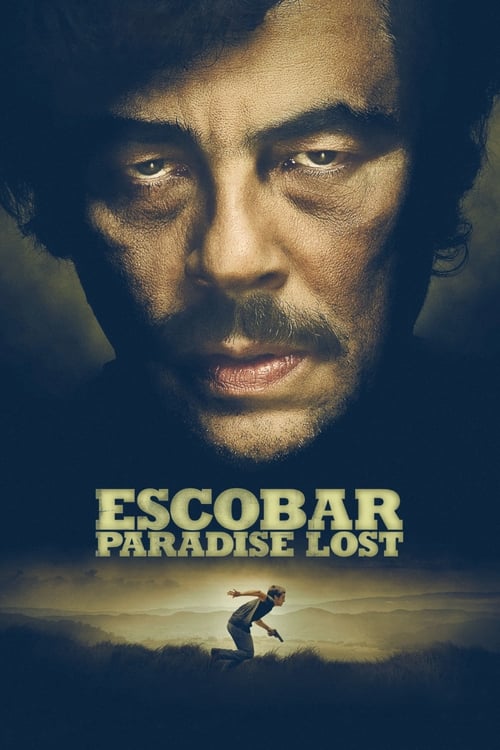
Escobar: Paradise Lost (2014)
Directed by Andrea Di Stefano
No — Escobar: Paradise Lost is not woke, scoring 12 out of 100 on our wokeness meter.
Escobar: Paradise Lost arrives with a title that promises a druglord and a runtime that mostly delivers a sunburned Canadian.
Consciousness Markers
The cast is heavily Latin American (Benicio del Toro, Claudia Traisac, Carlos Bardem, Tenoch Huerta Mejía), but this reflects the natural setting of a Colombia-set narco drama rather than any deliberate representation agenda.
No LGBTQ+ characters or themes appear anywhere in the film.
Maria is a largely passive romantic object whose function is to motivate the male lead; there is no feminist framing or commentary.
The film treats the Colombian drug trade as a crime-thriller backdrop with no engagement in racial or systemic-justice themes.
No environmental or climate themes are present.
The drug trade is depicted as violent criminal enterprise, not as a critique of capitalism or wealth inequality.
No body-positivity themes or messaging.
No neurodivergent characters or themes.
The film uses Pablo Escobar as a historical figure but does not reframe or revise history for ideological purposes.
The film is a straightforward suspense drama with no preachy or didactic messaging.
Why it received this score
Escobar: Paradise Lost arrives with a title that promises a druglord and a runtime that mostly delivers a sunburned Canadian. Josh Hutcherson plays Nick, a surfer who follows his brother to Colombia, falls for Maria, and discovers that her uncle runs the Medellin cartel. The romance occupies the first hour. The dread occupies the second. Benicio del Toro sits in the middle of it, glowering with the patience of a man who has already decided how this ends.
On the cultural ledger, the film is a sparse entry. The cast is Latin American across the board, which is the ordinary consequence of setting a narco drama in Colombia, not a statement of intent. Maria is a romantic object whose narrative function is to be loved and then mourned. She is given little else to do, and the film does not appear troubled by this. The drug trade here is violent criminal enterprise, presented without commentary on wealth, race, or systems. No sermon, no cause, no messaging to speak of. A young man cannot bring himself to shoot a fifteen-year-old guide, and that is the entire moral architecture.
The remainder is a competent genre exercise from 2014, a year when such exercises were not yet expected to carry ideological freight. Del Toro looms. The middle sags. The reviews were mixed and the box office was modest. For our purposes the film registers as close to inert, a vintage that offers almost nothing to the sommelier and asks only to be watched.
Analysis generated by our Consciousness Algorithm


Synopsis
For Pablo Escobar family is everything. When young surfer Nick falls for Escobar's niece, Maria, he finds his life on the line when he's pulled into the dangerous world of the family business.
Questions about Escobar: Paradise Lost
Is Escobar: Paradise Lost woke?
No — Escobar: Paradise Lost is not woke, scoring 12 out of 100 on our wokeness meter. That earns it a verdict of Ultra Based.
Does Escobar: Paradise Lost have any woke elements?
Very few. None of the 10 markers reaches 30, the level where a marker counts as present; the highest is Representation Casting at 20.
How does Escobar: Paradise Lost compare to other 2014 movies?
It ranks #113 of the 303 films from 2014 we've scored; their average is 13. The wokest is Selma (68).
How is the Woke Score calculated?
An AI-assisted process researches the film and its reception, scores it 0–100 on ten markers, then combines those into one 0–100 Woke Score. It measures a specific set of 2020s cultural themes, not film quality.