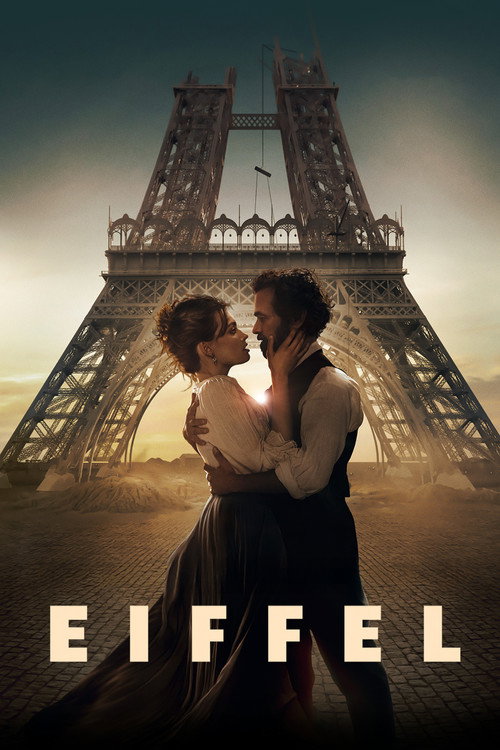
Eiffel (2021)
Directed by Martin Bourboulon
No — Eiffel is not woke, scoring 6 out of 100 on our wokeness meter.
Eiffel arrives as a handsomely appointed costume drama, which is the most reliable method for smuggling an entirely invented love affair into the historical record.
Consciousness Markers
Adrienne is written as headstrong and defiant, speaking up for Eiffel and defying her father, but she ultimately resolves into a tragic self-sacrificing figure in an unapologetically old-fashioned romance.
The film fabricates a wholly invented romance and reshapes Eiffel's biography (even suggesting the tower spells 'A' for Adrienne), but this is romantic historical fiction, not progressive reframing of the past.
A workers' strike briefly threatens construction, but it is resolved by Eiffel financing the tower with his personal fortune, celebrating rather than critiquing individual capitalist genius.
Reviews describe the film as 'unapologetically old-fashioned,' a conventional romance rather than a preachy message piece; it lectures no one.
A European co-production with a uniformly white French cast; no evidence of deliberate diverse or color-conscious casting in the film.
No LGBTQ+ characters, relationships, or themes appear anywhere in this 19th-century romantic drama.
No engagement with race, colonialism, or racial dynamics despite the film's 19th-century French imperial setting.
The film contains no environmental or climate themes whatsoever.
No body-positivity themes or diverse body representation are present.
No neurodivergent characters or themes are depicted.
Why it received this score
Eiffel arrives as a handsomely appointed costume drama, which is the most reliable method for smuggling an entirely invented love affair into the historical record. Gustave Eiffel, played by Romain Duris, would prefer to build a subway for Paris than a 300 metre iron tower, until a woman from his past walks into a society party and rearranges his ambitions. What follows is twenty-six years of thwarted passion, a lost child, a jealous newspaperman, and a closing revelation that the tower has been shaped like the letter A all along. The film is unapologetically old-fashioned, as one reviewer observed, and it intends this as a compliment. We are meant to swoon, not to think.
For a story set in the middle of French imperial expansion, with a World's Fair as its backdrop, the film shows almost no interest in who else was standing in the frame. The cast is uniformly white, the colonial machinery of 1889 is invisible, and the lone gesture toward class politics is a workers' strike that dissolves the moment Eiffel opens his personal checkbook. That resolution is telling. The crowd is calmed not by better wages but by the spectacle of individual genius, and the film regards this as triumph. Adrienne, played by Emma Mackey, has a defiant streak and speaks up for Eiffel when it counts, then spends the remainder of the running time sacrificing herself so that a monument may stand. It is a familiar arrangement, presented without a flicker of discomfort.
There is no environmental argument here, no examination of the body, no neurodivergent interiority, no queer undercurrent, and no sermon. The film fabricates its history freely and does so in the service of romance, not ideology. It is a pleasant, well-dressed anachronism, and it asks nothing of us but a handkerchief.
Analysis generated by our Consciousness Algorithm


Synopsis
The French government is asking Gustave Eiffel to design something spectacular for the 1889 Paris World Fair, but he simply wants to design the subway—until he crosses paths with a mysterious woman from his past.
Questions about Eiffel
Is Eiffel woke?
No — Eiffel is not woke, scoring 6 out of 100 on our wokeness meter. That earns it a verdict of Ultra Based.
Does Eiffel have any woke elements?
Very few. None of the 10 markers reaches 30, the level where a marker counts as present; the highest is Feminist Agenda at 15.
How does Eiffel compare to other 2021 movies?
It ranks #211 of the 242 films from 2021 we've scored; their average is 23. The wokest is The Forever Purge (83).
How is the Woke Score calculated?
An AI-assisted process researches the film and its reception, scores it 0–100 on ten markers, then combines those into one 0–100 Woke Score. It measures a specific set of 2020s cultural themes, not film quality.