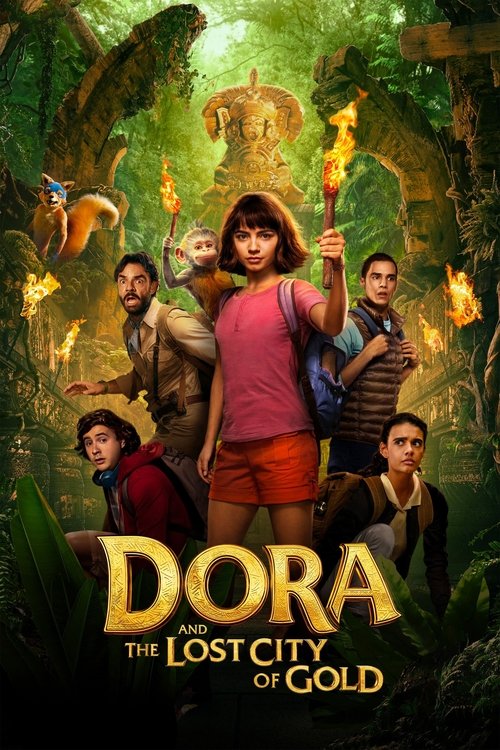
Dora and the Lost City of Gold (2019)
Directed by James Bobin
No — Dora and the Lost City of Gold is not especially woke, scoring 35 out of 100 on our wokeness meter.
Dora and the Lost City of Gold arrives as a live-action expansion of a children's cartoon, and it conducts itself with more dignity than that premise requires.
Consciousness Markers
A predominantly Latino cast headlines a mainstream studio family film, with Merced, Derbez, Peña, Longoria, del Toro and Trejo, plus Indigenous performers Kilcher and Madden. Much of this is faithful to the source, but the demographic weight is notable.
The film engages Incan/Quechua civilization directly, includes a Quechua-speaking queen and Indigenous actors, and treats the culture with reverence rather than as mere treasure backdrop. Dora's outsider status in an LA high school lightly touches cultural displacement.
The villains are greedy treasure-hunting mercenaries whose lust for gold is punished, and the film explicitly reframes the prize as water/knowledge over wealth. The anti-greed streak is present but gentle and slapstick-toned.
Dora is an intelligent, capable female lead who out-solves the adults and saves her parents, and Sammy is a comparably competent rival-turned-ally. It is a female-driven adventure, though without an explicit feminist thesis.
There are mild messages about respecting ancient cultures, not stealing their treasures, and staying true to oneself, but they are woven into a breezy family adventure rather than delivered as a sermon.
The temple's true treasure resolves to water rather than gold, an ecological nod, but there is no climate advocacy or environmental messaging driving the plot.
Dora's hyper-enthusiastic, socially out-of-step manner is celebrated rather than pathologized, and the arc resolves around embracing her oddity. This is generic 'be yourself' material rather than explicit neurodivergence representation.
No LGBTQ+ characters, romance, or themes anywhere in the film; the romantic subplots are Diego/Sammy and Randy's crush on Dora.
No body-diversity or body-image themes; physical appearance is not a subject of the film.
The Incan setting is fictionalized fantasy adventure (a legendary Parapata) rather than a rewrites of real history for ideological ends. No revisionist historical claims are made.
Why it received this score
Dora and the Lost City of Gold arrives as a live-action expansion of a children's cartoon, and it conducts itself with more dignity than that premise requires. James Bobin directs a cast that is, by the standards of mainstream studio family entertainment, conspicuously Latino, from Isabela Merced's Dora through Eugenio Derbez, Michael Peña, Eva Longoria, and the vocal contributions of Benicio del Toro and Danny Trejo. The source material demanded much of this, so the demographic weight registers as faithful casting more than as a statement. Still, it is a lot of faces for a Nickelodeon property, and the film does not apologize for any of them.
The Inca material gets the most care. The lost city of Parapata is fiction, but the film treats Quechua as a living language, casts Q'orianka Kilcher as its queen, and lets Dora address her in the tongue she learned. The culture is reverenced, not raided. When the temple's final test resolves to water instead of gold, the film quietly punishes the mercenaries who came for bullion. Greed is the villain here, and it wears a khaki vest and gets swallowed by a trap. The message is gentle. Nobody is lectured.
Dora herself is capable, clever, and out-thinks every adult in the room, and Sammy is a rival who becomes an equal. That is a female-driven adventure without a thesis attached. The arc, such as it is, asks Dora to remain strange in a world that mocks her for it, which lands closer to generic self-acceptance than to any clinical claim about how her mind works. The film ends with a dance number, a couple formed, and a sequel teased. It means well, it means it lightly, and it never once stops to explain itself. That restraint is its finest quality.
Analysis generated by our Consciousness Algorithm
Part of


Synopsis
Dora, a girl who has spent most of her life exploring the jungle with her parents, now must navigate her most dangerous adventure yet: high school. Always the explorer, Dora quickly finds herself leading Boots (her best friend, a monkey), Diego, and a rag tag group of teens on an adventure to save her parents and solve the impossible mystery behind a lost Inca civilization.
Questions about Dora and the Lost City of Gold
Is Dora and the Lost City of Gold woke?
No — Dora and the Lost City of Gold is not especially woke, scoring 35 out of 100 on our wokeness meter. That earns it a verdict of Based.
Does Dora and the Lost City of Gold have any woke elements?
4 of the 10 markers register at 30 or above, led by Representation Casting (58), Racial Consciousness (50) and Eat the Rich (35). On Representation Casting: A predominantly Latino cast headlines a mainstream studio family film, with Merced, Derbez, Peña, Longoria, del Toro and Trejo, plus Indigenous performers Kilcher and Madden.
How does Dora and the Lost City of Gold compare to other 2019 movies?
It ranks #60 of the 284 films from 2019 we've scored; their average is 22. The wokest is Black Christmas (79).
How is the Woke Score calculated?
An AI-assisted process researches the film and its reception, scores it 0–100 on ten markers, then combines those into one 0–100 Woke Score. It measures a specific set of 2020s cultural themes, not film quality.