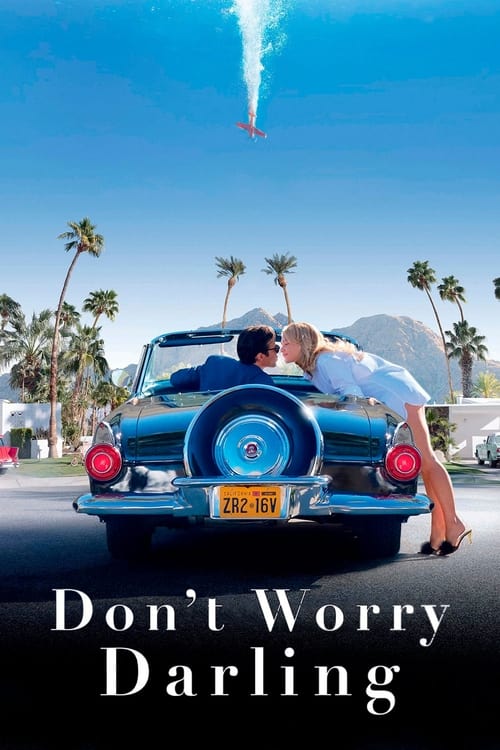
Don't Worry Darling (2022)
Directed by Olivia Wilde
Partly — Don't Worry Darling is somewhat woke, scoring 43 out of 100 on our wokeness meter.
Don't Worry Darling arrives as a tidy specimen of the modern social-consciousness thriller, a company town of the mind where the men commute to secret work and the wives keep house in a 1950s diorama that smells faintly of chlorine and dread.
Consciousness Markers
The entire premise is a feminist allegory: men imprison their wives in a simulated 1950s domestic fantasy of subservient housewives, and the villain Frank was explicitly modeled on Jordan Peterson and 'incel' ideology. The film's climax is a woman violently escaping patriarchal captivity.
Critics widely described the film's themes as heavy-handed and its ideas as underdeveloped, giving it a moderate preachy quality without a sustained didactic monologue.
The ensemble includes KiKi Layne, Gemma Chan, and Asif Ali in a notably multiracial cast, but their roles are largely incidental to the plot and Layne's part was reportedly trimmed in editing, so diversity reads as casting texture rather than a statement.
There is a mild critique of corporate company-town control and the consumerist fantasy the men pay to sustain, but the film's target is gender domination rather than class or wealth.
No LGBTQ+ characters, relationships, or themes appear anywhere in the film.
Despite a multiracial cast, the film engages no racial themes, commentary, or historical consciousness whatsoever.
No environmental or climate themes are present.
No body-positivity themes or messaging appear in the film.
No neurodivergence themes or characters are present; Margaret's breakdown is framed as trauma, not neurodivergence.
The 1950s setting is a fabricated simulation, not a revisionist retelling of real historical events.
Why it received this score
Don't Worry Darling arrives as a tidy specimen of the modern social-consciousness thriller, a company town of the mind where the men commute to secret work and the wives keep house in a 1950s diorama that smells faintly of chlorine and dread. Olivia Wilde directs with genuine visual assurance. The women wear the right dresses, the desert glows the right orange, and Florence Pugh carries the whole apparatus on her back like a woman dragging a piano up a dune. The intent is unmistakable: this is a parable about men who build cages and call them paradise, complete with a villain modeled on a certain podcast philosopher beloved by the aggrieved. The feminist argument is the film's entire spine. It is also its entire body.
Where the film extends its progressive reach into casting, it does so with a shrug. KiKi Layne, Gemma Chan, and Asif Ali populate Victory in a notably multiracial arrangement, and their presence registers as texture, nothing more. Layne's part was reportedly trimmed in the editing room, which is a shame, though the film never asked her to do anything but stand near the plot. Race, as a subject, is absent. The company town levies its mild critique of corporate ownership and the consumerist dream the husbands pay to maintain, but the target here is gender, not money, and the film keeps its economic resentments safely in the background.
The trouble is the delivery. Critics found the themes heavy-handed and the ideas thin, and the film earns that verdict. It lectures without quite knowing what it wants to say, gesturing at captivity and control while the third act buckles under its own reveal. There is no sustained sermon, just a persistent finger-wagging that wears out its welcome. For all the noise, the thing opened at number one and then fell hard, which feels like the correct fate for a movie that mistakes a mood board for an argument. We have seen this vintage before, and it does not improve with age.
Thematic tags: box_office_number_one. The film topped the domestic box office in its opening weekend. It is not a sequel, remake, or adaptation, and it won no Academy Awards. Its influences are borrowed, not licensed, which is a distinction the classification process respects. The score is what it is. The desert keeps its secrets, and so do we.
Analysis generated by our Consciousness Algorithm


Synopsis
Alice and Jack are lucky to be living in the idealized community of Victory, the experimental company town housing the men who work for the top-secret Victory Project and their families. But when cracks in their idyllic life begin to appear, exposing flashes of something much more sinister lurking beneath the attractive façade, Alice can’t help questioning exactly what they’re doing in Victory, and why.
Questions about Don't Worry Darling
Is Don't Worry Darling woke?
Partly — Don't Worry Darling is somewhat woke, scoring 43 out of 100 on our wokeness meter. That earns it a verdict of Woke-Adjacent.
What makes Don't Worry Darling woke?
3 of the 10 markers register at 30 or above, led by Feminist Agenda (78), Lecture Energy (40) and Representation Casting (35). On Feminist Agenda: The entire premise is a feminist allegory: men imprison their wives in a simulated 1950s domestic fantasy of subservient housewives, and the villain Frank was explicitly modeled on Jordan Peterson and 'incel' ideology.
How does Don't Worry Darling compare to other 2022 movies?
It ranks #39 of the 223 films from 2022 we've scored; their average is 22. The wokest is Bros (92).
How is the Woke Score calculated?
An AI-assisted process researches the film and its reception, scores it 0–100 on ten markers, then combines those into one 0–100 Woke Score. It measures a specific set of 2020s cultural themes, not film quality.