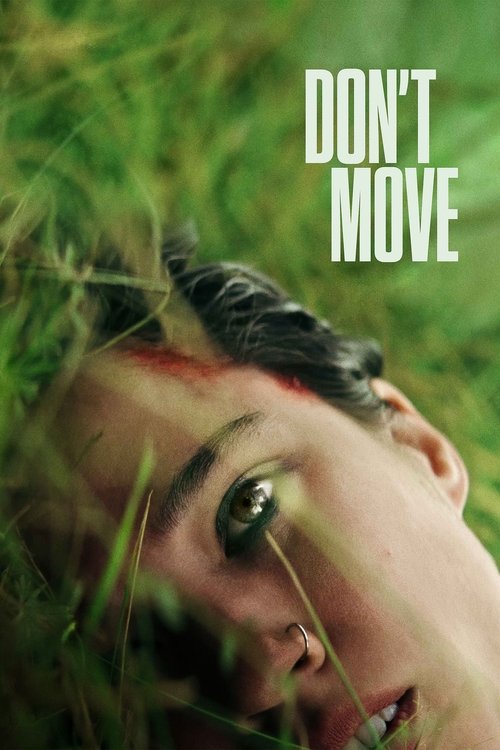
Don't Move (2024)
Directed by Brian Netto
No — Don't Move is not woke, scoring 8 out of 100 on our wokeness meter.
Don't Move is a lean piece of streaming catalog engineering: a grieving mother, a serial killer, a paralytic agent, and ninety minutes of California forest.
Consciousness Markers
The cast features a Native American lead (Kelsey Asbille) and a Black supporting actor (Daniel Francis), but their presence is unremarked upon and incidental to the survival plot.
The protagonist is a grieving mother who fights back against her captor, but the film frames this as generic survival instinct rather than any feminist statement.
The film is a lean genre exercise with no preachy messaging; the only thematic note is a mild 'renewed will to live' beat at the end.
No LGBTQ+ characters, themes, or subtext appear anywhere in the film.
Race is never addressed or thematized; the story is a straightforward cat-and-mouse thriller.
No environmental or climate themes are present.
No economic critique or class commentary exists in the film.
The film's focus on a paralyzed body is a horror mechanism, not a body-positivity statement.
No neurodivergent characters or themes are depicted.
The film is a contemporary fictional thriller with no historical subject matter to revise.
Why it received this score
Don't Move is a lean piece of streaming catalog engineering: a grieving mother, a serial killer, a paralytic agent, and ninety minutes of California forest. The premise is one good idea, executed with the grim efficiency of a film that knows its own limits. Adam Schindler and Brian Netto keep the camera close and the dialogue sparse. Kelsey Asbille spends most of the runtime unable to move her face, a demanding assignment she meets without complaint. Finn Wittrock does the talking, and he does plenty of it, filling the silence with a killer's autobiography that the film wisely declines to make profound.
The cultural ledger here is thin, and the film seems content to leave it that way. Asbille is a Native American actress playing a woman whose heritage is never mentioned. Daniel Francis appears as a highway patrol officer whose race goes equally unremarked. That is representation by staffing, not by argument, and it earns a small credit for refusing to make a fuss. The protagonist's gender registers only through her grief for a dead son. Her eventual violence reads as plain survival instinct, not as a statement about anything. No economic grievance, no climate dread, no sermon about bodies or minds intrudes on the chase.
The sole thematic gesture arrives at the end, when Iris thanks her would-be murderer for restoring her will to live before walking away. It is a strange, small beat, and the film builds nothing on top of it. Instead, we get a tight genre exercise that respects its own constraints. That is rarer than it should be, and less nourishing than the streaming algorithm presumably hopes. The result is a competent thriller with almost nothing on its mind, which, for a Friday night, may be the correct amount.
Analysis generated by our Consciousness Algorithm


Synopsis
A grieving woman in a secluded forest encounters a killer who injects her with a paralytic drug. As her body shuts down, her fight for survival begins.
Questions about Don't Move
Is Don't Move woke?
No — Don't Move is not woke, scoring 8 out of 100 on our wokeness meter. That earns it a verdict of Ultra Based.
Does Don't Move have any woke elements?
Very few. None of the 10 markers reaches 30, the level where a marker counts as present; the highest is Representation Casting at 15.
How does Don't Move compare to other 2024 movies?
It ranks #153 of the 189 films from 2024 we've scored; their average is 22. The wokest is The Six Triple Eight (92).
How is the Woke Score calculated?
An AI-assisted process researches the film and its reception, scores it 0–100 on ten markers, then combines those into one 0–100 Woke Score. It measures a specific set of 2020s cultural themes, not film quality.