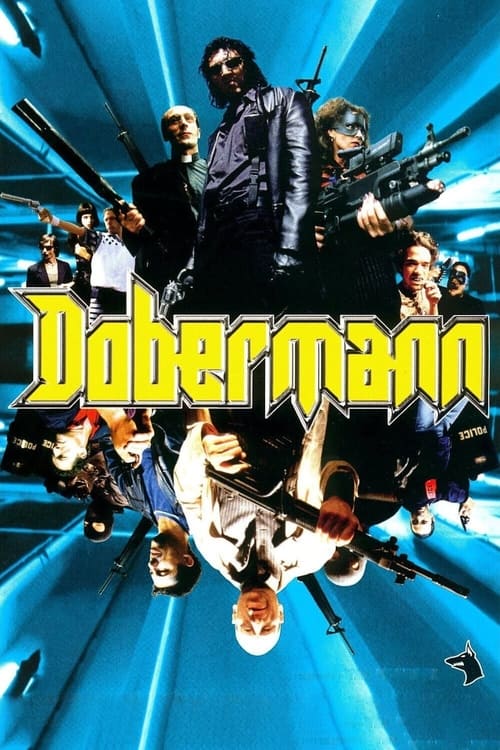
Dobermann (1997)
Directed by Jan Kounen
No — Dobermann is not woke, scoring 9 out of 100 on our wokeness meter.
Dobermann arrives from 1997, adapted from Joël Houssin's series of police novels, and it carries the fingerprints of an era that had not yet learned to apologize for itself.
Consciousness Markers
A gang member, Olivier, is a transvestite operating as 'Sonia,' and this identity is central to a plot thread, though the film treats it as a deviance/reveal device rather than affirming it.
The cast is a standard European ensemble for a French crime film of its era; there is incidental ethnic variety (Affif Ben Badra, Italian-born Bellucci) but no deliberate modern representation casting.
Nat is labeled 'the Gypsy,' giving a nominal Romani presence, but there is no racial commentary or consciousness in the film.
Bank robbery is the premise, but it is criminal spectacle rather than a critique of capitalism or wealth inequality.
Monica Bellucci's character is defined largely as the beautiful deaf girlfriend who is abducted and nearly raped; no feminist agency or critique is present.
The film is a visceral, amoral crime thriller with no didactic messaging or moralizing about social issues.
No environmental or climate themes whatsoever; the film is entirely urban crime and pursuit.
No body-positive themes or diverse body representation; the film trades on conventional violent-crime aesthetics and glamorized leads.
A deaf character exists, but deafness is not neurodivergence and it is used as a character tag rather than a thematic concern; no neurodivergent framing appears.
A pulpy cops-and-robbers story with no historical revisionism; it engages no real historical record to reinterpret.
Why it received this score
Dobermann arrives from 1997, adapted from Joël Houssin's series of police novels, and it carries the fingerprints of an era that had not yet learned to apologize for itself. Jan Kounen directs a bank robbery, a police raid, and a great deal of gunfire with the enthusiasm of a man who has discovered squibs and intends to use every one of them. Vincent Cassel plays the titular criminal as a charismatic brute. Tchéky Karyo plays the sadistic detective Christini as a slightly less charismatic brute. The moral universe is flat, gray, and uninterested in instruction. Nobody in this film has a lesson to teach us, which is its single most admirable quality.
Where the film gestures toward social texture, it does so with the delicacy of a sledgehammer. One gang member, Olivier, lives as a transvestite named Sonia, and the film treats this as a lurid plot hinge, a betrayal device, and finally a costume to be discarded. There is no affirmation here, only a revelation to be managed. Monica Bellucci's Nat is described as the Gypsy and defined by her deafness and her beauty, both deployed as narrative furniture. She is abducted, threatened, and rescued by a man grinding another man's face into the asphalt. The film offers no critique of any of this, because critique would require a point of view, and Dobermann has only an appetite.
Bank robbery appears as premise, not as argument about wealth. The Paris of the film is a playground of sirens and neon, not an ecosystem in need of saving. There is no environmental conscience, no body politics, no neurological vocabulary, no rewriting of the historical record. What remains is a lean, nasty, competently staged piece of pulp that predates the entire apparatus of contemporary moral signaling by roughly two decades. We classify it accordingly. Its cultural awareness is minimal, its intentions are base, and it is, in its own limited way, honest about both.
Analysis generated by our Consciousness Algorithm


Synopsis
The charismatic criminal Dobermann, who got his first gun when he was christened, leads a gang of brutal robbers. After a complex and brutal bank robbery, they are being hunted by the Paris police. The hunt is led by the sadistic cop Christini, who only has one goal: to catch Dobermann at any cost.
Questions about Dobermann
Is Dobermann woke?
No — Dobermann is not woke, scoring 9 out of 100 on our wokeness meter. That earns it a verdict of Ultra Based.
Does Dobermann have any woke elements?
Very few. None of the 10 markers reaches 30, the level where a marker counts as present; the highest is LGBTQ+ Themes at 22.
How does Dobermann compare to other 1997 movies?
It ranks #46 of the 109 films from 1997 we've scored; their average is 12. The wokest is Happy Together (65).
How is the Woke Score calculated?
An AI-assisted process researches the film and its reception, scores it 0–100 on ten markers, then combines those into one 0–100 Woke Score. It measures a specific set of 2020s cultural themes, not film quality.