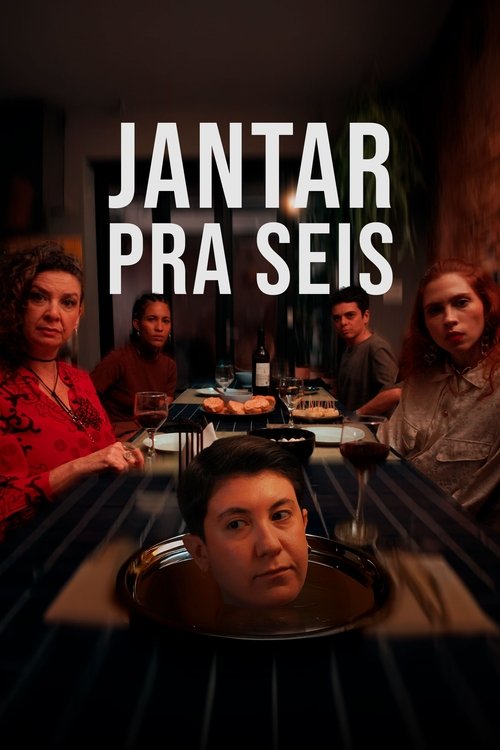
Dinner for Six (2025)
Directed by Isabela Lisboa
Dinner for Six is a Brazilian short film about a lesbian woman who invites her ex-girlfriends to a dinner party to understand her own romantic patterns before beginning a new relationship.
Consciousness Markers
The film's entire premise, cast of characters, romantic conflicts, and festival circuit are built around a lesbian protagonist and her relationships with women. This is not a subplot. It is the plot.
The entire principal cast is composed of women, the production explicitly prioritized women and LGBTQIAP+ creatives, and the director also stars in the film. This is not incidental diversity but a stated production mandate.
An all-female cast, a female director-writer-star, and a production crew described as primarily composed of women and queer creatives signals a deliberate feminist production philosophy, even if the narrative itself is focused on personal relationships rather than systemic critique.
The director's founding of Lesbicult and the film's positioning within explicitly queer festival spaces suggests some advocacy intent. The dinner-party format, however, channels this into personal drama rather than open sermonizing.
No evidence of racial consciousness as a thematic or structural concern was identified in the film's premise, reception materials, or production documentation.
No climate themes, environmental messaging, or ecological content of any kind was identified.
No anti-capitalist themes were identified. The film's crowdfunded, independent production model is a practical necessity, not a political statement embedded in the narrative.
No body positivity themes or commentary were identified in the available materials.
No neurodivergence themes or characters were identified.
The film is a contemporary drama with no historical setting or revisionist historical framing of any kind.
Why it received this score
Dinner for Six is a Brazilian short film about a lesbian woman who invites her ex-girlfriends to a dinner party to understand her own romantic patterns before beginning a new relationship. The premise is, in the taxonomy of modern independent cinema, a familiar one: gather the interpersonal wreckage in a single room and see what ignites. Director, writer, and star Isabela Lisboa is clearly in command of her material, and the film's entire creative apparatus, cast, crew, and festival strategy, operates as a coherent statement of queer representation. It screened at Latin America's largest LGBTQIAP+ festival, then traveled to Poland, London, Italy, and Tampa. This is not a film that stumbled into queer cinema. It was built to live there.
The progressive credentials are not incidental. Lisboa founded Lesbicult in 2018, a digital archive devoted to lesbian and bisexual visibility in film, and Dinner for Six reads as a natural extension of that project. The production materials note that the crew was composed primarily of women and LGBTQIAP+ creatives, a fact presented not as a happy accident but as a design principle. The film scores with genuine conviction on representation and LGBTQ+ content because those are, without ambiguity, its central concerns. The dinner table is not a metaphor for something else. It is where queer women sit, argue, and excavate their feelings. This is the film.
Where Dinner for Six avoids the higher registers of the scale is in its apparent restraint with sermonizing. The dinner-party format has a useful structural property: it forces characters to talk to each other rather than at the audience. There is no evidence of climate messaging, racial consciousness as a thematic frame, or anti-capitalist critique. The film appears to be, at its core, a modest and sincere drama about one woman's romantic history, produced by a community for a community. That is, by the metrics of this analysis, a fairly focused document. It does one thing, and it does it with commitment to the cause.
Analysis generated by our Consciousness Algorithm
Synopsis
Duda is a young lesbian who collects breakups. She is determined to make her next relationship work and decides to invite all her ex-girlfriends and her best friend to dinner. As soon as the guests arrive, secrets and surprises are brought to the table.