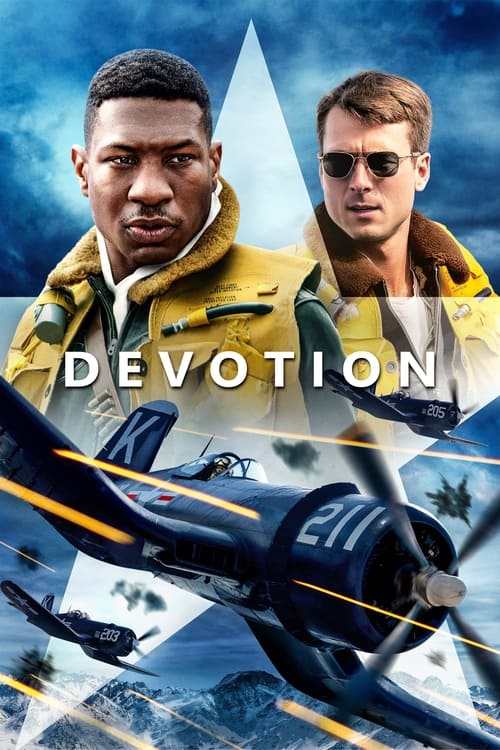
Devotion (2022)
Directed by J.D. Dillard
Yes — Devotion is woke, scoring 60 out of 100 on our wokeness meter.
Devotion arrives as a sober, well-tailored war picture, the kind Hollywood used to make on a schedule.
Consciousness Markers
The film centers on a Black naval aviator played by Jonathan Majors, with a Black director and supporting Black characters, reflecting the historical subject matter.
The narrative explicitly confronts the racism Jesse Brown faces as the only Black pilot in his squadron, including racist neighbors and superior officers.
The film depicts racism through personal experience rather than preachy monologues, though it has some earnest moments.
No LGBTQ+ themes or characters are present.
The female characters are supportive wives, with no feminist agenda or commentary.
No environmental or climate-related themes.
No critique of capitalism or wealth inequality.
No body positivity themes.
No neurodivergent characters or themes.
The film is a straightforward biopic that does not revise historical events for ideological purposes.
Why it received this score
Devotion arrives as a sober, well-tailored war picture, the kind Hollywood used to make on a schedule. It concerns Ensign Jesse Brown, the first Black aviator to complete the Navy's basic flight training, and his friendship with Tom Hudner, a New England officer who volunteers for the same squadron. J.D. Dillard directs with a steady hand and a personal stake, his own father having flown as the lone Black man in a similar outfit. Jonathan Majors carries the film's weight in the cockpit and in the quieter rooms where the weight is worse. The casting is deliberate, a Black lead surrounded by a Black creative team, and the film wears that intention easily. Nothing about it feels like a memo.
The racial material is where the picture earns its keep. Brown endures racist neighbors, racist instructors, racist officers who would happily end his career, and the film lets us watch him absorb each insult without a speech attached. His private ritual, standing before a mirror and shouting slurs at himself as fuel, is the sharpest and least comfortable idea here. Hudner wants to fight these battles on his friend's behalf and is told, correctly, to simply be present. That restraint keeps the sermonizing to a minimum. There is earnestness, an occasional swell of score that nudges us toward a lesson, but the film mostly trusts the history to make its own argument.
Everything else on the ledger stays blank. No romantic subplot bends toward ideology, the wives remain wives, and the enemy is weather, terrain, and the Chinese Army. There is no lecture about capital, no carbon accounting, no discourse about bodies or brains. The film is a straightforward tribute, and it revises nothing. It also lost a fortune, roughly ninety million dollars by one estimate, which the studio will remember longer than the reviews did. A sturdy, honorable, unprofitable monument.
Analysis generated by our Consciousness Algorithm


Synopsis
The harrowing true story of two elite US Navy fighter pilots during the Korean War. Their heroic sacrifices would ultimately make them the Navy's most celebrated wingmen.
Questions about Devotion
Is Devotion woke?
Yes — Devotion is woke, scoring 60 out of 100 on our wokeness meter. That earns it a verdict of Woke.
What makes Devotion woke?
2 of the 10 markers register at 30 or above, led by Racial Consciousness (85) and Representation Casting (85). On Racial Consciousness: The narrative explicitly confronts the racism Jesse Brown faces as the only Black pilot in his squadron, including racist neighbors and superior officers.
How does Devotion compare to other 2022 movies?
It ranks #12 of the 223 films from 2022 we've scored; their average is 22. The wokest is Bros (92).
How is the Woke Score calculated?
An AI-assisted process researches the film and its reception, scores it 0–100 on ten markers, then combines those into one 0–100 Woke Score. It measures a specific set of 2020s cultural themes, not film quality.