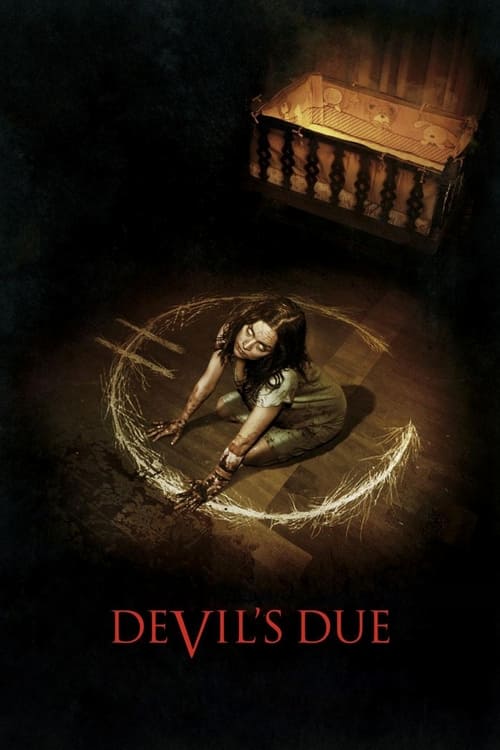
Devil's Due (2014)
Directed by Tyler Gillett
No — Devil's Due is not woke, scoring 0 out of 100 on our wokeness meter.
Devil's Due arrives in 2014 as a found-footage retelling of Rosemary's Baby, in which a honeymoon in the Dominican Republic ends with a satanic ritual, an unexpected pregnancy, and a young husband slowly realizing that his wife is carrying something other than a bundle of joy.
Consciousness Markers
The cast is predominantly white with a few Latino performers appearing naturally as cab drivers and cult members in the Dominican Republic setting; no commentary or deliberate representation agenda is present.
No LGBTQ+ characters, themes, or subtext appear anywhere in the film.
The film uses pregnancy body horror as a satanic plot device; it makes no feminist argument and treats its female lead as a vessel for demonic forces.
No engagement with racial themes or racial consciousness whatsoever.
No environmental or climate content.
No economic critique or anti-capitalist messaging.
The film's treatment of the pregnant body is one of revulsion and violation, the antithesis of body positivity.
No neurodivergent characters or themes.
The film is a Rosemary's Baby homage, not a revisionist retelling of history.
The film is a straightforward found-footage horror with no didactic or preachy messaging.
Why it received this score
Devil's Due arrives in 2014 as a found-footage retelling of Rosemary's Baby, in which a honeymoon in the Dominican Republic ends with a satanic ritual, an unexpected pregnancy, and a young husband slowly realizing that his wife is carrying something other than a bundle of joy. The cameras are handheld, the marriage deteriorates, and a palm reader issues warnings nobody heeds. It is a film of modest ambitions and a D+ CinemaScore, which is the audience equivalent of a shrug performed in unison.
For our purposes, the ledger comes back empty. The cast is white, the pregnancy serves as a vessel for demonic forces, and the film makes no argument about the female body beyond a general revulsion at what it can host. There is no economic grievance, no environmental sermon, no reworking of the historical record. The Dominican setting supplies a taxi driver and a cult, both functioning as plot machinery. Nobody lectures. Nobody is asked to examine their assumptions. The film wants to scare you and then end, which it does with a cut to Paris and a suggestion that the cycle continues.
This is, in the taxonomy of cultural signifiers, a clean specimen. A horror film from 2014, arriving before such films began showing up with a thesis stapled to the press kit. There is something to admire in a movie that wants only to be Rosemary's Baby with a camcorder, and does not pretend otherwise. The critical consensus found it derivative. The cult following found it charming. Both parties agree on what it is, and neither has tried to claim it for anything larger.
Analysis generated by our Consciousness Algorithm


Synopsis
An unexpected pregnancy takes a terrifying turn for newlyweds Zach and Samantha McCall.
Questions about Devil's Due
Is Devil's Due woke?
No — Devil's Due is not woke, scoring 0 out of 100 on our wokeness meter. That earns it a verdict of Ultra Based.
Does Devil's Due have any woke elements?
No. All 10 markers score zero.
How does Devil's Due compare to other 2014 movies?
It ranks #271 of the 303 films from 2014 we've scored; their average is 13. The wokest is Selma (68).
How is the Woke Score calculated?
An AI-assisted process researches the film and its reception, scores it 0–100 on ten markers, then combines those into one 0–100 Woke Score. It measures a specific set of 2020s cultural themes, not film quality.