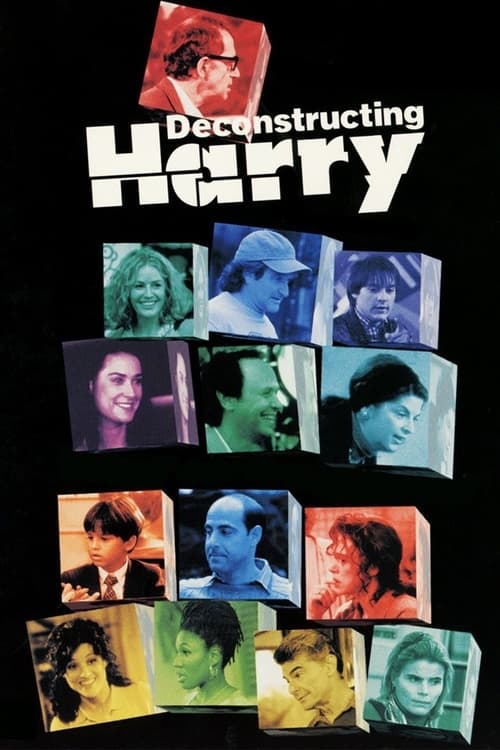
Deconstructing Harry (1997)
Directed by Woody Allen
No — Deconstructing Harry is not woke, scoring 0 out of 100 on our wokeness meter.
Deconstructing Harry arrives in 1997 with a dirty mind and a clean conscience, which is to say it has no conscience at all and no interest in acquiring one.
Consciousness Markers
The film is self-revelatory and confessional rather than preachy; it dramatizes its themes through farce and fantasy sequences rather than moral instruction.
The ensemble cast is overwhelmingly white, with Hazelle Goodman as a prostitute existing as a natural character rather than a commented-upon diversity statement. No representation-casting agenda is present.
No LGBTQ+ characters, themes, or subtext appear anywhere in the film.
The film is a self-lacerating portrait of a serial womanizer and his alienated exes; it offers no feminist critique or agenda, and its gender politics are decidedly retrograde.
Race is not a thematic concern; the Black prostitute character and the Jewish half-sister are incidental rather than vehicles for racial commentary.
No environmental or climate themes whatsoever.
The film concerns an artist's personal and sexual neuroses, not economic critique or class warfare.
No body-positivity themes; the film's treatment of women's bodies is largely prurient.
The 'insanity' keyword refers to the protagonist's self-absorbed dysfunction, not to neurodivergence as an identity or advocacy concern.
No historical revisionism; the film is a contemporary semi-autobiographical comedy with no engagement with historical narrative.
Why it received this score
Deconstructing Harry arrives in 1997 with a dirty mind and a clean conscience, which is to say it has no conscience at all and no interest in acquiring one. Woody Allen plays Harry Block, a novelist who mines his ex-wives, his lovers, and his half-sister for material and then wonders why the phone stops ringing. Three passengers ride along on his road trip: a prostitute, a friend, and a kidnapped son, which is either a premise or a diagnosis. The film moves by flashback, fantasy, and fiction, and the structure is genuinely inventive. The moral universe, however, is a shallow grave of self-pity dressed in a tweed jacket.
There is nothing here for the cultural auditor to seize upon. The cast is white, the gender politics are those of a man who thinks monogamy is a rumor, and the Black prostitute named Cookie is a character in a car, not a statement. Race, class, and climate go unmentioned. The film's only sustained argument is with its own protagonist, and it loses that argument on points. We are asked to laugh at a man who kidnaps his son and calls it a whim, and the film obliges us to find him charming. That is not a moral instruction, it is a shrug.
The picture earns a small measure of credit for refusing to pretend. It is confessional, obscene, and occasionally very funny, and it never lectures. A sermonizer would have told us what to think about Harry. Allen simply lets him talk, which is its own kind of punishment. There is also a scene in which a fictional character slides out of focus, and it is the most honest moment in the film. The whole enterprise is a man arguing with his own reflection in a dirty mirror, and the reflection wins on a technicality.
Analysis generated by our Consciousness Algorithm


Synopsis
Writer Harry Block draws inspiration from people he knows, and from events that happened to him, sometimes causing these people to become alienated from him as a result.
Questions about Deconstructing Harry
Is Deconstructing Harry woke?
No — Deconstructing Harry is not woke, scoring 0 out of 100 on our wokeness meter. That earns it a verdict of Ultra Based.
Does Deconstructing Harry have any woke elements?
Very few. None of the 10 markers reaches 30, the level where a marker counts as present; the highest is Lecture Energy at 5.
How does Deconstructing Harry compare to other 1997 movies?
It ranks #95 of the 109 films from 1997 we've scored; their average is 12. The wokest is Happy Together (65).
How is the Woke Score calculated?
An AI-assisted process researches the film and its reception, scores it 0–100 on ten markers, then combines those into one 0–100 Woke Score. It measures a specific set of 2020s cultural themes, not film quality.