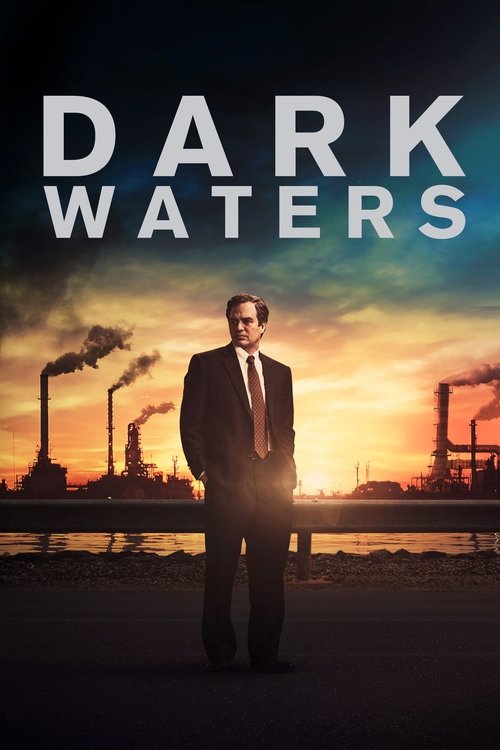
Dark Waters (2019)
Directed by Todd Haynes
Partly — Dark Waters is somewhat woke, scoring 42 out of 100 on our wokeness meter.
Todd Haynes, a director whose reputation rests on lush period melodrama, here submits to the grim mechanics of discovery, deposition, and the filing of motions.
Consciousness Markers
DuPont is portrayed as a corporation that knowingly poisoned a town and hid cancer findings for decades to protect profits, making corporate greed the film's central villain.
The film is a pointed message movie that builds to an explicit indictment of DuPont and a closing note that PFOA is in virtually everyone's blood, clearly aiming to outrage and instruct its audience.
The film is squarely about toxic chemical contamination (PFOA 'forever chemicals') and environmental harm, but it frames this as a public-health and corporate-crime issue rather than a climate-change crusade.
The cast is overwhelmingly white, reflecting the real demographics of the Cincinnati legal world and rural West Virginia; William Jackson Harper appears in a supporting role but the film makes no effort at color-conscious casting.
The film dramatizes a real, recent legal case and exposes buried corporate history, but it presents itself as journalism rather than reinterpreting a historical narrative through a modern ideological lens.
Anne Hathaway's Sarah Bilott is a supportive spouse whose main function is to voice the family's strain; there is no feminist framing of the narrative or its institutions.
The story centers on white farmers and a white corporate lawyer; race is not a thematic concern and no racial consciousness is articulated.
There are no LGBTQ+ characters, relationships, or themes anywhere in the film.
The film depicts illness, cancer, and birth defects as tragedy, not as a body-image or self-acceptance theme.
No neurodivergent characters or themes are present.
Why it received this score
Todd Haynes, a director whose reputation rests on lush period melodrama, here submits to the grim mechanics of discovery, deposition, and the filing of motions. Mark Ruffalo plays Rob Bilott, a Cincinnati corporate defense attorney who crosses over to sue the very client class he once served, and the film follows him across two decades of paperwork and pay cuts. The result is a legal thriller that treats the manila folder as an instrument of mass destruction. It is patient, gray, and almost entirely indoors, and the camera regards a warehouse of DuPont documents with the reverence other films reserve for sunsets.
The villain is a corporation, and the film has no interest in ambiguity on that point. DuPont dumped tons of toxic sludge uphill from a dairy farm, watched the cattle die, and kept its own cancer findings in a drawer for decades. Corporate greed is the engine here, and the indictment is assembled with the methodical pleasure of a good plaintiff's brief. The environmental dimension is present but narrow: this is a story about poisoned water and poisoned blood, not about the atmosphere. The chemical in question never leaves the human body, which is a more intimate horror than a warming planet, and the film knows it.
The cast is white, the farmers are white, the lawyers are white, and the film declines to remark on any of it. Anne Hathaway's Sarah exists mainly to register the toll on a marriage, which she does with admirable economy. Several real plaintiffs appear as themselves, lending the proceedings a documentary weight the screenplay does not always earn. The closing card informs us that the substance is in nearly every human being alive, a final instruction delivered without a wink. It wants us angry, and we are, though the anger is aimed at a specific boardroom and not at the arrangement that produced it.
Analysis generated by our Consciousness Algorithm


Synopsis
A tenacious attorney uncovers a dark secret that connects a growing number of unexplained deaths to one of the world's largest corporations. In the process, he risks everything — his future, his family, and his own life — to expose the truth.
Questions about Dark Waters
Is Dark Waters woke?
Partly — Dark Waters is somewhat woke, scoring 42 out of 100 on our wokeness meter. That earns it a verdict of Woke-Adjacent.
What makes Dark Waters woke?
3 of the 10 markers register at 30 or above, led by Eat the Rich (70), Lecture Energy (60) and Climate Crusade (30). On Eat the Rich: DuPont is portrayed as a corporation that knowingly poisoned a town and hid cancer findings for decades to protect profits, making corporate greed the film's central villain.
How does Dark Waters compare to other 2019 movies?
It ranks #45 of the 284 films from 2019 we've scored; their average is 22. The wokest is Black Christmas (79).
How is the Woke Score calculated?
An AI-assisted process researches the film and its reception, scores it 0–100 on ten markers, then combines those into one 0–100 Woke Score. It measures a specific set of 2020s cultural themes, not film quality.