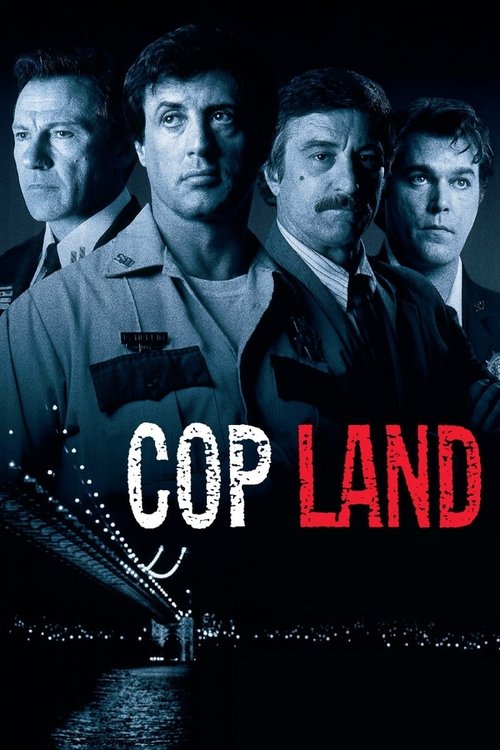
Cop Land (1997)
Directed by James Mangold
No — Cop Land is not woke, scoring 4 out of 100 on our wokeness meter.
James Mangold's Cop Land arrives from 1997, a year when a crime drama could still concern itself entirely with the moral rot of the New York Police Department and the small New Jersey town that shelters it.
Consciousness Markers
The ensemble is almost entirely white, with women (Garofalo, Sciorra, Moriarty) confined to supporting roles; there is no meaningful racial or ethnic diversity in the cast.
The story critiques police corruption, union protection, and organized crime, but frames this as individual moral failure rather than a systemic anti-capitalist indictment.
A few women exist in the story (deputy Cindy, Liz, Rose), but they function as love interests or moral mirrors rather than vehicles for any feminist argument.
Deleted scenes depicting the town's racism and racial profiling of Black motorists were cut from the released film, leaving the theatrical version with essentially no racial commentary.
The film explores corruption and moral compromise through plot and character rather than overt preaching, offering little in the way of direct messaging.
No LGBTQ+ characters, themes, or subtext appear anywhere in the film.
The film contains no environmental or climate-related themes whatsoever.
Stallone's 40-pound weight gain is used to depict a physically diminished, beaten-down man, which is the opposite of a body-positivity message.
Heflin's partial (and later total) deafness is a physical disability, not a depiction of neurodivergence such as autism or ADHD.
The film is a fictional crime drama loosely inspired by the director's hometown; it makes no revisionist claims about historical events.
Why it received this score
James Mangold's Cop Land arrives from 1997, a year when a crime drama could still concern itself entirely with the moral rot of the New York Police Department and the small New Jersey town that shelters it. Sylvester Stallone plays Freddy Heflin, a sheriff who lost the hearing in one ear saving a woman from the Hudson and has spent the years since tending a community of officers he worships. The film's concerns are corruption, loyalty, and the slow cost of looking away. Nothing in its 101 minutes gestures toward the social questions that would come to dominate the following decades. The environment goes unmentioned. So does any question of sexual identity. This is a picture built from the older materials of urban crime fiction, and it is content to remain there.
The ensemble is white and male to a degree that casting notices barely registered at the time. Janeane Garofalo, Annabella Sciorra, and Cathy Moriarty occupy the margins as a deputy, a love interest, and a wife, and the film uses them as mirrors for Heflin's conscience instead of agents of their own. Mangold wrote scenes addressing the town's racial hostility, including officers chasing Black motorists and a deputy noting the pattern in traffic tickets, but the theatrical cut omits them, leaving the finished film with no racial argument at all. Heflin's deafness is a physical injury, and Stallone's forty-pound gain renders him diminished and beaten, a visual argument against physical vitality, not for it.
What remains is craft. The film argues that a man can be complicit and still choose otherwise, which is a moral position, not a political program. It never lectures. It never preaches. It simply watches Freddy decide.
Analysis generated by our Consciousness Algorithm


Synopsis
Freddy Heflin is the sheriff of a place everyone calls “Cop Land” — a small and seemingly peaceful town populated by the big city police officers he’s long admired. Yet something ugly is taking place behind the town’s peaceful facade. And when Freddy uncovers a massive, deadly conspiracy among these local residents, he is forced to take action and make a dangerous choice between protecting his idols and upholding the law.
Questions about Cop Land
Is Cop Land woke?
No — Cop Land is not woke, scoring 4 out of 100 on our wokeness meter. That earns it a verdict of Ultra Based.
Does Cop Land have any woke elements?
Very few. None of the 10 markers reaches 30, the level where a marker counts as present; the highest is Eat the Rich at 8.
How does Cop Land compare to other 1997 movies?
It ranks #78 of the 109 films from 1997 we've scored; their average is 12. The wokest is Happy Together (65).
How is the Woke Score calculated?
An AI-assisted process researches the film and its reception, scores it 0–100 on ten markers, then combines those into one 0–100 Woke Score. It measures a specific set of 2020s cultural themes, not film quality.