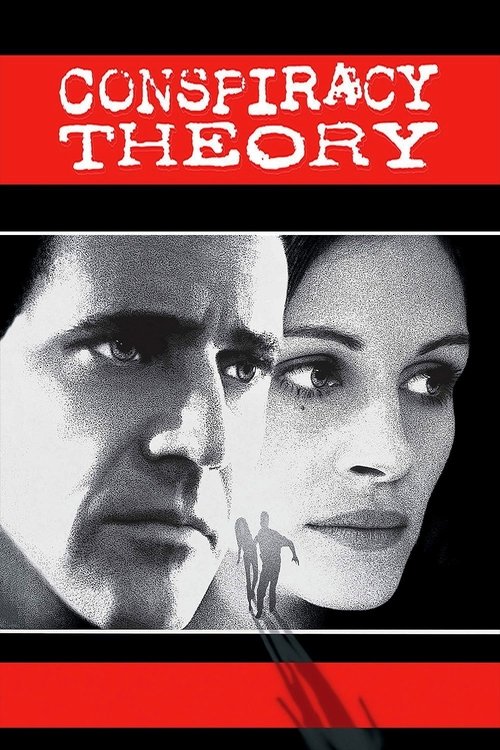
Conspiracy Theory (1997)
Directed by Richard Donner
No — Conspiracy Theory is not woke, scoring 10 out of 100 on our wokeness meter.
Conspiracy Theory is a 1997 political action thriller in which Mel Gibson plays a New York taxi driver who believes the government is a nest of assassins, and Julia Roberts plays the Justice Department attorney who becomes his reluctant accomplice.
Consciousness Markers
Julia Roberts plays a capable Justice Department attorney who drives the investigation and ultimately kills the villain, giving her some agency, but she is also positioned as a love interest and object of the protagonist's obsession.
Predominantly white principal cast (Gibson, Roberts, Stewart), with Black actors in minor supporting roles (Cylk Cozart, Terry Alexander, Michael Potts) who exist in the story without comment. No deliberate diversity casting agenda.
No social-issue lecturing; the conspiracy monologues are character color and plot mechanics rather than didactic messaging.
The film's paranoia targets government agencies and a deep-state cabal (CIA, MKUltra), not capitalism or the wealthy. Anti-government rather than anti-capitalist.
Minority actors appear in small supporting roles, but the film makes no racial commentary or consciousness of any kind.
No LGBTQ+ characters, relationships, or themes of any kind appear in the film.
The Ravenswood Generating Station appears as a plot location only; there is no environmental or climate messaging whatsoever.
No body-positive themes; a wheelchair features as a torture-escape plot device, not as representation.
Jerry's compulsive behavior and paranoia are played as eccentric quirk and thriller mechanics, not as modern neurodivergence representation or awareness.
The film invokes real programs like MKUltra as thriller fodder rather than as revisionist historical argument or consciousness-raising.
Why it received this score
Conspiracy Theory is a 1997 political action thriller in which Mel Gibson plays a New York taxi driver who believes the government is a nest of assassins, and Julia Roberts plays the Justice Department attorney who becomes his reluctant accomplice. The film has no interest in the modern identity catechism. Its cast is mostly white, with Black actors in small supporting roles who exist without comment. There is no LGBTQ presence at all. Roberts gets to be competent, drives chunks of the investigation, and ultimately kills the villain, but she is also the object of Jerry's surveillance and romantic fixation. That earns a modest feminist credit and little else.
The film's paranoia aims at the CIA, MKUltra, black helicopters, and a secret agency that watches other agencies. It is anti-government, not anti-capitalist. The wealthy are not the enemy here. Climate messaging is absent. Ravenswood Generating Station is a plot location, not a sermon. Body positivity is absent. A wheelchair appears as a torture and escape device. Neurodivergence is absent. Jerry's compulsions and paranoia are eccentric thriller mechanics, not a portrait of neurological difference. Revisionist history is absent. Real programs become pulp fodder, not consciousness-raising argument. Lecture energy is faint. The conspiracy monologues are character color and plot machinery, not social instruction.
We are left with a slick, muddled studio product from the Clinton era, full of star wattage and narrative knots. Critics at the time found the first half promising and the last act swollen with explanations. The film did open at number one and helped push deep-state imagery further into the mainstream. As a document of contemporary social consciousness, it is nearly barren. It wants to entertain, confuse, and pair its damaged hero with a glamorous lawyer. It does not want to teach us how to live. For that small mercy, we can be grateful.
Analysis generated by our Consciousness Algorithm
Part of


Synopsis
A man obsessed with conspiracy theories becomes a target after one of his theories turns out to be true. Unfortunately, in order to save himself, he has to figure out which theory it is.
Questions about Conspiracy Theory
Is Conspiracy Theory woke?
No — Conspiracy Theory is not woke, scoring 10 out of 100 on our wokeness meter. That earns it a verdict of Ultra Based.
Does Conspiracy Theory have any woke elements?
Very few. None of the 10 markers reaches 30, the level where a marker counts as present; the highest is Feminist Agenda at 25.
How does Conspiracy Theory compare to other 1997 movies?
It ranks #41 of the 109 films from 1997 we've scored; their average is 12. The wokest is Happy Together (65).
How is the Woke Score calculated?
An AI-assisted process researches the film and its reception, scores it 0–100 on ten markers, then combines those into one 0–100 Woke Score. It measures a specific set of 2020s cultural themes, not film quality.