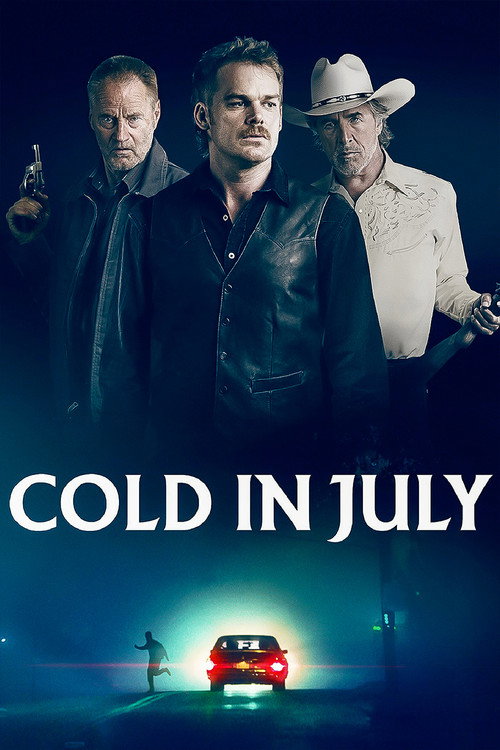
Cold in July (2014)
Directed by Jim Mickle
No — Cold in July is not woke, scoring 4 out of 100 on our wokeness meter.
It is 1989 in Laborde, Texas, and Richard Dane has just shot a burglar in his living room.
Consciousness Markers
The plot briefly notes that the snuff-film victims are illegal immigrant prostitutes whom authorities deem expendable, a faint gesture at the devaluation of marginalized lives, but it is incidental rather than a thematic focus.
The cast is overwhelmingly white, led by Michael C. Hall, Sam Shepard, and Don Johnson, with no meaningful diverse casting or commentary on representation.
There are no LGBTQ+ characters, themes, or subtext anywhere in the film.
The director explicitly stated he wanted to pivot from feminist themes to 'masculine themes'; the female characters are peripheral and the film is a study of manhood and violence.
No environmental or climate-related content whatsoever.
The villains are a corrupt informant and the Dixie Mafia; there is no economic critique or eat-the-rich framing.
No body-positivity themes or messaging present.
No neurodivergent characters or themes are depicted.
The 1989 Texas setting is period texture for a neo-noir, not a revisionist reframing of historical events.
This is a pulpy, twist-driven genre thriller that aims to entertain and unsettle rather than deliver moral instruction.
Why it received this score
It is 1989 in Laborde, Texas, and Richard Dane has just shot a burglar in his living room. What follows is a neo-noir that keeps shedding its skin: revenge thriller, conspiracy procedural, then something uglier involving snuff films and the Dixie Mafia. Jim Mickle directs with genre-hopping confidence, and the cast is led by Michael C. Hall, Sam Shepard, and Don Johnson. Every significant role is filled by a white performer. The film neither notices this nor has any reason to, and no commentary on representation intrudes on the proceedings.
The director has spoken openly about moving from the feminist concerns of his previous feature toward an examination of masculinity, and that intention is legible on screen. The women here are wives and hostages. There are no LGBTQ characters, no environmental themes, no economic critique (the villains are a corrupt informant and organized criminals, which is ordinary villainy, not a system), no body-positivity, and no neurodivergent characters. A single line of dialogue notes that the snuff-film victims were illegal immigrant prostitutes whom the authorities consider expendable. It is a genuine flicker of moral awareness about whose deaths get investigated. It lasts one sentence and is never returned to. The 1989 setting supplies period texture: VHS tapes, payphones, a certain quality of Texas light. It is not an argument about history.
The film's actual commitments are to pulp, to tonal risk, and to Don Johnson's hat. It wants to unsettle and entertain, and it does both without pausing to instruct the audience. There is no sermon here, no moral ledger held up for our approval. That restraint is unfashionable, and it is also the reason the thing still works. The classification ledger, by contrast, comes back nearly empty.
{"thematic_tags": ["book_adaptation"]} (included alongside review per classification instructions)
Analysis generated by our Consciousness Algorithm


Synopsis
While investigating noises in his house one balmy Texas night in 1989, Richard Dane puts a bullet in the brain of a low-life burglar. Although he’s hailed as a small-town hero, Dane soon finds himself fearing for his family’s safety when Freddy’s ex-con father rolls into town, hell-bent on revenge.
Questions about Cold in July
Is Cold in July woke?
No — Cold in July is not woke, scoring 4 out of 100 on our wokeness meter. That earns it a verdict of Ultra Based.
Does Cold in July have any woke elements?
Very few. None of the 10 markers reaches 30, the level where a marker counts as present; the highest is Racial Consciousness at 10.
How does Cold in July compare to other 2014 movies?
It ranks #224 of the 303 films from 2014 we've scored; their average is 13. The wokest is Selma (68).
How is the Woke Score calculated?
An AI-assisted process researches the film and its reception, scores it 0–100 on ten markers, then combines those into one 0–100 Woke Score. It measures a specific set of 2020s cultural themes, not film quality.