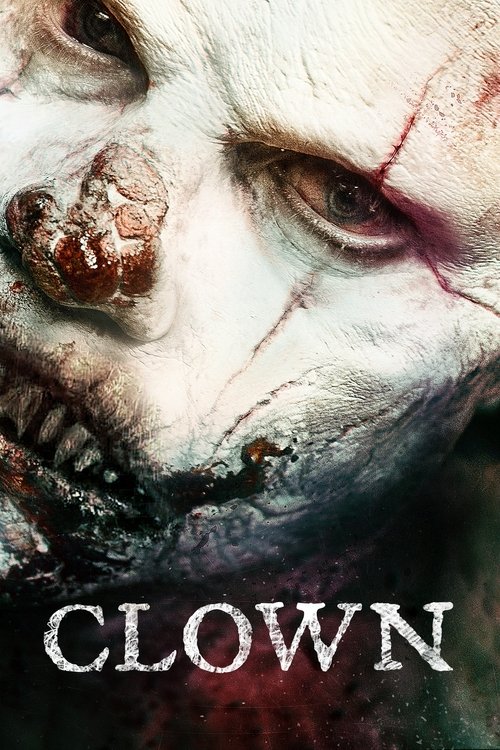
Clown (2014)
Directed by Jon Watts
No — Clown is not woke, scoring 6 out of 100 on our wokeness meter.
Jon Watts made his feature debut with Clown, a supernatural horror picture that reached American theaters in 2016, well before its director became synonymous with a certain web-slinging franchise.
Consciousness Markers
Meg becomes the one who decapitates the demon and saves her son, but this is the standard slasher 'final girl' convention rather than an articulated feminist agenda.
The cast is uniformly white with no evident effort at inclusive or color-conscious casting; characters are generic suburban family and townsfolk.
No LGBTQ+ characters, relationships, or themes appear anywhere in the film.
Race is never addressed or thematized; the film has no racial commentary of any kind.
No environmental or climate content whatsoever.
The Chuck E. Cheese set piece and real-estate-agent protagonist are incidental backdrops, not a critique of capitalism or wealth.
The film is body horror about a man's flesh fusing with a demonic suit — the opposite of a body-acceptance message.
A brief school-bullying subplot exists, but no neurodivergent characters or themes are present.
The invented Norse demon 'Clöyne' as the origin of clowns is genre mythology, not a reframing of real historical events.
The film is a gory creature feature that never pauses to deliver a moral or social lesson to the audience.
Why it received this score
Jon Watts made his feature debut with Clown, a supernatural horror picture that reached American theaters in 2016, well before its director became synonymous with a certain web-slinging franchise. The premise is durable. A real estate agent named Kent McCoy dons an old clown suit for his son's birthday party and cannot take it off. The fabric fuses to his skin, the nose grafts to his face, and a Nordic demon called the Clöyne begins steering him toward a diet of children. It is The Fly with greasepaint, and the practical effects, courtesy of Alterian and Tony Gardner, do the heavy lifting.
The film has no interest in instructing anyone. It wants to show a man's flesh knitting into polyester and to let the audience squirm. There is no racial commentary, no environmental parable, no economic argument smuggled into the Chuck E. Cheese massacre, and no lesson waiting at the end. Kent's wife Meg does decapitate the monster and save her son, which grants her the customary final-girl distinction, though the film treats this as slasher housekeeping instead of a statement. The invented Norse demon is genre mythology, not a revision of anyone's history. The body horror concerns a body betraying its owner, which is the opposite of a body-acceptance message.
Some films carry the cultural freight of their moment. This one carries a severed head and a melting costume. It is competently assembled, tonally uneven, and content to be a killer clown movie with better effects than most. Reviewers at the time split on it, and the split feels correct. For our purposes, the ledger is nearly blank. There is nothing here to score, and the film seems at peace with that. A rare thing, and not an unlikable one.
Analysis generated by our Consciousness Algorithm


Synopsis
A loving father finds a clown suit for his son's birthday party, only to realize the suit is part of an evil curse that turns its wearer into a killer.
Questions about Clown
Is Clown woke?
No — Clown is not woke, scoring 6 out of 100 on our wokeness meter. That earns it a verdict of Ultra Based.
Does Clown have any woke elements?
Very few. None of the 10 markers reaches 30, the level where a marker counts as present; the highest is Feminist Agenda at 10.
How does Clown compare to other 2014 movies?
It ranks #185 of the 303 films from 2014 we've scored; their average is 13. The wokest is Selma (68).
How is the Woke Score calculated?
An AI-assisted process researches the film and its reception, scores it 0–100 on ten markers, then combines those into one 0–100 Woke Score. It measures a specific set of 2020s cultural themes, not film quality.